
The US is stifling Russian arms exports: The truth is different.
Russia still holds 23% of the global arms market share. Revenue from Russian arms sales is projected to increase in 2017.
Confirming achievements?
According to RT, in a recent report to Congress, US officials stated that the US government has decided not to impose any new sanctions on Russia.
According to U.S. State Department spokeswoman Heather Nauert, the goal of the sanctions is to prevent Moscow from profiting from the sale of weapons and military equipment.
This objective has been achieved as, under pressure from current sanctions, governments around the world have had to cancel many multi-billion dollar agreements with Russia, especially with defense corporations.
"Since the enactment of the Countering America's Adversaries Through Sanctions Act (CAATSA), we estimate that foreign governments have canceled billions of dollars worth of Russian arms sales."
"Because large defense contracts are often tied to long timeframes, the results of this effort are only just beginning to become clear," U.S. State Department spokesperson Heather Nauert revealed.
A State Department spokesperson added that Congress had received a classified report on the matter.
"Based on this assessment, if the law is applied effectively, there is no need to impose sanctions on specific Russian entities or individuals, because in practice, the law is used as a deterrent," Nauert asserted.
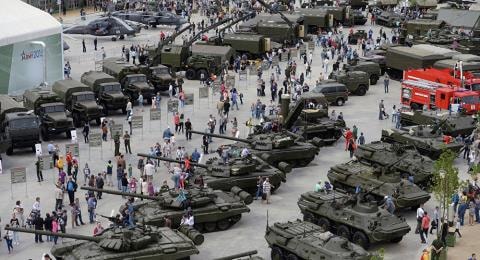 |
| Russian military exhibition |
In an interview with Sputnik following the US announcement, political expert Yuri Svetov stated that the US sanctions are purely economic sanctions.
"Many countries have welcomed Defense Minister Sergei Shoigu. Countries that traditionally buy American weapons are now considering purchasing Russian weapons..."
"The world's largest arms supplier is the United States. Russia ranks second but is showing signs of high growth, so the US needs to block and seize the Russian arms market," Yuri Svetov stated.
Meanwhile, Russian Deputy Prime Minister Arkady Dvorkovich stressed that Moscow considers the sanctions "counterproductive and meaningless".
The US statement seems to assert that US sanctions against Russia have been remarkably successful in curbing the Russian defense industry. However, in reality, Moscow has been proving a different truth.
Rising strongly
Russia has been one of the world's leading arms exporters, second only to the United States for the past five years.
According to a report by the Stockholm International Peace Research Institute (SIPRI), the United States holds approximately 33% of the global arms market share, while Russia accounts for 23%. In 2016, Russian arms exports increased by 3.8% to $26.6 billion.
According to data provided by the British military analysis firm Jane's Information Group, Russian arms sales revenue is projected to increase in 2017.
Although precise figures for 2017 are not yet available, some Rosoboronexport leaders have indicated that Russia has reached a $2.5 billion agreement to sell S-400 missiles to Türkiye, despite NATO's objections.
Russia has also held talks with Indonesia about purchasing a squadron of 11 SU-35 fighter jets for $1.14 billion.
 |
| Russia's S-400 air defense missile system. |
In 2017, Russia surprised the world by announcing the export of its S-400 missile defense system not only to Serbia, a traditional partner of Russia in the Balkans, but also to Türkiye, a pillar of NATO in the Middle East, and Saudi Arabia, a historical ally of the US in the Gulf region.
In 2015 and 2016, Russia's arms sales generated approximately $15 billion annually. Russia maintained a 23% share of the global arms trade between 2012 and 2016. Russian arms exports are considered to be in a stable state.
According to Russia's arms manufacturer Rosoboronexport, the company has received export orders worth $45 billion this year.
Rosoboronexport is actively engaging with more than 50 countries worldwide. Contracts for the purchase of high-tech Russian systems, primarily aircraft and air defense systems, account for a significant portion of its procurement list.
Russian defense companies have increased production by more than 10% compared to last year. This has also contributed to the success of the Russian economy during a period of sanctions from various European and American parties.


