
115-Year-Old Beauty in Xiangfu
(Baonghean) - Mrs. Lo Thi Hoa, from Quang Phuc village, Tam Dinh commune (Tuong Duong district), has turned 115 years old. At this age, this Thai woman still remembers many stories about her life, especially about her participation in the Phu Tuong Beauty Contest.
Her legs were weak, her eyesight failing, her hearing impaired, but her mind still remembered much. However, Mrs. Lo Thi Hoa only spoke Thai, so that day, her daughter-in-law, Mrs. Lo Thi Lan, helped us translate. She began her story: “I was born in 1902 in Quy Chau. When I was young, the enemy burned down our village, and my parents brought my siblings and me here to escape the disaster…”
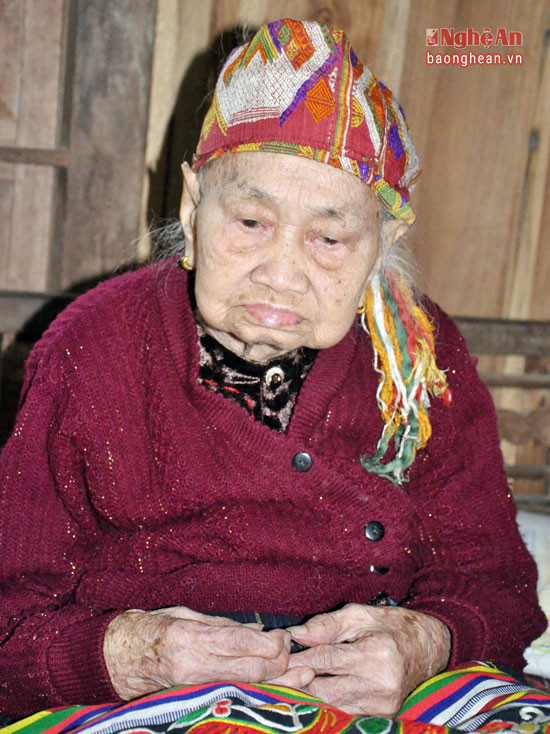 |
| At 115 years old, Mrs. Lo Thi Hoa is still quite lucid and remembers many events from her life. Photo: Cong Kien |
The sisters grew up in their small stilt house, surrounded by the corn and rice harvests. Before long, the little girl, covered in dirt, had become a beautiful young woman with a slender figure, fair skin, sparkling black eyes, long flowing hair, and a radiant smile like a blooming bauhinia flower. Her beauty, carried by the mountain breeze, spread throughout the region; villages near and far knew of her, and young men longed to meet and date her.
That year, the Imperial Court held a beauty contest, and the officials sent a letter requesting her to participate. Traveling over 20 kilometers to the Cua Rao region, the mountain girl Lo Thi Hoa was overwhelmed by the sight of the rows of buildings, the silks and brocades. Most of the contestants were beautifully dressed in brand-new dresses and colorful outfits.
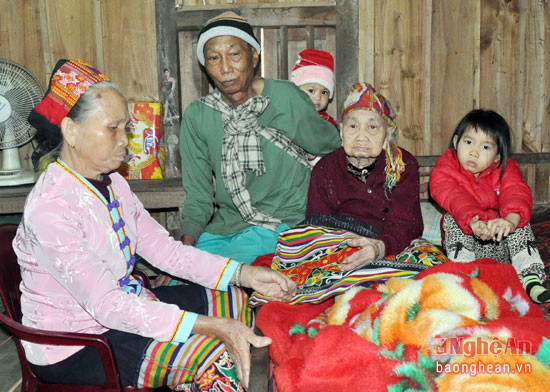 |
| Ms. Lo Thi Hoa lives with her youngest son, Lo Kham Phong, and his wife; the family consists of four generations living together. Photo: Cong Kien |
Because her family was poor and couldn't afford new dresses, Mrs. Hoa had to wear her everyday dress, the one she used for going to the market, weddings, and village festivals. That dress was overshadowed by a sea of magnificent costumes, and naturally, she didn't win any awards. Everyone marveled at her natural beauty, like a wildflower, and regretted not having a beautiful outfit to receive an award.
Although she won no prize, the village girl from Quang Phuc attracted the attention of many young men, including wealthy sons of rich families, riding on horseback, wearing embroidered silk robes, and carrying bags full of silver ingots. Some even directly asked, "If you want to be my wife, come down to the boat later and follow me back to the village. My parents have many buffaloes and much silver, so you don't have to worry about poverty." Mrs. Hoa paid no heed to their flirtatious words and promises, and after the meeting, she quickly boarded the boat and sailed downstream back to her village.
Shortly afterwards, the mountain girl Lo Thi Hoa accepted the marriage proposal of a young man from the same village, two years older than her, whose father held a minor official position in the region. After moving to her husband's home, she continued with her work in the fields, spinning silk, and weaving cloth. And from here, her life began with countless hardships and worries. Her first child breathed his last shortly after birth; her second child met the same fate.
After that incident, she suffered from menorrhagia and, after waiting a long time without success, sometimes thought she had lost her ability to become a mother. Persistently seeking treatment, undeterred by mountains and valleys, traveling throughout the villages and hamlets to find healers and medicine, she was finally blessed. Her third daughter, named Lo Thi Than, was born when she was over 40 years old, bringing joy to the entire family.
A few years later, baby boy Lo Kham Cuong was born, bringing immeasurable joy. Then the family welcomed another little member, Lo Kham Phong (born in 1950), and Mr. and Mrs. Hoa were truly happy and content, even if it was belatedly...
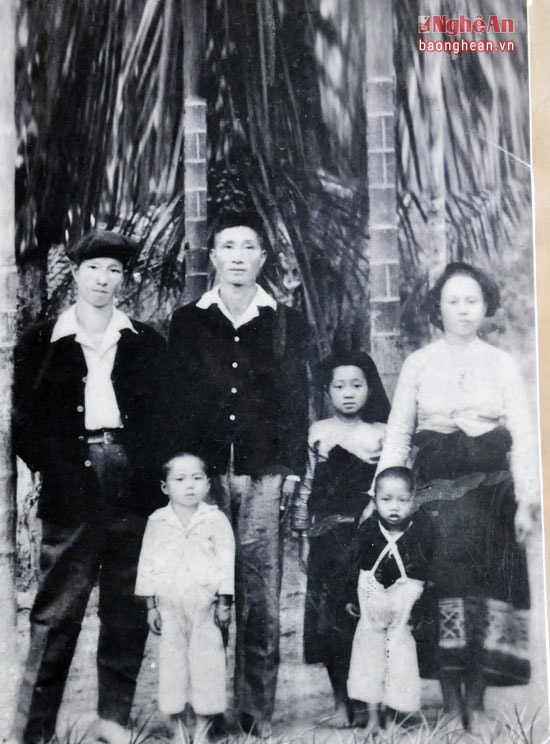 |
| This photo, taken in 1952, shows Mrs. Lo Thi Hoa and her husband with their three children and a distant relative. Sixty-five years have passed, but their faces are still quite clear (photo provided by the family). |
Ms. Lo Thi Hoa's memories still hold the joyful days when the people seized power during the August Revolution (1945). "That day, every village was covered in bright red flags, and everyone celebrated. People were cheering and shouting. They said to each other that from then on they were free from a life of slavery," she shared.
During the fierce years of war, her husband (Mr. Lo Van Hoa) went to the front lines several times as a civilian worker, carrying supplies and ammunition. Mrs. Hoa stayed at home, taking care of her parents-in-law and raising three young children. She would wake up at 2 a.m. to pound rice and prepare meals for the whole family. After eating, she would work tirelessly in the fields or on the hillsides all day, only resting briefly in the hut at noon.
As the sun sets behind the mountains, they rush to the stream to catch fish and gather some vegetables for dinner. Then they tend to the pigs and chickens; they sit at the loom until late at night, only managing to rest for two or three hours. It's not just her; most Thai women here are like this, finding joy in the warmth and well-being of their families, even though they endure much hardship and toil.
Currently, Mrs. Lo Thi Hoa lives with her youngest son, Lo Kham Phong, and his wife in the same stilt house, where four generations live together. Mr. Lo Van Hoa and their other children have all passed away. Fortunately, the family still has a photograph of Mrs. Hoa and her husband with their three children and a distant relative, taken in 1952. Even after 65 years, everyone's faces are still quite clear.
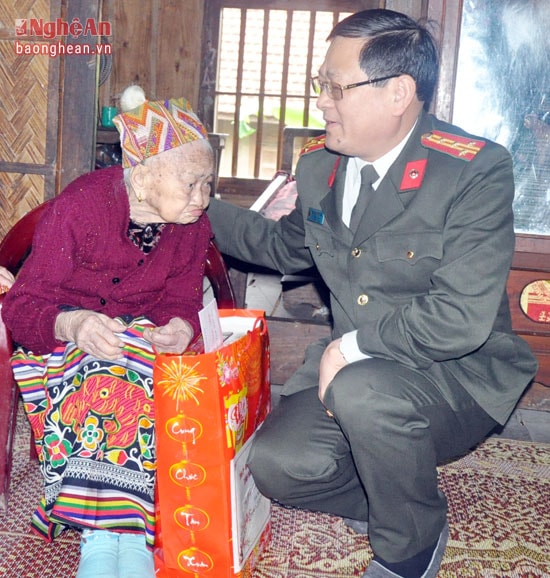 |
| Colonel Nguyen Huu Cau - Member of the Standing Committee of the Provincial Party Committee, Director of the Provincial Police, presents gifts to Mrs. Lo Thi Hoa on the occasion of the Lunar New Year of the Rooster. Photo: Cong Kien. |
To date, Mrs. Hoa has 30 grandchildren and great-grandchildren, plus four great-great-grandchildren (the fifth generation). She says that life is now very comfortable; they eat well, dress well, have a TV to watch, ride a motorbike to work, and travel by car. Unlike in the past, when there were months of food shortages, clothes were worn and tattered, and people had to walk everywhere or travel long distances by boat.
She was also very happy that every Lunar New Year, the district and provincial leaders came to her house to visit and give gifts. This past Lunar New Year (Year of the Rooster), she received a congratulatory letter from the Chairman of the Provincial People's Committee and a gift from the Director of the Provincial Police Department.
When asked about the secret to her longevity, Mrs. Lo Thi Hoa calmly replied: "I have no secret at all. Throughout my life, I've drunk water from the Co stream, eaten sticky rice from the fields, eaten rice I grew myself, caught my own shrimp and fish, worked year-round, and when I was sick, I went into the forest to find medicinal plants. In my old age, I live happily and help my children and grandchildren, I don't cause any trouble with anyone, and I try to eat rice regularly every day..."
Cong Kien
| RELATED NEWS |
|---|


