
The US is developing a self-propelled artillery system with a range three times greater than the Msta-S.
According to National Interest, the US has begun producing a new generation of self-propelled artillery with a range of up to 70km – more than three times the range of the Msta-S in the Russian Army.
The new self-propelled artillery system being developed by the US is based on the existing M109A7 prototype in the US military. The purpose of this self-propelled artillery development program is to compete directly with Russia.
The new American artillery system is quite advanced, featuring a caliber of up to 155mm and an integrated automatic loading system to increase firing speed and loading stability.
|
| American heavy self-propelled artillery. |
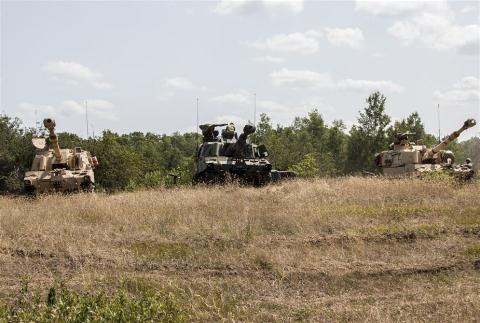
Furthermore, this generation of artillery can also fire missiles through the barrel and destroy targets at ranges up to 70km. With this range, the US has created a generation of self-propelled artillery with an effective range three times greater than Russia's Msta-S.
Not only is the US quietly developing new weapons, but it is also quietly surpassing Russia in this field, as General Robert Brown, Commander of the US Army Pacific Command, stated:
"The U.S. military needs to maximize the range of all its tactical and strategic weapon systems to gain an advantage over its adversaries. The U.S. needs artillery capable of firing as far as rocket launchers, rockets with the range of missiles, and missiles that can destroy targets at distances of nearly 500 km."
Based on the US plan to increase the range of its artillery, experts believe this could turn artillery into a trump card for the US in a future military conflict with Russia. This plan completely contradicts previous US statements about Russian investment in artillery.
Not long before, this same general had asserted that, in modern warfare, large investments in artillery forces were no longer appropriate, and that major powers had gradually shifted the role of artillery to air forces and tactical missiles that were highly mobile, powerful, and versatile in many situations.
Therefore, the number of towed artillery pieces gradually decreased, so now the US prioritizes heavy artillery with powerful firepower to support infantry, such as the M777. This is the reason why US artillery is inferior to Russian artillery. But to prepare for the possibility that air support might not be available in time, the US suddenly realized it needed a sufficiently strong artillery force to surpass Russia.
However, the US effort is highly unlikely to succeed because, according to data published by Global Firepower in 2017, Russia currently possesses approximately 14,000 artillery pieces of various types, while the US has a much more modest number of only 1,299 artillery pieces, ranking 12th in the world in terms of artillery.
Of Russia's approximately 14,000 artillery pieces, towed artillery accounts for 4,000 of various types. Self-propelled artillery makes up the largest proportion of the Russian artillery, totaling 6,000 of various types.
Of these, the most modern is the 2S19 Msta-S. Although there are up to 6,000 of them, only about 2,000 are currently in active service. The Russian Army's multiple rocket launcher force currently has approximately 3,600 rocket launchers.
However, only about 1,200 multiple rocket launchers are operational, the majority being BM-21 Grad. The number of the most powerful multiple rocket launcher system, the BM-30 Smerch, on active duty is believed to be only about 30, with the remaining more than 100 in storage.
Russian artillery is also equipped with a number of man-portable and self-propelled anti-tank missile systems. For example, the Khrizantema-S missile system is capable of destroying any advanced tank in the world.


