
Will the US deploy ground troops against ISIS?
(Baonghean) - Deploying ground troops to Iraq – this assessment is being mentioned more and more frequently by high-ranking US officials, in the context of the US-led war against the self-proclaimed Islamic State (IS) organization being assessed as not achieving the desired results.
Most recently, Republican Senator Lindsey Graham proposed deploying 10,000 ground troops to Iraq and Syria. While it's acknowledged that sending troops to Iraq would be an extremely difficult decision for President Barack Obama, the US cannot continue pouring billions of dollars into airstrikes without "eradicating ISIS" as originally intended.
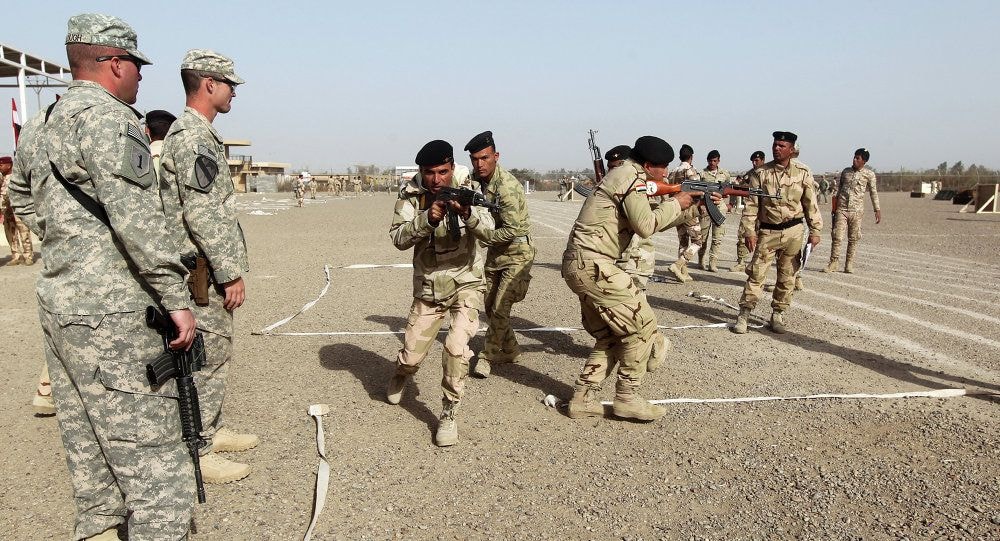 |
| US soldiers conducting training exercises in Iraq. (Image: Internet) |
According to Senator Lindsey Graham of South Carolina, the airstrikes by the US-led international coalition can only repel attacks, not eradicate ISIS in Iraq and Syria. Therefore, the US needs to deploy at least 10,000 ground troops in both countries, coordinating with ground forces from its Arab allies, to defeat ISIS. Senator Graham also sharply criticized the current policy of the Obama administration as "half-hearted use of force," and its consequence is that it has turned Iraq and Syria into safe havens and launching pads for terrorist groups to carry out attacks like the 9/11 attacks.
This is not the first time the idea of deploying ground troops against ISIS has been raised. Previously, many other lawmakers have expressed concerns that the White House has not implemented "thorough plans" to eliminate ISIS, leading to the coalition becoming increasingly ineffective. In mid-December last year, US Secretary of State John Kerry urged lawmakers to consider using ground forces in Iraq and Syria to fight ISIS, and to approve legislation creating a legal framework allowing the Obama administration to conduct unlimited military operations in the Middle East. Three days ago, US Defense Secretary Chuck Hagel also hinted at this possibility, saying that "all options must be considered, including sending ground troops." Recently, NATO Secretary General Jens Stoltenberg also stated that conducting airstrikes is important, but will "not solve the problem."
Experts have analyzed and dissected numerous reasons that would make it difficult for President Barack Obama to decide whether to send troops to Iraq again. However, what is happening on the ground—a "half-hearted use of force"—may force him to reconsider. Ever since the US formed the international coalition against ISIS last September, analysts have questioned the effectiveness of the coalition, which relies solely on airstrikes without ground troops. And more than four months later, that question remains. Currently, the US and its coalition partners continue their relentless airstrikes against ISIS, and statistics on losses inflicted on the group are regularly updated. However, it is easy to see that these losses are primarily to infrastructure, while casualties are rarely accounted for.
It's worth remembering that at the recent second meeting of the international coalition in London, the US presented basic figures summarizing the coalition's activities in the fight against IS over the past four months: killing 6,000 IS fighters and recapturing 700 square kilometers of territory held by IS in Iraq. However, what the public is more concerned about is what the US didn't mention: While the airstrikes did indeed kill 6,000 IS fighters, during that same period, tens of thousands of new fighters joined IS, including 5,000 from Europe. IS's network also expanded to neighboring countries such as Libya, Yemen, Afghanistan, Pakistan, Egypt, and most recently, Israel. The 700 square kilometers that Kurdish forces recaptured with the support of airstrikes also did happen, but it was recaptured by IS just days later. To date, IS still controls a vast area in Iraq and Syria, covering over 32,000 square kilometers, with a military force of 200,000 troops inside these two countries and more than 31,000 abroad. Such comparisons are sufficient to explain why the coalition's anti-IS campaign has so far been considered ineffective.
The deployment of US ground troops to Iraq remains an open possibility. Despite numerous mentions by US officials, President Barack Obama has yet to reveal his calculations on this matter. However, Obama certainly doesn't want to see ISIS rampage, with videos of hostage executions, including American hostages, being released unchecked; he doesn't want to see over $8 million spent daily on airstrikes go to waste; and he doesn't want the collapse of a coalition the US has painstakingly built – for whatever purpose. Therefore, many analysts believe that the presence of US troops on the Iraqi battlefield is likely only a matter of time.
Thuy Ngoc


