
The US acknowledges the power of the Tu-160 bomber.
The National Interest magazine recently compared the capabilities of the B-1B Lancer and the Tu-160 bomber and acknowledged that the Russian aircraft holds the advantage.
According to the American magazine, both aircraft look quite similar and serve comparable roles, but the two bombers still possess many differences.
The US B-1B operates at low altitudes and reaches speeds of 1.25 Mach, meaning the bomber cannot fly over territory with air defense systems. However, the aircraft can obtain radar imagery of ground objects and use high-precision weapons.
Since the start of U.S. military operations in Iraq and Afghanistan, this bomber has been equipped with the Sniper XR.
|
| B-1B aircraft. |
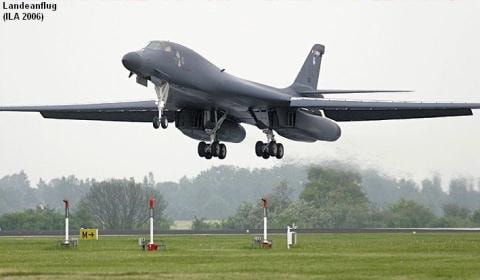
The newspaper wrote that Russia's Tu-160 is larger and faster than the B-1B. Furthermore, the Tu-160 has a maximum takeoff weight of 272,000 kg and reaches speeds exceeding 2.05 Mach, while the American bomber can only take off if its weight does not exceed 216,000 kg.
Russian bombers are equipped with X-55 long-range cruise missiles. The Tu-160 is capable of carrying 12 such missiles. The bomber also carries X-102 cruise missiles with thermonuclear warheads.
Along with National Interest, the American publication Inquisitr also shared a similar assessment regarding the power of Russian long-range aircraft. Inquisitr stated that the improved Tu-160 model, even before its completion, was considered the fastest missile-carrying aircraft of the 21st century, with new electronic systems giving it even greater advantages in the sky and surpassing the B1 Lancer bomber.
According to Inquisitr data, the B-1 Lancer is equipped with the AN/APQ-164 passive electronically scanned array radar, which features a microprocessor capable of steering the electronic beam to reduce detectability. In addition, the radar has the capability to set a synthetic aperture for high-resolution digital mapping of the ground.
In addition, the B-1 Lancer is equipped with the AN/ALQ-161A radar warning and jamming receiver. This system includes eight AN/ALE-49 flare launchers. The B-1 also has the ALE-50 towed camouflage system.
Thanks to electronic support measures, the B-1 Lancer has a relatively low radar and infrared signature. The B-1's radar cross-section is estimated at approximately 2.4 m². The aircraft is also equipped with an advanced inertial navigation system and a modern satellite navigation system.
Meanwhile, information about the Tu-160's radar has not yet been released, but airforce-technology.com reports that it is equipped with advanced electronics, a modern navigation and attack radar, and a highly automated electronic warfare system.
Furthermore, the Tu-160 is designed to reduce its infrared and radar signature, although it is not a stealth aircraft. Based on this information alone, the Inquisitr magazine suggests that while the two aircraft are comparable in terms of mission capabilities, the B-1 Lancer appears inferior to Russia's Tu-160 in many other aspects.


