
In 2015, the determination was to bring Vietnam up to par with ASEAN-6.
(Baonghean) - Editor's Note: At the 2015 Mid-Term Vietnam Business Forum (VBF) themed "Enhancing Business Competitiveness for International Integration," held in Hanoi last week, for the third consecutive time, Prime Minister Nguyen Tan Dung and members of the Government participated in direct dialogue with domestic and foreign businesses. Reiterating its commitment to the business community, the Prime Minister affirmed that Vietnam is determined to achieve specific goals so that by the end of this year, Vietnam's business environment will be on par with the ASEAN-6 countries, and by the end of 2016, in many aspects, it will reach the average level of ASEAN-4. The question is: what needs to be done, and how, to turn the government's commitment into reality?
Proactive integration at a new level
As a mechanism for continuous and close dialogue between the Vietnamese Government and the domestic and international business community, the Vietnam Business Forum (VBF) aims to improve the necessary business conditions to promote the development of the private sector, facilitate the investment environment, and contribute to Vietnam's sustainable economic growth. For nearly two decades, the VBF has become an annual event and is considered an effective dialogue channel between the Government and the business community, always accompanying the country's institutional reform and economic management process. This reform, along with the self-adjustment and improvement of businesses, has gradually enhanced the competitiveness of the economy and businesses, making the attraction of foreign direct investment (FDI) increasingly effective.
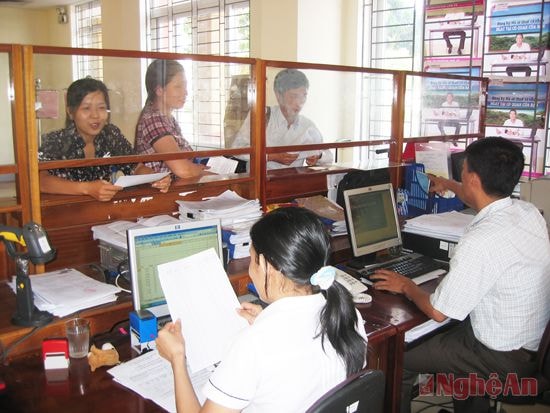 |
| Receiving and processing requests from citizens and businesses at the Nghe An Tax Department. Photo: Mai Hoa |
In his opening remarks at VBF 2015, Minister of Planning and Investment Bui Quang Vinh stated that, thanks to the efforts of all levels and sectors, especially the consensus of the people and the business community, Vietnam has achieved positive results in socio-economic development. However, the Vietnamese economy still faces many difficulties and challenges. To make the Vietnamese economy more vibrant, dynamic, and efficient, in addition to its own efforts, Vietnam urgently needs the joint efforts, support, and valuable assistance of international organizations, donors, and the domestic and international business community.
At the 2015 VBF Mid-Term Agenda, the central issue of greatest interest to delegates was the proactive process of international integration at a new level. With the prospect of completing 14 free trade agreements (FTAs), Vietnam will soon have free trade relations with 55 partners, including 15 G-20 members. Simultaneously, the government is making strenuous efforts to improve the business environment, enhance national competitiveness, restructure the economy, and innovate the growth model – all fundamental foundations for Vietnam's international integration at a new level, opening up vast opportunities for future cooperation and development.
There will be no tax collection.
According to Sherry Boger, President of the American Chamber of Commerce in Vietnam, allowing citizens and businesses to engage in dialogue with the government and officials through various forms ensures that policies and laws are more aligned with reality and closer to the people in society. Proactively resolving difficulties and obstacles for businesses cannot be achieved simply through willpower or determination, but must be done through the amendment of specific policies and regulations. At this forum, the business community once again received concrete commitments from the head of the government and ministers – the "commanders of sectors" – on a range of issues of concern to businesses. For example, addressing concerns about the circular on importing used machinery, Minister of Science and Technology Nguyen Quan affirmed that the latest draft circular on this matter will certainly resolve the concerns of investors.
 |
| Customs officers in Vinh are carrying out customs clearance procedures. Photo: CL |
Accordingly, if the FDI project has been approved, the import of machinery for the project will no longer require an assessment step. Afterward, if importing machinery outside the project, the investor can choose to meet only one of two criteria: either the machinery is less than 10 years old or its quality is at least 70% of its original condition. Minister Nguyen Quan affirmed: If the investor commits to ensuring the quality of the used machinery, customs clearance will be granted immediately, and inspection will only be conducted after installation. Only if the commitment is not met will the investor bear all costs. Furthermore, for each specialized field, ministries and agencies can issue specific regulations rather than rigidly applying a single standard to all types of machinery.
Addressing concerns from foreign investors about having to complete two separate procedures – investment certification and business registration – Minister of Planning and Investment Bui Quang Vinh affirmed: According to Vietnamese regulations, when investing in Vietnam, at least one investment project is required to establish a business, a practice adopted by many countries worldwide. To overcome the long waiting times, the draft of the new Government Decree on this matter will shorten the time for issuing investment certificates from 45 days to 15 days, and the business registration procedures for investors must be completed within 2 days. In the financial sector, in addition to addressing financial management issues, Minister of Finance Dinh Tien Dung clearly assured investors that there will be no retroactive tax collection on goods previously exempt from tax but now subject to tax due to changes in preferential import and export tariff schedules... and the Ministry of Finance will do its utmost to contribute to creating a more open and efficient business environment.
Political will and concerted efforts are needed.
Following the recommendations from the business community at the forum, Prime Minister Nguyen Tan Dung instructed the Ministry of Planning and Investment to compile them and requested ministers and heads of sectors to take specific actions and solutions according to their respective areas of management. The Prime Minister emphasized: From the National Assembly and the Government to the ministries and sectors, everyone must act in consensus to create a better and more favorable business environment, as well as to enhance the competitiveness of businesses, products, and the Vietnamese economy. The Vietnamese Government is determined to achieve specific goals so that by the end of this year, Vietnam's business environment will be on par with the ASEAN-6 countries, and by the end of 2016, many aspects will reach the average level of the four best ASEAN countries – the Prime Minister pledged.
The Prime Minister stated: In the coming period, the Vietnamese Government will strive to build upon the achievements made; diligently overcome limitations and weaknesses; and focus on decisively directing and implementing comprehensively the tasks and solutions to enhance competitiveness and successfully integrate into the international community. To achieve rapid and sustainable development, Vietnam needs to focus on management and administration to ensure the strengthening of macroeconomic stability and control inflation at no more than 5%, not only for 2015 but also for subsequent years.
In addition, the government will manage interest rates and exchange rates in line with market signals, increase foreign exchange reserves to ensure at least 12 weeks of imports; ensure the budget deficit in 2015 is 5% and will be lower than 5% for the next five years (2016-2020). Along with that, it will ensure public debt remains within safe limits, linked to the restructuring of public investment, ensuring the efficiency of public investment, as well as ensuring average annual export growth of approximately 10-15%; and keeping the trade deficit below 5%. The government will continue to direct efforts to remove difficulties and obstacles, creating favorable conditions for domestic and foreign businesses to develop more strongly and achieve economic growth in all three sectors: agriculture, industry, and services.
Improving the business environment, enhancing national competitiveness, and strengthening the competitiveness of businesses in international integration are difficult and long-term tasks. Along with its own efforts, the Vietnamese Government hopes to continue receiving effective cooperation from other countries, development partners, and the entire business community for the common good and development. Currently, Vietnam is continuing to focus strongly on implementing three strategic breakthroughs: institutional reform, mobilizing resources for investment in socio-economic infrastructure, and promoting human resource training to meet the development needs of the economy. In particular, the economic restructuring process aims to achieve the goal of enhancing the competitiveness of the economy, including a decisive restructuring of public investment to achieve higher efficiency. Therefore, proactively promoting international integration will create a broader development space for Vietnamese businesses and people, as well as foreign investors and businesses in Vietnam.
Red River
| Representing the business community in Vietnam, the Chairman of the Vietnam Chamber of Commerce and Industry (VCCI), Vu Tien Loc, stated: "For the first time in many years, in 2015, more than 70% of businesses reported being satisfied with the tax sector's administrative reform efforts. This is a remarkable achievement, showing that if the goals of Resolution 19 are implemented decisively, it can open up unexpected breakthrough prospects in many areas in a short period of time. The key is to have political determination and the concerted efforts of all ministries and sectors, from mindset and perspective to action," Chairman Vu Tien Loc said. |


