
Nam Dan - The spirit of May
(Baonghean)It's rare to see such a vibrant and in-depth new entrepreneurial spirit in Nam Dan as it is now. The people are exercising their right to self-governance, coupled with the dedication and responsibility of the political system at all levels, to strive towards the goal of a prosperous people and a strong homeland, becoming a "model district" as President Ho Chi Minh envisioned during his lifetime...
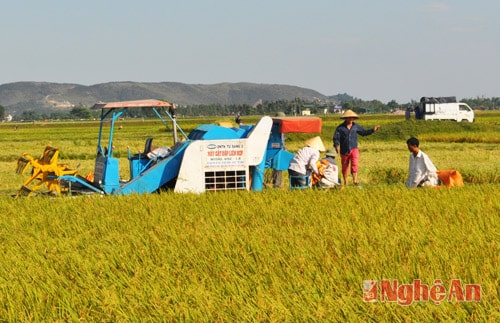 |
| Mechanized harvesting of the summer-autumn crop in Nam Cat commune. |
Nam Cat is the first locality in Nam Dan district to harvest its summer-autumn crop, and the aroma of fresh straw fills the village roads. "This year's harvest is bountiful!" On the My Thien fields, amidst the rumbling of combine harvesters and the bustling activity of tractors and trucks transporting rice, the farmers of Nam Cat, wiping away sweat, excitedly shared their joy. Significantly, the introduction of mechanization into crop production has not only brought about overall labor productivity increases but has also created a new image of agricultural production in the fields, from land preparation and planting to harvesting and transporting produce to storage facilities.
The Party Secretary of Nam Cat commune, Mr. Vuong Hong Thai, led reporters on a tour of the rice paddies. As they walked, he briefly explained: Nam Cat now has nearly 100 plows, 3 rice transplanters, and 5 combine harvesters. With 375 hectares of rice fields, this is not yet considered basic agricultural mechanization, but given the potential of the people, that goal is not far off… Nam Cat currently has 700 workers employed in high-income markets. The remittances help accelerate the construction of houses and transportation infrastructure, brightening the face of the new rural area and developing services to encourage people to invest in production and maximize the potential of the land.
Mr. Nguyen Van Nghia, from My Thien hamlet, is considered a pioneer in mechanizing rice fields, having invested nearly 500 million VND in purchasing plows and combine harvesters. He plans to buy more rice transplanters soon (93 million VND/each), both for his family and to provide services to other farmers. This bold investment stems from his and the farmers' realization of the significance of introducing mechanization into agricultural production. It not only frees up labor but also facilitates the application of new technical advancements to increase productivity, yield, and quality of agricultural products. We visited Tho Moi hamlet in Nam Cat, where the fields were thriving after trial planting with rice transplanters. Hamlet Party Secretary and Head Ta Quang Phuong said that the entire Tho Moi hamlet had conducted a trial planting of 2.5 hectares of rice using transplanters. The results showed very few pests and diseases, significantly reduced fertilizer use thanks to the elimination of the need for water drainage as in previous planting methods, and most importantly, a much higher yield per square meter. Machine transplanting uses 1.2 kg of rice seeds per sao (approximately 1000 square meters), reducing seed usage by at least one and a half times compared to traditional seed sowing, and one transplanter can replace 25 laborers...
Nam Cat is also a "center" for aquaculture services thanks to the dynamism of its people. Eels, crabs, snails, frogs, etc., are purchased from Nam Cat and supplied throughout Vinh City and even to Hanoi. But what's noteworthy is that, from this profession, farmers in Nam Cat are now exploring ways to cultivate aquatic products on their own fields. Here, along the wide, paved or concrete village roads, houses worth billions of dong are springing up everywhere, but the tall, spacious, and meticulously crafted wooden house of Mr. Hoang Dang Cong's family in Da Cat hamlet is still considered impressive. Unlike some families who earn thousands of dollars a month working abroad, Mr. Cong and his wife have built their business solely on buying and selling eels, crabs, and snails.
Currently, Hoang Dang Cong is developing a commercial crab farming model on an area of 4.5 sao (approximately 1,200 square meters), having stocked the ponds with crab larvae before the Lunar New Year of the Horse. He has already harvested nearly 300 kg; the normal selling price is 60,000 VND/kg, but during this peak hot season, the price has reached 100,000 VND/kg. Hoang Dang Cong affirmed: “If you prevent diseases in crabs well and know the market conditions at different times to sell, then crab farming is very profitable. In this first year, I haven't calculated the profit yet, but if things go as smoothly as they have, I will apply to bid for land to expand the farming area to about 1 hectare.” Hearing this, the Party Secretary of Vuong Hong Thai commune immediately said: “Go ahead, go ahead! The commune will support you!” The commune always creates favorable conditions for people to pursue any model they are passionate about. For example, the family of Ms. Nguyen Thi Tam in Hoa Hoi hamlet, at the beginning of this year, was given the opportunity by the commune to implement a model of specialized commercial vegetable cultivation on an area of 1.2 hectares, irrigated by sprinkler pipes directly to the fields. Currently, it is developing well, opening up a new way of doing business here...
Beside the fragrant lotus ponds of Kim Lien, lies the 300-hectare Tranh rice paddy, a large-scale model farm producing high-quality rice. The joy of May, celebrating President Ho Chi Minh's birthday, and the bustling preparations for the harvest season further amplify the enthusiasm of the commune as it prepares to announce the completion of the new rural development program – the first in the district and the second in the province. The final meters of Grade A concrete-paved internal field roads are being urgently completed. Cement is stacked along the roads; sand and crushed stone are brought in by trucks, creating a lively atmosphere for construction in time for the harvest season.
According to Mr. Nguyen Sy Dang, who is in charge of constructing the rural road in Hong 1 hamlet, there are only over 100 meters left to complete the 686-meter-long road extending into the rice fields, and the entire team is trying to finish paving it with concrete within two days. Mr. Nguyen Van Dan, a rural development officer in Kim Lien commune, was busy at Hong 1 when he was suddenly spotted at the Lien Cat - Lam Tra road, simultaneously delivering cement and loudly directing the clearing of the ground to ensure the completion of the 826-meter-long road paving within the next two days… The Chairman of Kim Lien commune, Mr. Nguyen Hong Son, said: “As one of the three communes selected by the district as a pilot site for new rural development, after more than three years of implementation, Kim Lien has focused on boosting economic development and infrastructure, with a focus on tourism… The results of being recognized as having completed the new rural development criteria are primarily due to the joint efforts and contributions of each citizen, followed by the local Party committee, government, and mass organizations finding positive solutions to effectively utilize resources.”
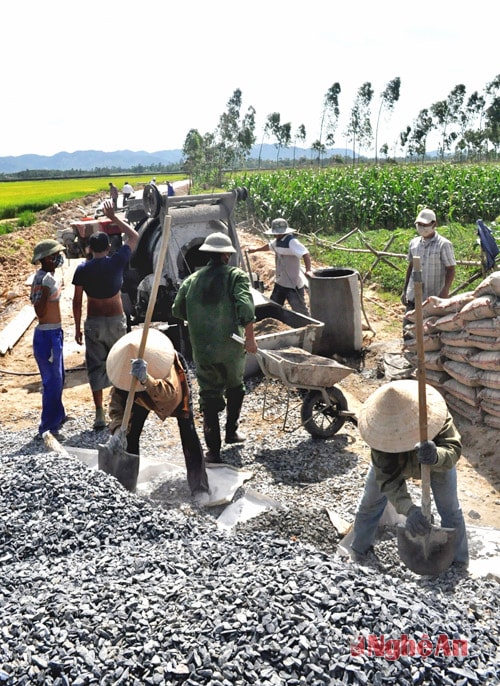 |
| Construction of rural roads in Hong 1 hamlet, Kim Lien. |
In the late afternoon, arriving in Nam Giang commune, the bustling scene of factory workers returning home after a day's work fills the air. Along the long asphalt roads stretching between the golden rice fields of May, winding around the foot of the lush green Dai Hue mountain range, are groups of visitors coming to visit the tomb of Mrs. Hoang Thi Loan, the Dai Tue pagoda, and more. This vibrancy, along with the towering structures of factories, industrial project functional areas, and tourist zones, shows that Nam Giang is on the verge of achieving "complete prosperity."
Industrial development in the area has helped Nam Giang reduce poverty at a remarkable rate: In 2010, the poverty rate was 18%, now it has decreased to 8%, and the goal is to reduce it to 5% by the end of 2014. Nam Giang commune is considered the "industrialization center" of the district. While agricultural land in Nam Giang has shrunk due to land allocation for investment projects, the people have proactively utilized the spillover effects of industrial and tourism projects to vigorously develop services and other industries. In Nam Giang district, there are 14 large-scale investment projects across two industrial zones (Dong Man and Dong Dung) with a total area of 55 hectares. Notable projects include the Hoa Hiep Hot Plastics Project with a capacity of 120 m3/h, the Saigon Beer - Song Lam factory, two garment projects (including a South Korean project attracting 2,700 workers), the high-tech complex of Nam Dan Van An Co., Ltd. (expected to attract 14-16 thousand workers), and a water treatment plant with a capacity of 20,000 m3/day.
The Chairman of Nam Giang Commune, Mr. Tran Huu Van, said: “Although the commune does not collect the budget, Nam Giang is still proud to be the land that ‘generates’ nearly 1/10 of the province’s budget revenue, with over 600 billion VND collected in 2013 from investment projects in the area. The impact of industrial projects is increasingly evident: completely changing the face of the rural area, especially the road infrastructure; providing stable jobs and income for 600 young people; and bustling service industries opening up thanks to the dynamism of hundreds of households serving the industrial and tourism projects. In the long term, if both industrial zones in the area are fully developed, Nam Giang will completely shift to a service-based economy and implement the town planning according to the province’s policy.”
It's difficult to list all the breakthroughs in new businesses in Nam Dan at this time; but imagine the Lam River and National Highway 46, a combination of natural and man-made features, dividing the district into three continuously developing, sustainable areas: cattle farming and alluvial crops in the southern region; tourism and high-quality rice cultivation and poultry farms in the central region; and industry, pig farms, and safe vegetable fields in the northern part of the district. Every May, traveling throughout Nam Dan district, one can further appreciate the awareness and responsibility of the Party committees, the government, and every citizen in their relentless efforts to develop the economy and build a new rural area, aiming to live up to the nation's expectations for the progress of this district, the homeland of our beloved President Ho Chi Minh!
Mr. Vu


