
The Year of the Goat: Talking about the best qualities of goats.
One of the twelve zodiac animals has long been associated with world history and culture. It's even more familiar because people commonly call it "goat" rather than names with Sino-Vietnamese connotations like "yang" or "shan yang"... Many goat species possess characteristics not found in other animals, both in nature and society...
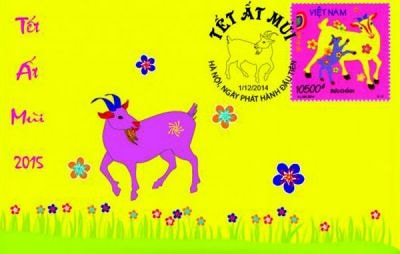 |
| The image shows a Sumatran mountain goat on a set of stamps issued by the Vietnam Stamp Company. |
This species holds great spiritual significance.
Among livestock, the goat holds rich spiritual significance and high symbolic value. It plays a close yet important role, creating strong, diverse, and positive influences on the cultural life of many countries. Goats are always considered symbols of fertility, prosperity, growth, and development in nature, as well as the moral aspects of society. The image of the goat is also featured in books and on postage stamps, a symbol carrying a global cultural message.
This species has a wide range of adaptability to different climates and terrains.
Goats have a wide adaptability to various climates and ecosystems, including harsh arid regions (due to their ability to use water sparingly) or rugged terrain (thanks to their excellent climbing skills). Goats can live in difficult and arid places that other ruminant livestock may not tolerate. Therefore, goats can be found on all continents of the world.
Asia is the continent with the largest wild goat population.
Wild goat populations in Asia account for up to 90% of the world's wild goat population. Notably, Asia is also the continent with the most endangered goat species in the world, including those listed in Appendix I of CITES:
(1) Sumatran mountain goat Capricornis sumatraensis

Globally, this goat species is found only in a few Asian countries such as Indonesia, Malaysia, Thailand, and Vietnam. In just 21 years, the population of this goat species has declined by more than 30% and is expected to continue declining in the future.
This valuable goat breed is characterized by its habitat in mountainous regions at altitudes ranging from 200 to 3,000 meters. They typically forage in the early morning and late afternoon. In Vietnam, Sumatran mountain goats are found in the provinces of Son La, Cao Bang, Lai Chau, Lang Son, Hoa Binh, Quang Ninh, Hai Phong, Thanh Hoa, Nghe An, Ha Tinh, Quang Binh, Quang Tri, Thua Thien Hue, Quang Nam, Kon Tum, Gia Lai, Dak Lak, and Lam Dong. Adults weigh over 150 kg. Their appearance is similar to deer, with a long mane of hair on the top of their head, and tufts of long hair covering from the ears to the corners of the mouth. Both males and females have short antlers, no longer than 30 cm. The antlers are tubular and round with many horizontal folds inwards towards the horn bone, and the tips are pointed and curved backwards. The antlers are unbranched. The entire body is covered with thick, long, stiff hair, dark gray or ash gray in color. From the forehead to the shoulders, the hair is very long, forming a mane. The tail is very short.
(2) Pakistani mountain goat Capra falconeri

This goat species is distributed in northeastern Afghanistan, northern Pakistan, parts of Pakistani-controlled Kashmir, Indian-controlled Jammu and Kashmir, southern Tajikistan, and southern Uzbekistan.
This is also an endangered species with over 2,500 adult individuals, and this number continues to decline at an estimated rate of about 20% over two generations. Adult Pakistani ibex stands 65-115 cm tall and weighs up to 110 kg. Pakistani ibex are sexually dimorphic. Males have long hair on their chin, throat, chest, and shins. Females are redder, with shorter hair and a short black beard. Both sexes have spiral horns. Male horns can grow up to 160 cm and female horns up to 25 cm. Some researchers believe that Pakistani ibex are the ancestors of several domesticated goat breeds. Notably, Charles Darwin acknowledged that modern goats arose from crossbreeding Pakistani ibex with wild goats.
(3) Chinese mountain goat Capricornis milneedwardsii

This species of goat, also known as the Continental Mountain Goat, is distributed in Myanmar, Cambodia, southern and central China, Laos, Thailand, and Vietnam. They live in rugged hills and rocky mountains, especially in limestone areas up to 4,500m above sea level.
Chinese mountain goats are quite large, with published studies showing that adult individuals weigh over 150 kg. These goats typically live alone or in small groups within a small area of just a few square miles, where they graze on grass, branches, and leaves from roads along the beaten path. Chinese mountain goats mark their territory with droppings and markings. They are most active at dawn and dusk, and spend the rest of the day in dense vegetation. This species has a gestation period of approximately eight months and gives birth to a single offspring in September or October.
(4) Red mountain goat Capricornis rubidus

This species, which is on the verge of extinction, is found in the tropical forests of northeastern India (south of the Brahmaputra River), Bangladesh (east of the Jumuna River), and northern Myanmar.
This species of mountain goat has a body length of approximately 140–155 cm, a height of 85–95 cm, and weighs 110–160 kg. They have a distinctive reddish-brown coat. A black stripe runs along their back from the shoulders to the tail. Their head and neck are covered in a mane of hair that can stand up when agitated. Their throats are covered in white fur, resembling a bib. Each individual red mountain goat has large black eyes, long, pointed, conical ears, and curved horns 15–25 cm long, found in both males and females (females usually have longer horns). Their tails are short, only 8–15 cm long.
Like many other mountain goat species, the red mountain goat is diurnal, especially active in the early morning and late afternoon. They live in caves and on cliffs. When warning an opponent, the red mountain goat emits a whistling sound or a snort. Red mountain goats live solitary lives or in small groups of 2-5 individuals. Their diet consists of grass and leaves.
Threats to the red mountain goat include leopards and eagles, but above all, habitat loss and human hunting are driving it to the brink of extinction. Their current population is unknown.
(5) Himalayan mountain goat Capricornis thar

This species of mountain goat is distributed in eastern and southeastern Bangladesh, Bhutan, Nepal, northern India, Tibet, and possibly western Myanmar. They live on rugged, steep hillsides with rocky soil, especially in limestone areas up to 3,000 meters above sea level. Their numbers are very small and declining. According to a recent study, the density of Himalayan mountain goats is 1.6 individuals per square kilometer. Major threats include hunting, habitat destruction, encroachment on agricultural land, and fuel extraction.
The earliest domesticated species
Over 350 breeds of goats have been recorded worldwide. Although opinions differ, scientists generally agree that goats were one of the earliest animals domesticated by humans, followed later by dogs. Like other domesticated animals, after being domesticated, goats were first raised for meat, and later for milk. The origin of domestic goats is actually wild goats.
The most important livestock species and the one that provides the most food sources.
When talking about livestock, people usually think of buffalo, cattle, pigs, etc. But few know that it is goats, not other species, that are raised in large numbers and play an important role in the production economy of developing countries, especially in Asia and Africa. Of the world's goat population of 921 million, the largest number are raised in Asia (accounting for 26%, with leading countries including China: 173 million, India: 125 million, and Pakistan: 53 million...), and in Africa at 174 million.
Goats provide a significant source of nutrition. While the European goat population accounts for only 3% of the world's total, they produce nearly 20% of the world's total goat milk. Conversely, Asian and African countries produce almost 90% of the world's total goat meat. Goat hair and hides can be used for clothing, hats, and other personal items. Horns and bones can be used for handicrafts and decorations. Furthermore, goat farming provides a valuable source of fertilizer for plants or as food for fish.
Goats are relatively cheaper than cattle, making them easier to buy, especially for the poor who have just escaped disasters such as floods, storms, or war. Mahatma Gandhi, the famous Indian leader, affirmed: "Goats are the poor man's ox." RM Acharay, President of the World Goat Breeders Association, also stated: "Goats are a reliable insurance policy for the poor."
For a long time, Vietnamese people have considered goat farming as a way to develop the economy, yielding quick and high profits due to goats' high fertility and short gestation period (5 months). Goats are easy to raise, adaptable, and resistant to disease, utilizing natural conditions without competing with humans for food. Vietnam has imported three dairy goat breeds from India (Beetal, Jumnapari, Barbari), two dairy-specialized breeds (Alpine, Saanen), and one super-meat breed (Boer) from the United States for purebred breeding and crossbreeding with local goat herds (including Grass goats and Bach Thao goats) to improve their productivity. According to the latest data, the country produces an average of about 20,000 tons of goat meat annually from a total goat population of 1,345.3 million, with an average growth rate of 7.38% per year.
The most stubborn animal
Despite their docile appearance, goats are actually capricious and restless animals. They are very gluttonous and, when searching for food, they eat and destroy, sometimes even damaging crops and trees. Even domesticated goats are very stubborn: if the herder wants them to go one way, they will go another.
The most herbivorous animal
Belonging to the Even-toed Ungulate Order and the Ruminant Suborder, goats eat all day, even chewing while sleeping. They eat during the day and ruminate at night (approximately from 10 PM to 3 AM) or during rest periods between grazing sessions throughout the day. Adult goats ruminate 6-8 times a day, while young goats ruminate 15-16 times. Due to their rumination habits, goats can eat 170 plant species, accounting for 80% of wild vegetation. Their main food sources are grass, leaves, twigs, sprouts, fruits, moss, and lichens on cliffs, including most types of natural and cultivated plants. Goats can eat bitter plants that other animals cannot. Goats are voracious eaters, but they are always seeking new food. They are agile and active animals; they move quickly around plants, plucking the tastiest leaves and buds before quickly moving on to other plants and bushes.
Goats prefer to eat at a height of 0.2-1.2m. They can stand on two legs for a long time to pick leaves, and even climb trees to choose the tastiest parts to eat. Goats' lips and tongues are very flexible, allowing them to grasp food and select the types they prefer most.
Goats have difficulty eating food close to the ground and often have to kneel down to eat. They are also very thirst-tolerant animals. Researcher Devendra asserts that a goat weighing 18-20 kg needs to drink 680 ml of water per day in the summer and 454 ml in the spring. Goats are very clean animals; they do not eat leftover, dirty, or rotten food; they usually discard spilled food and do not eat it again.
Ruminant behavior in goats plays a crucial role in digestion: food is mixed with saliva and crushed, creating a rumen pH of 5.5 to 6.5, which is favorable for rumen microorganisms to thrive. In grazing areas, the vegetation is replaced by another layer, allowing for better growth. In areas where goats graze under the canopy of forestry trees or fruit trees, they also help to limit the growth of harmful weeds and shrubs, and their manure serves as a good source of fertilizer for crops.
The most social species
Goats typically live in herds, with each individual holding a specific social position. Herds of wild goats can number several hundred, and there may be a leader within the herd. On pastures, the herd moves to graze following the lead goat, occasionally craning their necks to look around. Goats are very secure within the herd; if separated, they become very frightened. The strong sense of community in goats ensures that the individual activities of each goat are inseparable from the collective activities of the herd, and that the survival and development of the species depend on the existence of each individual. Although prey to predators, goats are not always passive. In some cases, when cornered, mountain goats have miraculously fought off entire packs of wolves to protect themselves and their herd. When sick, goats often continue to follow the herd until they are completely exhausted and collapse.
They are active and love to climb.
Goats are active animals, enjoying running, jumping, and climbing. On average, goats travel 10-15 km daily. They can climb steep cliffs and dangerous rocky outcrops near deep ravines, moving easily on even the most precarious surfaces. If necessary, adult males can stand for extended periods on a rocky outcrop on the edge of a precipice, even on an area of only 200-300 cm². By gripping slightly protruding rocks with their hooves, goats can climb almost vertical slopes. Even young goats, only 12-15 days old, can jump onto rocks 1-2 meters high.
This species is highly sexualized and exhibits great reproductive capacity.
In culture, the horns of a female goat symbolize fertility and abundance. Male goats represent virility and sexual desire because goats are inherently full of sexual energy. In reality, a male goat can mate with an entire herd of female goats, and from this, the goat is also seen as representing lewdness, with the image of an old goat or the goat's blood of men.
In fact, goats have a relatively early age for giving birth to their first offspring (11-13 months old), with each female goat producing an average of 1.5-1.7 litters per year, each litter containing 1.4-1.8 kids. Therefore, if you compare buying a newborn female goat with a female calf, after four years the goat will have given birth to 23 kids with a total weight of 500 kg; whereas a cow will only give birth to one calf weighing about 350 kg. Therefore, goat farming allows for faster herd expansion and capital recovery compared to buffalo and cattle farming.
Although goats are small, they have a relatively high milk production capacity. In practical conditions in Vietnam, if we consider the milk yield/body weight ratio, Barbari goats have the highest: 3.41, followed by Bach Thao goats at 2.4, while dairy cows raised in Ba Vi have a ratio of 2.1.
According to Nhan Dan newspaper


