
Empress Nam Phuong and her final days in France
Upon hearing of his wife's death, Emperor Bảo Đại purchased a coffin made of oak, the most precious type of wood in France, to bury his virtuous, kind, and moral wife.
The bookNam Phuong - the last empressThe book by author Lý Nhân Phan Thứ Lang, recently published, contains much little-known information about the life and career of Empress Nam Phương.
With the permission of The World Publishing House and Saigon Books,Zing.vnThis excerpt from the book shares with readers a multifaceted perspective on the last empress in Vietnamese history.
In 1949, Bảo Đại returned to Vietnam to assume the position of Head of State, but Empress Nam Phương remained in France. During holidays, she often went for walks with her children to buy toys or to the movies with Prince Bảo Thắng and Princess Phương Dung – her two youngest children. In France, Empress Nam Phương initially resided at Thorenc Castle in Cannes. There, she enrolled her daughters in the Couvent des Oiseaux, the school she had attended until her marriage.
There were also times when Bảo Đại went to France, and Empress Nam Phương accompanied him to casinos to watch him play baccarat or roulette for fun. On those occasions, if Bảo Đại won any money, he would give it all to her to buy clothes. The Empress was very fond of fashion from Christian Dior and Balmain. She was a very stylish woman, and light purple was her favorite color. Perhaps because her life had been filled with more sadness than joy, she chose purple?
Every day, her activities included taking care of her children, reading books and newspapers, or gardening and pruning. In the evenings, she enjoyed playing the piano for her children. She was also an art lover. In her room, one could see paintings by Renoir and Buffet. She disliked Picasso's Cubist paintings because her soul was not suited to this style of painting, nor to Surrealism.
She loved keeping dogs. She had a whole pack of them at home, including a Saint Bernard, a breed as big as a tiger, often used for searching for missing people in the woods while skiing. She could play table tennis, tennis, and golf, but wasn't very good at them.
|
| Mrs. Nam Phuong and her children in their early days in France. |
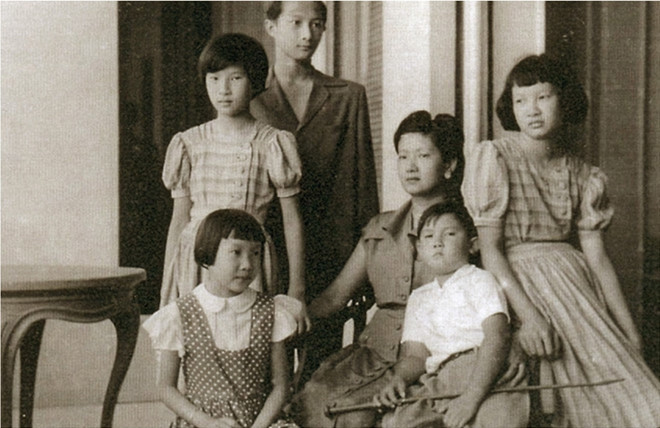
After 1955, Bảo Đại became deposed, so he sadly left home to wander, leaving Nam Phương alone with their children. By then, her children were grown up and each had found work in a different place.
In later years, Empress Nam Phuong left Thorenc Castle to live at Domain de la Perche in Chabrignac, in the central-western region of France, about 400-500 kilometers from Paris. She owned a large estate there, which her family (Mr. and Mrs. Nguyen Huu Hao) had purchased for her. Her house was isolated from the other houses in the area, as it was a rural village where people rarely interacted with each other.
In terms of material comforts, Empress Nam Phuong never lacked anything while living abroad. Her personal assets, purchased for her by the Nguyen Huu Hao family, included a large apartment in Neuilly and another on Opera Avenue. She also owned numerous properties in Morocco, Congo, and other countries. She divided all these properties among her children, each receiving a separate share, and only kept her farm in Chabrignac, comprising 160 acres with a herd of nearly a hundred cows and a rose garden that always bloomed beautifully.
People living near Empress Nam Phuong's house said that Bao Dai rarely returned to visit his wife and children. He would only visit once or twice a year, and then leave immediately. The only time he came was for Princess Phuong Lien's wedding, to help Empress Nam Phuong officiate the ceremony, before disappearing again a few days later.
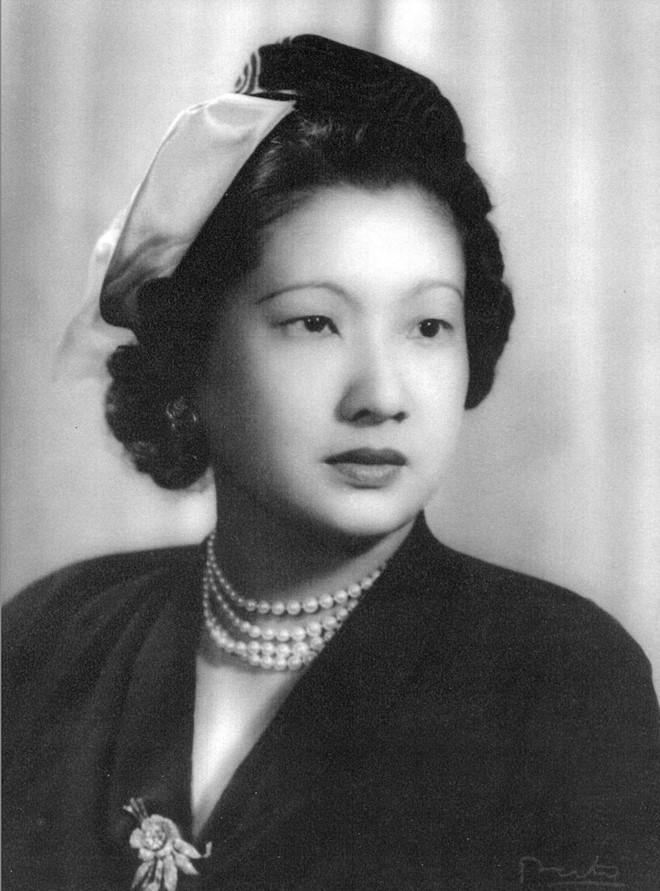 |
| Nam Phuong embodies the modern and elegant image of a contemporary woman. |
Seeing that Bảo Đại was getting old but still indulging in a life of pleasure, Empress Nam Phương chose a quiet place to live out her final days peacefully. She once expressed a wish to return to Vietnam so that, upon her death, she could be buried next to her parents' graves in Da Lat. However, Bảo Đại and her children objected and refused to let her return.
In her final years, Empress Nam Phuong rarely went out or met people. Occasionally, she would travel to Paris to visit her children who were studying and working there. Conversely, during the summer, her children would come to visit her and stay for a few days to keep her company. During this time, she suffered from severe heart disease and frequently experienced shortness of breath.
Around 5 p.m. on September 15, 1963, Empress Nam Phuong felt unwell and sent a family member to call a doctor. After examination, the doctor said she had a mild sore throat and would recover with a few days' medication. However, unexpectedly, just a few hours after the doctor left, she experienced difficulty breathing. Her servant then asked a French neighbor to fetch another doctor, but before the second doctor could arrive, Empress Nam Phuong passed away that night at the age of 49.
When she passed away, apart from her two maids, no close relatives were by her side. Her children were either studying or working in Paris, while Bảo Đại was living in southern France.
Upon hearing of Empress Nam Phuong's death, Bao Dai returned immediately and purchased a coffin made of oak, the most precious wood in France, to bury his virtuous, kind, and moral wife, who until the end of her life was never criticized or complained about. Even Bao Dai himself never dared to reproach his wife for infidelity, because since their separation, Empress Nam Phuong had never had any lovers, not even going dancing or swimming with another man. Perhaps Empress Nam Phuong was born into a family with strict moral principles, so she maintained her religious duties very strictly, even with her children.
Nam Phuong's funeral was conducted according to Catholic rites and was very simple. Those attending included only Bao Dai, the princes and princesses, and a few close family friends. Locally, the provincial governor and representatives from the area where Nam Phuong resided came to offer condolences and attend the funeral. Notably, Princess Nhu Ly, daughter of King Ham Nghi, also attended the funeral. Princess Nhu Ly lived near Nam Phuong's residence, but sadly, the two had never met until after Nam Phuong's death.
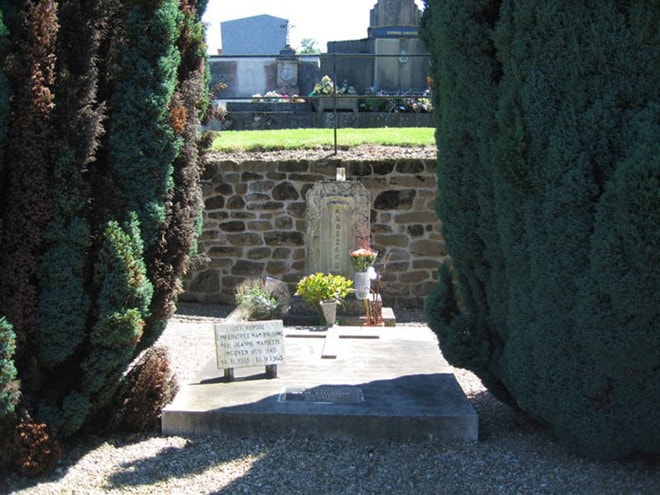 |
| The tomb of Empress Nam Phuong at the Catholic cemetery in Chabrignac (France). |
The remains of Empress Nam Phuong were interred in the Catholic cemetery in Chabrignac. On her grave is a tombstone inscribed with the following words:Ici Repose l'Imperatrice Nam Phuong Nee Jeanne Mariette Nguyen Huu Hao November 14, 1913 - September 15, 1963.
And on the back of the tombstone is written in Chinese characters: "The tomb of Empress Nam Phuong of Dai Nam."
It is said that, a few years ago, strangers took advantage of the darkness to dig many holes in Empress Nam Phuong's tomb in search of gold, silver, and jewels to see if she had taken them with her. And what they took is unknown; only her family and descendants know.
It's a sad fate for Empress Nam Phuong. In her youth, she enjoyed great happiness and material comforts, as well as fame. Yet, in her final years, she died in lonely solitude in a foreign land at a relatively young age. Empress Nam Phuong was born in 1914 and died in 1963, at the age of 49 – an age considered unlucky in Vietnam, as the folk saying goes: "Forty-nine hasn't passed, yet fifty-three has arrived."
However, with her benevolent beauty and compassionate heart, even though Empress Nam Phuong passed away long ago, stories about her life will continue to be remembered by people.


