
When will Nam Tien 2 finally advance?
(Baonghean) - At this time, the mountainous district of Ky Son has begun its rainy season. The roads leading to remote villages are becoming increasingly difficult and arduous. We arrived at Nam Tien 2 village (Bao Nam commune) after a night of torrential rain. The road from the center of Bao Nam commune to here is only about 2 km, but it took us nearly 30 minutes of struggling with the motorbike. The precarious dirt road along the mountainside was muddy, slippery, and bumpy with countless potholes, even huge ones...
(Baonghean) - At this time, the mountainous district of Ky Son has begun its rainy season. The roads leading to remote villages are becoming increasingly difficult and arduous. We arrived at Nam Tien 2 village (Bao Nam commune) after a night of torrential rain. The road from the center of Bao Nam commune to here is only about 2 km, but it took us nearly 30 minutes of struggling with the motorbike. The precarious dirt road along the mountainside was muddy, slippery, and bumpy with countless potholes, even huge ones...
Upon arriving at Nam Tien 2, we immediately recognized the village head, Xeo Pho Peng, because more than two years ago, we had the opportunity to work with him here. Xeo Pho Peng said: “Many people who come here, including our own villagers, have slipped and fallen while traveling on this road. Because the road is so steep, it becomes slippery when it rains, making it very easy to fall. Soon, with the prolonged rain, only walking will be possible. You've been here several times, so you must know.”
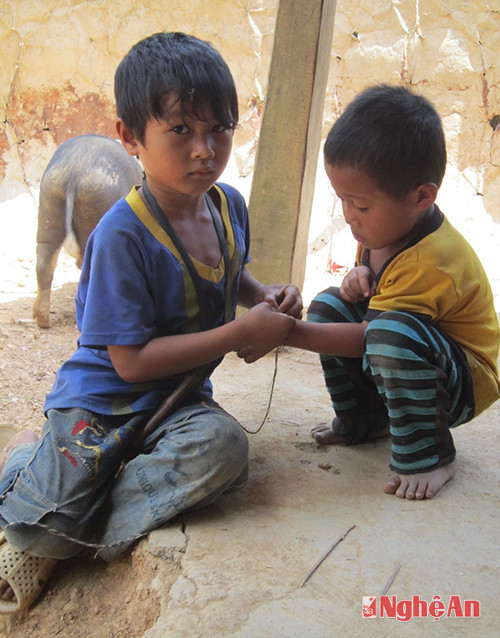 |
| Children in Bao Nam |
Nam Tien 2 village is home to nearly 50 households of the Khmu ethnic minority, of which more than 30 families are classified as poor and frequently suffer from food shortages. Like other villages in Bao Nam commune, the living conditions and production activities of the people in Nam Tien 2 village are currently fraught with difficulties. Poor road access, low levels of education, and inadequate environmental sanitation are the "straits" that bind the people of Bao Nam in general, and Nam Tien 2 village in particular, to poverty and backwardness. The proportion of makeshift thatched houses remains high. This is because the main source of income here is from slash-and-burn farming. With the steep terrain and outdated farming techniques, productivity and output are low, and the lack of supplementary occupations makes food shortages understandable.
It's readily apparent that the Khmu people in Nam Tien 2 still maintain the practice of letting livestock roam freely and keeping them confined under the house floor. Walking through the village, one often sees herds of pigs running freely in the streets, and some even lying on the doorsteps of houses. Almost all families here use the house floor as a shelter for their buffaloes, cows, pigs, and chickens. It can be said that the entire village is living in a polluted environment, easily leading to the spread of infectious diseases, especially among children. Discussing the environmental sanitation issue, Village Head Xeo Pho Peng analyzed the reasons: “At village meetings, the management board has repeatedly urged and reminded the villagers about the harmful effects of letting livestock roam freely and keeping them confined under the house floor, but they still refuse to listen. Partly, this is due to a strong conservative mindset, believing that ‘no one has died from raising chickens or pigs under the house floor.’ Another reason is the lack of space to move the livestock shelters away from the residential area.”
Discussing the direction of poverty alleviation, the village head shared: “To prevent poverty from clinging to the lives of the people of Nam Tien 2, we must first rely on our own efforts. Along with that, the people hope to continue receiving attention, support, and investment in building and improving infrastructure, accelerating the process of poverty eradication by finding suitable plant and animal breeds and providing scientific and technical guidance...”
Text and photos:Tuong Anh


