
Improve operational quality
(Baonghean)Currently, youth union work and youth movements are facing many challenges, especially in rural areas. Given this reality, finding practical solutions to strengthen and improve the quality of activities of grassroots youth union branches in rural areas is a matter of great concern for all levels of the youth union.
Activities are conducted in phases.seasonal activities…
The Youth Union branch of Block 13, Nghi Huong Ward, Cua Lo Town currently has about 20 members participating in activities (70% of whom are students from universities and colleges) out of a total of 40 members of the eligible age group. Dang Hoa Bac, the Secretary of the Block 13 Youth Union branch and a student at Van Xuan University, honestly shared: “We usually only hold Youth Union meetings once every few months, and activities are organized in concentrated batches. For example, on holidays like the founding day of the Youth Union (March 26th), International Children's Day, Youth Month, and the Summer Volunteer Campaign… Similarly, in Block 11, there are also about 20 young people participating in activities, but mainly students. Maintaining monthly meetings as required is impossible, and activities are usually only organized on weekends (Saturdays and Sundays).” Speaking with us, Mr. Hoang Van Hop, Secretary of the Youth Union of Nghi Huong commune, said: "Even the team of secretaries of the 14 hamlet-level Youth Union branches mainly consists of students from universities and colleges in the area, or those who have graduated but haven't found jobs yet. Currently, the entire ward has 170 young people working abroad, not including those working in other jobs and not present in the locality."
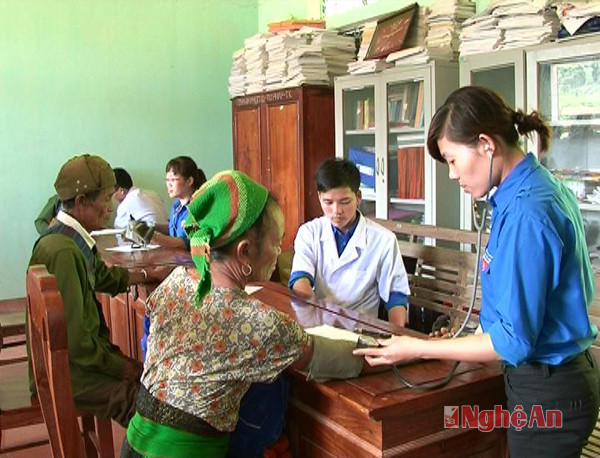 |
| The Young Doctors Club of Thai Hoa Town provided free medical examinations and medication to the people of Nam Nhoong commune (Que Phong district). Photo: Khac Quang |
This is a common situation in many rural youth union branches today. Many Youth Union officials acknowledged the reality: villages lack young people, making it difficult for the Youth Union to gather forces for activities. The team of secretaries for village-level Youth Union branches is unstable, lacking both in numbers and in professional skills, as well as in the ability to organize activities and mobilize young people. Some branches change secretaries 2-3 times a month. Therefore, the quality of activities at the grassroots level is not truly innovative, the content is meager, and thus it fails to attract young people to participate. Ms. Chu Thi Ngoc, Secretary of the Youth Union of Quynh Giang commune, Quynh Luu district, said: Most young people who finish high school go to universities, colleges, and vocational schools; the rest go to work far away; those who don't go anywhere belong to the group of young people lacking ambition; those who get married are burdened by economic pressures and are not enthusiastic about Youth Union movements. Therefore, the quality of activities in rural Youth Union branches is not high, and activities are limited. At a workshop on rural youth union activities organized by the Quynh Luu District Youth Union, Mr. To Van Thang, Secretary of the Party Committee of Quynh Thuan commune, expressed his concerns about the shortcomings in the quality of youth union branch activities and the quality of union members, the low membership rate (Quynh Thuan has 9 rural youth union branches and 3 school youth union branches, but only over 400 young people are registered out of 1,500 young people of eligible age, mainly school youth union members), and the need for specialized activities.
Due to a lack of manpower, many rural youth union branches focus their activities during the summer when school-aged children are on vacation, primarily on superficial tasks such as environmental sanitation, canal dredging, and cultural and artistic exchanges. The work of training and recommending union members for Party membership consideration lacks initiative, mainly depending on the Party branch committee, and there is still a tendency for the Party committee to "create work" for the youth union organization. Youth union affairs at some grassroots levels are not given sufficient attention, and the management of records and monitoring of union members remains limited. The situation of union members abandoning union activities or failing to transfer their membership still occurs in many grassroots union branches.
Besides the reasons stemming from the Youth Union organization, it is also necessary to address the issue of some Party branches and committees not paying sufficient attention to the Youth Union. In many places, Party branches and committees have not assigned Party members or committee members to be in charge of youth work, or the assignment is merely a formality. The awareness of participating in social and group activities among a segment of Youth Union members is poor. On the other hand, life in rural areas is still difficult, but the regulations and policies for Youth Union officials, especially at the village level, are still inadequate, thus they are not committed or enthusiastic about their work…
And the solutions…
Faced with this situation, many Youth Union organizations have actively sought practical solutions to strengthen and improve the quality of activities of grassroots Youth Union branches in rural areas. Nghi Loc district currently has 593 grassroots Youth Union branches with more than 36,000 members and young people of eligible age. In the past period, especially during the "Year of Youth Union Branches" in 2013, the Standing Committee of the Nghi Loc District Youth Union implemented many contents and solutions to improve the quality of activities of grassroots Youth Union branches. First, it issued regulations on managing Youth Union members, guided the management of the Youth Union's records system and membership management register, focusing on recruiting members without prioritizing quantity, selecting outstanding young people with good moral character and a strong sense of self-improvement for consideration for membership. Emphasis was placed on innovating the content, form, activities, and operations of the Youth Union organization: organizing model branch activities, inter-branch activities, thematic activities, and full-scale Youth Union activities. The Nghi Loc District Youth Union issued criteria for "Strong Youth Union Branches at the District Level," emphasizing aspects such as: maintaining monthly branch activities, undertaking youth projects, having exemplary young entrepreneurs, having complete and clear records, effectively managing youth union members, and ensuring no members violate the law or engage in social vices. The Standing Committee of the Nghi Loc District Youth Union also organized training courses on professional skills such as public speaking, writing, document drafting, internet usage, and game organization skills… to enable Youth Union officials to understand, advise on, and organize high-quality and effective activities. Emphasis was placed on vocational training and job placement for young people, creating conditions for youth union members to confidently access loans to develop their businesses and prosper in their homeland.
In Quynh Luu district, the District Youth Union Secretary Nguyen Van Thuong stated: To overcome difficulties in the activities of rural youth unions, especially the 538 grassroots branches, in addition to issuing a plan to implement the action program to innovate the methods of youth union activities, guiding two-way youth union activities, and directing all levels of youth union organizations to advise on and do a good job of planning, training, fostering, and selecting cadres to ensure quality and youthfulness, the District Youth Union Executive Committee organized a workshop on the current situation and solutions to improve the quality of youth union organizations in rural areas. In 2013, the Quynh Luu District Youth Union successfully organized a competition for high-quality branch meetings for rural youth unions to overcome difficulties in maintaining branch meetings once a month.
Many rural youth union branches in Cua Lo Town have closely coordinated with Party branches and mass organizations such as the Veterans Association and the Women's Association to encourage the children of cadres and Party members to participate in youth union activities and youth movements in the locality, with binding agreements in year-end evaluations and rankings. When important issues arise, some youth union branches even invite representatives from the Party committee and mass organizations to attend branch meetings, and vice versa. Along with many other units such as Thanh Chuong and Tan Ky, the Cua Lo Town Youth Union also advises the Party committee and government to create conditions for youth union branch secretaries to concurrently hold the positions of village militia leader or police officer. Currently, 60% of youth union branch secretaries in the town are concurrently holding these positions, increasing their support and creating motivation for them to remain involved in the movement.
Speaking about solutions to improve the quality of grassroots youth union branches in rural areas, Mr. Chu Duc Thai - Head of the Provincial Youth Union's Organizing Committee - said: The Provincial Youth Union Standing Committee has issued Guideline 14 on youth union activities in residential areas, strengthening two-way activities. Accordingly, youth union members studying and participating in activities at high schools, vocational schools, and continuing education centers in the area have the responsibility and obligation to participate in youth union activities in their residential areas, subject to simultaneous management and evaluation by both the school's youth union and the local youth union branch. As a result, the number of youth union members participating in activities in their local areas during the summer and throughout the school year has increased, leading to more vibrant activities.
Based on Regulation 289 of the Central Youth Union, the Standing Committee of the Provincial Youth Union has directed grassroots Youth Union branches to advise and coordinate with Party committees and authorities to pay attention to the planning of Youth Union cadres, ensuring that cadres are assigned according to age, and that mature Youth Union cadres are transferred to new positions; creating favorable mechanisms for Youth Union activities, for example, assigning the Youth Union to undertake projects and tasks in the area to generate operating funds; paying close attention to inspection and guidance; and creating mechanisms for coordination with various sectors, mass organizations, and other organizations to socialize youth work. Emphasis is placed on vocational training and job creation in the locality, limiting the situation of Youth Union members leaving to work far away, which creates difficulties in gathering, managing, and organizing Youth Union activities and movements. Guidance is provided to grassroots branches to regularly organize periodic and thematic inspections, orient branch activities, and promptly commend and replicate new models and good practices.
Khanh Ly


