
Improving the living standards and health of rural people.
(Baonghean) - Insufficient funding to meet planned needs, coupled with delays in the construction progress of many centralized water supply projects and low, untimely contributions from beneficiaries... These are some of the difficulties and obstacles encountered in implementing the Rural Water Supply and Sanitation Program in 2013. However, thanks to the efforts of relevant levels and sectors, the people, and the support of international organizations, the rural water supply and sanitation sector has still achieved high efficiency, contributing to improving the lives and health of people in rural areas.
Recognizing that the implementation of the Clean Water and Sanitation Program would face many difficulties regarding investment capital, relevant authorities at all levels have implemented appropriate solutions. These include strengthening propaganda and mobilization efforts to encourage people to actively participate by contributing money and labor to build water supply and sanitation facilities, while also integrating various programs and projects and effectively utilizing domestic and international investment capital.
Mr. Nguyen Ich Xuan – Head of the Planning Department – Center for Water and Rural Sanitation, stated: “A favorable factor in implementing the Clean Water and Rural Sanitation Program is that the rural water supply and sanitation plan has been adjusted and supplemented for the period up to 2015, taking into account the period up to 2020. Based on this, relevant levels and sectors have coordinated to implement the program in a synchronized manner. Communication activities have focused heavily on community mobilization, introducing sustainable technologies and materials, as well as training to improve management, operation, and maintenance skills for sustainable projects. In addition, the water supply projects have been built on a large scale with modern treatment technology, ensuring water quality meets regulations. The significant increase in the number of people receiving clean water from centralized water supply projects is a positive sign for the sustainable development of the program…”
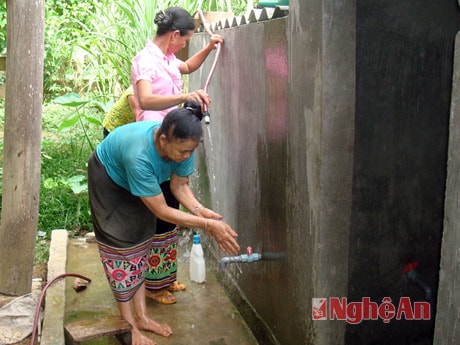 |
| Clean water arrives in Tham village, Chau Thuan commune (Quy Chau district). Photo: Tran Ngoc Lan |
One advantage in the investment and implementation of the National Program on Clean Water and Sanitation in our province over the past period is the availability of multiple investment channels, such as: support from the central government (Clean Water and Sanitation Program, Program 135/CP, Program 30a, New Rural Development Program); provincial budget support; international support (loans from the Asian Development Bank - ADB); preferential support capital and revolving credit fund of the Vietnam Women's Union, and especially the very large amount of capital contributed by the people. This diversity of investment sources has created favorable conditions for our province to successfully implement the National Program on Clean Water and Sanitation. In 2013, the total capital mobilized in this sector was 213 billion VND, including over 20.6 billion VND from ADB loans, 10.2 billion VND from preferential support funds and the revolving credit fund of the Vietnam Women's Union, and approximately 80 billion VND from people's contributions. As a result, in 2013, the percentage of rural population using hygienic domestic water (according to Decision 51/2008/QD-BNN) increased from 66.5% to 68.5%. The number of rural households with toilets according to TC08/BYT increased from 43.5% to 45.2%. The percentage of health stations with water supply and toilet facilities meeting standards increased from 85% to 87%, and the percentage of rural schools with water supply and toilet facilities increased from 54.75% to 56.72%.
Despite diverse investment sources and active public contributions to the National Program on Clean Water and Sanitation, the actual needs in Nghe An province have not been fully met. Therefore, during implementation, the province has devised appropriate solutions, prioritizing investment in upgrading and renovating facilities, managing operations, and maintaining infrastructure to ensure the sustainable development of the program. In reality, some centralized water supply systems using modern water treatment technology have produced clean water meeting the Ministry of Health's Standard 02, but after commissioning, these systems have failed to be effective due to unsuitable management models and a lack of uniformity in the water supply pipeline system.
Therefore, our province has boldly reformed its management methods, such as: assigning the management and operation of some centralized water supply facilities in the towns of Nam Dan, Tuong Duong, and Ky Son districts to specialized enterprises (Nghe An Water Supply Company Limited), or the Center for Domestic Water and Rural Sanitation to manage some water supply facilities in Hung Nguyen. Through this, these specialized units continue to invest, improve production capacity, and most of the facilities have proven effective. Simultaneously, the province also focuses on investing in the construction of new projects in the field of clean water supply, especially projects funded by the ADB. Recently, with the efforts of Dien Chau district and relevant levels and sectors, the district is currently implementing the clean water and rural sanitation project in the Central region, funded by an ADB loan – the Dien Yen Clean Water and Rural Sanitation Sub-project. The sub-project has an investment capital of 52.8 billion VND, of which the water plant construction package is over 37 billion VND. According to the design, the clean water plant has a capacity of 1,700 m3/day and modern water treatment technology that meets the standards of the Ministry of Health. Upon completion, it will supply clean water to more than 3,700 households in the commune (comprising 13,179 people) and public areas.
The construction of the water treatment plant took over 15 months, and by December 2013, the design and construction of the centralized water supply system had reached 61.7%. The design and construction of public and household toilets reached 58.48%. The supervision of the water supply and toilet construction reached 60%. Information, education, communication, and community mobilization activities were carried out according to the approved plan, and to date, 30% of the total project work has been completed. It is known that phase 2 of the project will be implemented across the communes of Long Thanh, Khanh Thanh, Vinh Thanh, and Trung Thanh in Yen Thanh district. With innovative management methods and a focus on prioritizing investment capital for upgrading, expanding, and constructing new centralized water supply projects, in 2013, the percentage of people in our province using clean water according to QCVN 02:2009/BYT increased from 27% to 29.2%.
Mr. Phan Bui My, Director of the Center for Domestic Water Supply and Rural Sanitation, stated: “To effectively implement the National Program on Clean Water and Rural Sanitation, Nghe An province plans to increase the percentage of rural residents using hygienic domestic water from 68.5% to 73% by the end of 2014. Specifically, the percentage of households using clean water according to QCVN 02:2009/BYT will increase from 29.2% to 35.0%. The number of rural families with toilets meeting criteria 08/BYT will increase from 45.2% to 50%, and the number of health stations with clean water supply and toilets will increase from 87% to 90.4% by the end of 2014. The number of schools with clean water supply and toilets will increase from 56.72% to 58.76%...”
To achieve that goal, it is necessary to implement synchronized solutions regarding communication, promulgate appropriate mechanisms and policies, and promote the socialization of rural domestic water supply in accordance with Decision 131/2009/QD-TTg dated November 2, 2009, of the Prime Minister on some preferential policies to encourage investment and management of rural clean water supply projects. At the same time, priority should be given to providing capital support for connection projects and expanding existing water treatment plants to reduce upstream costs, expedite construction, ensure water quality, and maximize the capacity utilization of existing water treatment plants. "Focus on investing in large-scale, inter-communal water supply projects, limiting fragmented investments to minimize construction land area, facilitate water quality control, and reduce management and operation costs..." It is estimated that the capital needed to implement the Clean Water and Rural Sanitation Program in 2014 is approximately 300.9 billion VND, of which 50 billion VND needs to be supported by the central budget, 25 billion VND by the provincial budget, and the remainder from investment capital of programs, projects, international organizations, and contributions from the people.
Hoang Vinh


