
Enhancing the responsibility of each doctor and medical professional.
(Baonghean) - The issue of medical ethics and patient care has always been a matter of public concern. This issue once again became a hot topic at the conference on implementing "Innovating the style and attitude of healthcare workers to ensure patient satisfaction," which was recently organized by the Department of Health and widely implemented across healthcare facilities.
Reforming service attitudes is a mandatory requirement.
It is no coincidence that the Nghe An Department of Health chose Quynh Luu General Hospital to implement Decision No. 2151/QD-BYT (dated June 4, 2015) of the Ministry of Health approving the plan to implement "Innovating the style and attitude of healthcare staff towards patient satisfaction." This unit has just been recognized as a new model for hospital quality management according to ISO: 9001-2008 standards. Quynh Luu Hospital is also only the second hospital in the entire province to be recognized with this standard and is a shining example of innovation in patient service and reception.
Dr. Nguyen Hoai Nam, Director of the hospital, said: "It took the hospital nearly three years to prepare for this accreditation. During that time, in addition to continuously improving the quality of medical examination and treatment, the unit improved and developed many operational procedures to serve and satisfy patients. For example, using magnetic cards for patients instead of traditional medical records. This is a completely new system; patients with health insurance cards only need about 3 minutes to go to the reception area to have their photo taken and receive a magnetic card. For subsequent visits, patients do not need to present their insurance card or other identification documents, but only the magnetic card. Thanks to this, not only is the waiting time for patients faster, but the hospital also finds it more convenient to process patients' personal information and easily update patients' medical history through previously stored information."
After nearly three years of implementation, the hospital has issued nearly 20,000 magnetic cards, mainly to retirees and those eligible for social welfare programs. Patient Vo Van Tu (72 years old), when coming for a check-up, shared with us: “Since the examination process has been shortened and simplified, we feel much more convenient. The waiting time to be examined has been reduced by more than half.”
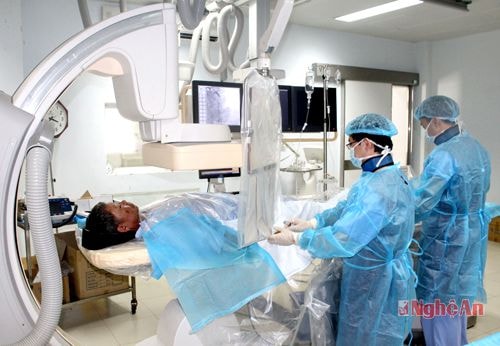 |
| Using an interventional cardiology machine on a patient at Nghe An Friendship General Hospital. Photo: Tu Thanh |
Never before has the improvement of service style and attitude been as important to hospitals as it is now, and most delegates attending the implementation conference affirmed that this is a decisive factor in the "survival of the hospital." For Hospital 115, this is even more crucial because since its establishment, the hospital has always identified itself as a private hospital, a "latecomer," whose existence and development depend entirely on patients and customers. Therefore, to ensure patient satisfaction, for many years the hospital has required its doctors and nurses to say "no" to bribery. Many staff members who violated hospital regulations have had their bonuses cut, been reprimanded, or even suspended from work after complaints from patients and their families.
At the Orthopedic Trauma Hospital, Dr. Nguyen Hoai Nam, the hospital director, stated: “Because it is a newly established hospital, all procedures are still in their initial stages, so we always remind the doctors and nurses to have a courteous attitude and treat patients as if they were our own family members. Every day, the hospital has an administrative team directly supervising the examination, treatment, and patient care in the departments. If any doctor or nurse causes difficulties for patients during examinations, or forces seriously ill patients to move themselves, they will be reprimanded. Repeated violations will result in a negative performance review and deductions from benefits.”
Director of Northwest Hospital, Tang Viet Ha, said: “Currently, we have many procedures to assess hospital quality. However, in my opinion, whatever the procedure, it must be practical and focused on serving patients. This is not too complicated, and with attention, it can be changed. For example, at our hospital, in the past, patients often argued with medical staff when starting the registration process. After careful investigation, we discovered that the main cause stemmed from hospital staff, from the habit of asking, 'Where are the documents?' This is not wrong, but it causes frustration for patients because when they come to the hospital, what patients and their families care about most is their health, not the procedures and paperwork. Faced with this reality, when implementing hospital quality management according to the RCI essential standard, the hospital has developed a new procedure. In this procedure, the process of asking patients must be the fifth step, after medical staff have conducted screening, first aid, and health checks.” "It's good for the patients... The patients' attitudes have improved significantly after these changes."
Enhancing accountabilityof each doctor
The Ministry of Health's Decision 2151 on "Innovating the style and attitude of healthcare workers towards patient satisfaction" is considered a major campaign throughout the healthcare sector today. Of course, this is not entirely new, but rather a concretization of the 12 ethical principles of medical conduct and the implementation of grassroots democracy, which healthcare facilities have been practicing for some time. However, because these principles have not been fully implemented, this decision aims to rectify the overall awareness and responsibility of staff and address long-standing shortcomings in the sector. These include the continued presence of many healthcare workers who do not adhere to professional procedures, exhibit inappropriate attitudes, lack professionalism and ethics, and even engage in negative behaviors that erode public trust.
Regarding this decision, Dr. Nguyen Hong Truong, Deputy Director of Vinh City General Hospital, said: "We fully support the Ministry of Health's policy, and at this time, if any hospital does not implement it or specifically instruct its staff to change their behavior and attitude, it will fall behind, and this is also a matter of each hospital's reputation."
According to Decision 2151, there are 13 specific measures that need to be implemented to change the awareness, attitude, and service style of healthcare workers towards patients. Among these, in addition to organizing training on the new regulations for all healthcare staff throughout the sector, there will be several additional requirements for healthcare facilities. These include establishing customer care departments to professionalize patient care and service; continuing to use hotlines and suggestion boxes; respecting and listening to feedback and concerns from the public for adjustments; implementing the "Supporting Patients in Hospitals" project to coordinate assistance and advice for patients during treatment; and finding solutions to address negative behaviors of individual healthcare workers such as indifference, irritability, arrogance, and authoritarianism. The "Patient Satisfaction Assessment" toolkit will be applied to evaluate the attitude, service, and care provided by healthcare staff to patients, continuously improving the quality of patient care. The health sector will organize commitment signing ceremonies between officials and department heads, between department heads and hospital leaders, between hospital leaders and the Director of the Department of Health, and between the health sector and the Provincial People's Committee.
Dr. Bui Dinh Long, Director of the Department of Health, stated: "This is a regulation of the health sector, and once signed, all medical facilities must implement the contents properly. We will conduct inspections and supervision, and any unit found to be in violation will be punished. Individually, anyone who fails to comply will be held accountable and responsible to their unit."
My Ha


