
The Princess in the Deep Mountains
We have visited Chau Thuan commune, Quy Chau district many times, and each time we feel a sense of returning to our roots. Chau Thuan is beautiful, rich in legends and cultural identity, yet it remains largely unspoiled, needing exploration to transform its potential into gold...
(Baonghean)We have visited Chau Thuan commune, Quy Chau district many times, and each time we feel a sense of returning to our roots. Chau Thuan is beautiful, rich in legends and cultural identity, yet it remains largely unspoiled, needing exploration to transform its potential into gold...
Ancient legends
Chau Thuan – a valley embraced by the two streams Khe Chai and Khe Ninh – is now in the middle of the dry season. Spring in this high mountain region is characterized by foggy, cold mornings, and warm, sunny afternoons. This year, the drought isn't particularly severe, so peach blossoms still sway in the breeze in front of the houses. About 7 km from Hang Bua, Chau Thuan appears with stilt houses nestled in Bong 1 and Bong 2 villages along the Chieng Ngam road. The road winds through the mountains, which stand silently, witnessing life's events and telling ancient stories...
The former name of Chau Thuan was Muong Chai. According to legend, Muong Chai was founded by a Thai ethnic man named Cam Coong, who came from Thuong Xuan, Thanh Hoa, around the 13th-14th centuries. After Cam Coong and his wife passed away, Muong Chai was under the administration of his eldest daughter, Mrs. Chai, and the villagers lived in prosperity and happiness. When Mrs. Chai became old and frail, bandits rose up in the surrounding area, and Muong Chai was repeatedly raided. Mrs. Chai sent people to bring Tao Noong, a hero from the Ke Nam region (present-day Chau Binh commune), to help govern the land. Tao Noong arrived, recruited able-bodied men, and organized the fight against the bandits. However, when the land was free from bandits, Tao Noong, relying on his past achievements, became tyrannical and committed many cruel acts against the people. Tao Noong imposed many harsh laws that the entire village was forced to obey. Seeing the people's lives being oppressed, Mrs. Chai sent trusted confidants to find another talented person to subdue Tao Noong. That person was Tao Noi, whose real name was Cam Ba Hue, originally from Thuong Xuan district (Thanh Hoa province). Mrs. Chai ordered a large ceremony to welcome Tao Noi, and at the same time, organized a brotherhood ceremony between Tao Noong and Tao Noi. While the ceremony was underway, Tao Noong was surrounded and killed by Tao Noi and the villagers. Under Tao Noi's leadership, the Muong land returned to peace.
Legends often contain more fictional elements than factual ones. However, the locals still believe the story is true, because the evidence remains: a rather large, ancient bronze cauldron. Legend says that Tạo Nọi brought this cauldron with him to Mường Chai, where he cooked a buffalo during that historic ceremony. Later, Tạo Nọi entrusted the cauldron to the head shaman for safekeeping, and it was only to be used during the annual ceremonies of the village; it was absolutely forbidden from being used for cooking food or drinks during normal times. We were guided by Ms. Lữ Thị Mai, the acting Party Secretary of the commune, to see the sacred artifact of Mường Chai, which is kept at the commune's community learning center. This four-handled bronze cauldron weighs about 35-40 kg and has a mouth wide enough for two people to encircle. According to Ms. Mai, setting aside the superstitious elements, there is a very interesting coincidence: the cauldron has been stolen several times, but after about a lunar cycle, it is always returned to its original place. She had witnessed something similar once, around the 1990s, when a bronze cauldron was stolen and sold to a scrap metal shop in Dien Hong commune, Dien Chau district. Yet, after about a month, the shop owner traveled a long distance to return the cauldron... This return, coupled with the local legends that "anyone who insults the cauldron will encounter misfortune," has further enhanced the mysterious and sacred aura surrounding the bronze cauldron.
Mr. Cam Ba Kinh, Vice Chairman of the People's Committee of the commune, personally led us to Chieng village to meet Mr. Cam Ba Quy (85 years old) to see another testament to the village's legend: an ancient Barringtonia tree. Mr. Quy said: Chieng village used to be called Ten Kho, meaning "warehouse." Legend says that it was here that Mrs. Chai built a large house to live in, and she planted a young Barringtonia tree in front of it. At that time, Muong Chai was full of bandits, and wealthy people in the area often buried their valuables here. Later, the people of Chieng village still occasionally unearthed earthenware jars full of silver ingots... Leading us to see the Barringtonia tree lying in an open field, next to a stilt house, Mr. Quy said: He has seen the Barringtonia tree since he was a child, and now that he is about to return to his ancestors, its size, shape, and form remain the same. He doesn't know how much older the tree is. He hopes that the descendants of the village will continue to preserve the tree and remember the gratitude owed to their ancestors.
The legend of the founding of the village is as it is, but traces of human presence in Chau Thuan date back much earlier. Archaeologists have proven the continuous existence of humans in the Khe Chai and Khe Ninh valleys since the Old Stone Age – two hundred thousand years ago. Fossilized remains of hominids and rudimentary stone tools have been found in the sediments of Tham Om cave (meaning "Big Cave" in Thai). Tham Om was surveyed by two French geologists and archaeologists, E. Saurin and M. Colani, from the 1930s (20th century). In 1973, Tham Om was explored by Vietnamese archaeologists, and subsequent archaeological excavations began in 1975. Tham Om was the first archaeological site in Vietnam to discover fossilized teeth of ape-like humans in the final stages of evolution into modern humans, along with tools... And according to some historical records, during the resistance war against the Ming invaders, Chau Thuan was one of the bases of the Lam Son rebels. And Tham Chang (Elephant Cave) was where Le Loi gathered and trained elephant troops.
Turning into the pristine forest path still glistening with morning dew, Tham Chang cave emerges in tranquil silence. The cave ceiling soars high, its interior deep and dark, with streams of water appearing and disappearing, rushing through the rocky crevices; calm in the dry season but fierce in the rainy season. Inside, there is a vividly shaped stalactite resembling a hand. Tham Chang has a passage leading to the mountaintop, popularly known as the "path to heaven," and another that extends deep below, called the "path to hell"... Ha Thi Tu Anh, a pure and innocent Thai girl, told me a legend still passed down here: “A herd of divine elephants descended from heaven to earth, and while searching for food, they got lost in Chieng Ngam. When the gates of the Upper World closed, the herd hurried back to heaven. One young elephant, lost and unable to keep up, stood before the large cave entrance, staring blankly at its siblings as they ‘fleeted’ back to the Upper World, waving its trunk and roaring to call its herd until it turned to stone. The name Elephant Cave originates from that legend.”
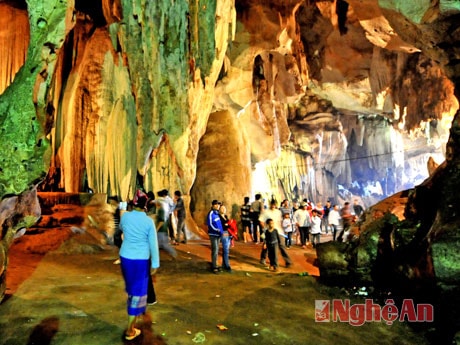 |
| Tourists visiting Bua Cave. Photo: Sy Minh |
Tham Om Cave lies halfway up Tham Mountain, a deep, winding cave resembling a "corridor" xuyên through the limestone mountain, leading to Ton That Cave, another cave with the magnificent beauty of stalactites and layers of red and yellow sediment. The deeper you go, the more Tham Om divides into many branches, with streams and smooth, flat sandy plains. In the past, ancient ape-like humans left this arid land to seek refuge in the river deltas...
Chau Thuan today
Upon arriving at the entrance of Chau Thuan commune, we met Mr. Vi Thanh Hoai, the commune's cultural officer. We greeted each other warmly, and Mr. Hoai asked permission to hang up the remaining banner encouraging everyone to actively preserve the cultural traditions of their homeland. After finishing the task, he took us on a tour of the 10 villages to show us the changes in the commune. Mr. Hoai shared: "Economically, Chau Thuan is still poor, but in the socio-cultural field, it's very 'rich.' The movement to build cultural communities is thriving, with 9 out of 10 villages achieving the title of 'Cultural Village.' Chau Thuan is one of the cradles of traditional Thai culture in the northwestern region of Nghe An. Today, the locality still preserves the tangible and intangible cultural features of the Thai people, such as the Nhuon and Xuoi folk songs, the Khac Luong dance, the gong culture, the rice wine culture, and the housewarming ceremony." The rituals of worshipping Heaven (Pu Then) and honoring those who contributed to the founding of the village (Pu Ban, Pu Muong) are still performed in the form of "Xen Muong, Xen Ban" every spring. The majority of Chau Thuan's inhabitants still preserve traditional cultural characteristics such as their houses (90% of the houses in the commune are stilt houses), clothing, and cuisine. Above all, the people here are especially hospitable. With its scenic spots, legends, and unique cultural features, nowhere is more suitable for tourism development than here. Sadly, Muong Chai remains like a sleeping princess hidden deep in the mountains.
Chau Thuan is now bustling with the new rural development movement, serving as a model commune in Quy Chau district. From the top of Kem Kho mountain, one can gaze out over the entire Muong Chai valley and see the cascading white water of Khe Chai waterfall; the inter-district and inter-commune road system has been expanded, renovated, upgraded, and paved with concrete. Major roads have been opened, motorized vehicles are increasingly common, the system of kiosks is becoming more diverse and abundant, and service activities are gradually changing; sugarcane is being harvested on the hillsides, and rice has been planted in the fields; in the villages, the elders are urging the younger generation to continuously preserve and promote traditional cultural identities, customs, and moral standards, while eliminating outdated customs, social evils, and fostering a spirit of mutual support, solidarity, and assistance to improve economic life. It is known that all 10 hamlets in Chau Thuan commune have established regulations specifying clearly the rights, responsibilities, and obligations of all citizens living and working in the area.
Spring has arrived in Muong Chai. Hang Bua is about to hold its festival. With the determination of Quy Chau district to promote tourism, it is hoped that many investors and tourists will come to this place. And then, the season of joy will arrive, and the "princess" in Vi Thanh Hoai's dreams will be awakened…
Chung - Duong


