
Dynamic Nghia Dan
Bold in choosing investment directions; flexible and dynamic in implementation methods, just four years after the district was separated to establish Thai Hoa Town, Nghia Dan District has already emerged with a new stature, transformed according to the orientation of becoming the development center of the Northwest region.
(Baonghean)Bold in choosing investment directions; flexible and dynamic in implementation methods, just four years after the district was separated to establish Thai Hoa Town, Nghia Dan District has already emerged with a new stature, transformed according to the orientation of becoming the development center of the Northwest region.
Anyone who visited Nghia Dan district shortly after its establishment would be surprised by the rapid changes. The Ho Chi Minh Trail leading to the district center, once a small, potholed road, has been replaced by a wide, smooth asphalt road with a complete system of welcome gates and streetlights. Nghia Dan town, established on the basis of most of the land of Nghia Binh commune and the former 1/5 State Farm, has also undergone significant transformation. The system of food and beverage services, restaurants, guesthouses, and banking services has also sprung up simultaneously, creating a new look and meeting the increasing transaction and exchange needs of the people. The district now has a comprehensive and well-developed administrative center, facilitating work for officials and facilitating easy transactions for citizens, contributing to a new image and stature for the district.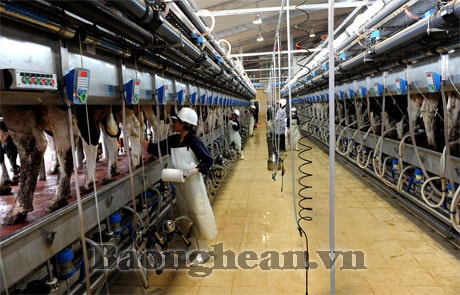
Automated milking line at TH Dairy Farm.
In the field of attracting investment, Nghia Dan's greatest achievement after its separation is the gradual and effective implementation of the TH Group's large-scale industrial dairy farming project. After nearly three years of implementation, this large-scale industrial dairy farming project has created new prospects not only for Nghia Dan but also for the entire western region of Nghe An province, enhancing the application of new technologies to increase value and improve land use efficiency. Currently, the dairy farm has nearly 25,000 cows, of which nearly 10,000 are producing milk, generating commercial milk value and increasing the investor's reinvestment capacity. Recognizing the importance of the project in promoting economic restructuring and raising awareness among officials and people, Nghia Dan has actively participated and provided support and favorable conditions during the project's investment and development process, such as land clearance and resettlement planning for residents. On the land handed over by the district and relevant units to the investor, TH Milk Joint Stock Company has gradually put it into effective use, proactively creating a local feed source for its dairy herd. In early 2013, with the commissioning of phase 1 of TH Milk Joint Stock Company's milk processing plant, the entire production process will be completed, bringing high economic efficiency and contributing to economic growth and structural transformation.
Besides the concentrated dairy farming project, TH Group and Bac A Bank have also invested in several other projects in the district, such as: a clean vegetable farming project, a medicinal plant cultivation project, and an MDF wood project… Notably, the province and the Ministry of Agriculture and Rural Development are submitting to the Government a plan for the “Nghia Dan High-Tech Agricultural Zone,” creating new prospects for investment in applying new technologies and improving the efficiency of using hilly and basaltic red soil resources in the western region. Another success of Nghia Dan in attracting investment is the formation of the Nghia Long industrial cluster, covering 20 hectares, which has attracted two businesses: Phuong Nguyen Company, which produces and processes wood, and Toan Cau Company, which processes ultra-fine limestone powder for export.
At this time, visiting Nghia Dan, one can clearly see that the area is wearing a new coat of color thanks to the enthusiasm of the people in the communes and villages in building new rural areas and consolidating land plots. In Nghia Khanh commune, one of the two communes in Nghia Dan selected as a pilot commune for land consolidation and reallocation to implement the criteria of building new rural areas this time, Nghia Khanh, formerly associated with the historical relic of the Lang Tru banyan tree, a symbol of the revolutionary movement and the place where the first Party branch in the Northwest region was established, is now being infused with the spirit of leading the way in land consolidation and reallocation, implementing the construction of new rural areas.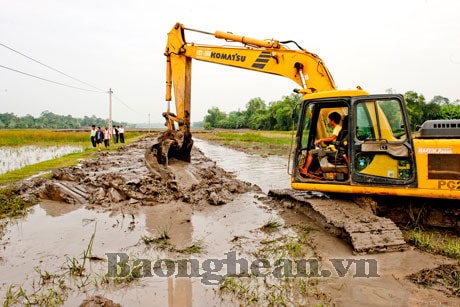
Implementing land consolidation and exchange for the new rural development program in Nghia Khanh commune. Photo: Sy Minh
To gain the support and contributions of households in land consolidation and exchange for the construction of new rural areas, the commune Party Committee issued a specialized resolution on new rural construction, emphasizing the significance of land consolidation and exchange. The commune People's Committee concretized this with a feasible plan. The land conversion plan and methods were brought to the hamlets for democratic discussion among the people. Where people did not understand, officials directly explained, and Party members set a good example by actively leading the way. Thanks to this comprehensive solution, most households in the hamlets actively agreed to implement it. From a situation where a household had 5-6 fragmented plots of land, or even 2 plots in one area, Nghia Khanh has reduced each household to 2 plots of land (one high-lying plot and one low-lying plot) with the smallest area being 500m2 and the largest about 2,000m2.
It can be said that the initial success in building new rural areas in Nghia Khanh commune is creating a vibrant atmosphere for the Nghia Dan District Steering Committee to continue urging its widespread implementation in the remaining communes of the district. Nghia Dan clearly identifies the implementation of new rural area construction according to the criteria as an opportunity for the district to change the face of rural areas and agriculture. Depending on the conditions of each commune, the district and commune steering committees choose the most effective implementation contents to prioritize. While Nghia Khanh and Nghia Lac communes are two pilot communes in land conversion, with Nghia Khanh commune having achieved breakthrough results and learned valuable lessons, Nghia Binh and Nghia Long communes, chosen as pilot areas for rural road construction, are also urgently completing their projects according to schedule with cement support from the province. Twelve communes have implemented production development support models that are beginning to show effectiveness, such as: chicken and pig farming models in Nghia Tan commune, beekeeping and pig farming models in Nghia Hieu commune, and agricultural mechanization models in Nghia Long commune… Other communes, based on their actual conditions, have also effectively integrated items according to the criteria and have renovated 7 cultural centers, mobilized more than 4 billion VND to build additional school facilities, and upgraded commune health stations...
In 2012, despite difficulties caused by the economic downturn at the national and provincial levels, complex weather patterns, and outbreaks of diseases affecting livestock, poultry, and crops, the Party Committee and people of Nghia Dan district, encompassing all ethnic groups, strived to successfully implement socio-economic development tasks in the area. Basically, all targets set by the District People's Council were met and exceeded, with some indicators showing significant increases, such as: Total production value reached 1,016,500 million VND, an increase of 13.33% compared to the same period; average production value per capita/year reached 21.5 million VND, an increase of 10.25%; total budget revenue in the district reached 34,698 million VND, equivalent to 165% of the District People's Council resolution and 200.17% of the provincial plan; the poverty rate decreased by 2.45%, down to 20.55%...
In the agricultural sector, thanks to clearly defining agriculture as the driving force for sustainable development and growth, Nghia Dan not only facilitates investors in deploying and applying new technologies in agricultural production but also implements many agricultural, forestry, and fisheries extension models with outstanding economic efficiency. Typical examples include the integrated pest management model for sugarcane grassy shoot disease on 10 hectares in Trap hamlet and 2 hectares in Xuan 2 hamlet (Nghia Lien commune); the GAP-compliant pig farming model in Nghia Hoi commune involving 12 households with 50 breeding pigs; and the goat farming model in Nghia Lac commune with 991 goats, bringing high economic benefits, with an annual income of approximately 50-70 million VND per household with a total herd of over 50 goats per household, creating favorable conditions for poverty alleviation. The service and trade sectors also experienced strong growth, with many types of activities showing significant increase. The estimated production value reached 181,800 million VND, a 24.69% increase compared to the same period last year. Currently, there are 19 operating markets in the area, including one level 3 market. Upgrading is underway for four markets in Nghia Mai, Nghia Tho, Nghia Loc, and Nghia Thinh communes. The total retail sales turnover is estimated at 183,833 million VND, a 25% increase compared to the same period last year…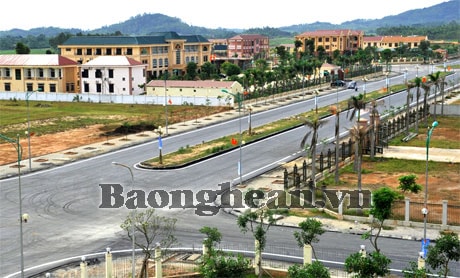
The new district administrative center has been put into operation.
Discussing the socio-economic development orientation for 2013, Mr. Vi Van Dinh, Chairman of the Nghia Dan District People's Committee, affirmed that Nghia Dan will focus on seizing opportunities, overcoming difficulties, and leveraging internal resources to improve the quality of sustainable growth, effectively mobilizing and utilizing resources for building new rural areas. The district will significantly improve the investment environment, apply mechanisms and policies to support production development, and assist businesses in developing their production and business activities, striving to successfully implement the 2013 socio-economic development plan, creating momentum for achieving the goals of the 2011-2015 socio-economic development plan; ensuring social security and welfare, improving people's lives; maintaining political stability, and ensuring national defense, security, and social order.
Huu Nghia


