
Raising awareness about prenatal screening.
(Baonghean)Each year, Nghe An province sees the birth of over 50,000 children, of which 1.5-3% are born with congenital birth defects due to genetic factors. One of the key solutions to mitigate these harmful effects is prenatal and newborn screening…
A recent population survey revealed that our province currently has nearly 13,000 children with disabilities (accounting for 1.6% of the total number of children aged 0-16), and on average, about 850 children are born with congenital defects each year (accounting for 1.9% of the total number of children born annually). Hundreds more children are disabled due to other causes. This poses a significant challenge for all sectors, levels of government, and families in ensuring these children's normal physical and mental development, as well as their ability to learn and integrate into the community. It also increases the burden on families and society, impacting the quality of the population.
Due to the lack of a prenatal screening center, detecting congenital birth defects in our province has been difficult in recent years. In fact, only 35.81% of pregnant mothers undergo regular ultrasound and prenatal check-ups. The rest have missed this crucial screening period for early intervention and detection of fetal abnormalities. Meanwhile, some diseases, if detected and treated early in the fetal and neonatal stages, can help children develop normally or avoid severe physical and intellectual consequences. Intervention and treatment of diseases in the fetal and neonatal stages is a positive approach to reducing the rate of disability and intellectual impairment in the population.
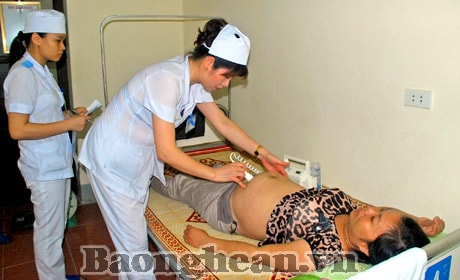
Prenatal check-up for pregnant women at the Provincial Center for Reproductive Health Care. Photo: Tu Thanh
With the goal of having 15% of pregnant women screened prenatally and 30% of newborns screened by the end of 2015, since 2011, the project "Improving the quality of the population through propaganda, mobilization, early detection and intervention of birth defects and diseases in fetuses and newborns" has been piloted in 30 communes in 5 districts: Hung Nguyen, Dien Chau, Yen Thanh, Nghi Loc and Cua Lo town.
In Nghi Loc district, right from the start of this project, the Population and Family Planning Center has carried out many communication activities such as disseminating information through mass media, organizing training courses, thematic talks, and providing direct counseling to pregnant women, mothers, and related individuals participating in prenatal and newborn screening. Regarding this activity, Mr. Pham Ngoc Khanh, Deputy Director of the center, said that the most difficult challenge was persuading families to take blood samples from their children's heels for testing, because: "They understand what we say, but it's not easy to convince them to agree because every family feels sorry for their child, loves their child, and fears that their child is too young. Meanwhile, according to regulations, blood must be taken from newborns within 24 hours, and each time, three drops must be taken from the child's heel."
Visiting the Obstetrics Department at Nghi Loc District General Hospital and listening directly to the doctors and midwives advising the families of pregnant women, one realizes that this job is not simple at all. Many cases require nearly 30 minutes of persuasion, and just as they manage to convince the pregnant woman, they face opposition from the grandparents. To gain everyone's trust, midwife Dang Thi Hoi always uses her own child's case to convince them. With such perseverance, in the first six months of 2013, they successfully collected blood samples from 300 newborns (accounting for half of the total number of births). Dr. Nguyen Thi Thu Ha – Deputy Head of the Obstetrics Department – even joked: "Convincing one family to agree is more difficult than handling a difficult delivery."
The implementation process at commune health stations and hospitals also revealed several other difficulties, such as: Due to the considerable distance between health stations and post offices in some districts, and the requirement to send samples to the Prenatal Screening Center and the Central Obstetrics and Gynecology Hospital within 24 hours, many health facilities were not enthusiastic about collecting and sending samples; in some places, blood samples were collected but only sent to the post office once every few days, resulting in low accuracy. Some localities implementing the model did not pay enough attention to communication, and many pregnant women did not have full access to information about prenatal and newborn screening…
Of the 2,760 blood samples sent to the Prenatal Screening Center, Central Obstetrics and Gynecology Hospital, 30 samples showed G6PD deficiency requiring timely monitoring and treatment (G6PD deficiency can cause jaundice, leading to potentially fatal brain diseases, or neurological complications, mental and motor developmental delays)...; there were 5,301 ultrasound examinations, of which 89 cases of pathology were detected, 80 pregnancies were terminated, and 9 cases were referred for monitoring and treatment.
Therefore, it is clear that prenatal and newborn screening is extremely important. Because of this, since 2013, instead of only implementing the project in 5 districts and towns, our province has decided to expand it to all 21 districts and towns. This is truly a great opportunity for mothers and newborns to minimize the risk of birth defects during pregnancy and after birth. The important thing now is to strengthen public awareness campaigns, increase advocacy, and provide counseling so that everyone understands and considers this a normal practice to ensure their children are born healthy.
My Ha


