Throw-in
(Baonghean) - Every year-end, the staff of a certain agency have the opportunity to gather together for a meeting to review performance and rank achievements in emulation campaigns.
These meetings are usually very lively, and they almost always end with a drinking and singing session, with the host rarely being someone who has just been voted outstanding. It's understandable; after three hundred and sixty-five days of "battle," only at the end of the year do we have a chance to fully chat and reminisce. It would be a waste if we didn't talk, laugh, or get angry. The performance review is where each individual is forced to place themselves within the overall evaluation environment, to self-reflect and receive feedback, to examine their strengths and weaknesses in order to adjust, correct, and improve. In short, performance review is good and extremely necessary.
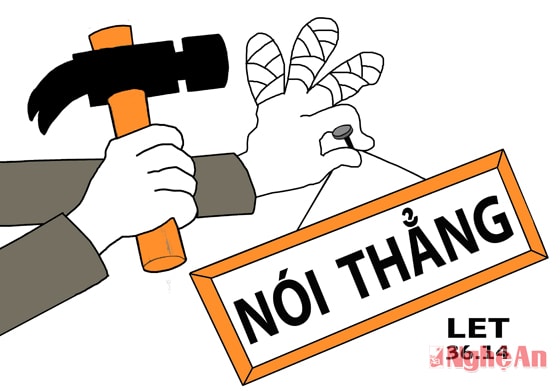 |
| Cartoon by: Le Viet Tri |
Generally speaking, that's the case, but in reality, review meetings can vary greatly from place to place. Many units hold serious meetings, offering frank and sincere feedback with a high sense of constructive criticism and responsibility. Those criticizing are open and unafraid, and those being criticized are willing to happily accept the feedback. The results of these meetings help people better understand who they are, where they stand, and which direction to take in order to choose the most appropriate next steps. However, alongside those agencies that do this well, it's regrettable that some units conduct reviews in a perfunctory and superficial manner. A few perfunctory comments, like, "Comrade Nguyen Van A is enthusiastic in his work but sometimes hesitant in criticism and self-criticism," are often offered. Some even encourage each other with phrases like, "I suggest you pay close attention to your health so you can continue to contribute to the community."
Worst of all, in some places, people exploit the review process to criticize, to nitpick, to find fault, even accumulating "attacks" for an entire year to unleash during the review, to ambush someone. It's terrible! And there are even units that "casually" turn the review meeting into a chaotic forum, where the speaker, the listener, and the moderator all broadcast simultaneously. From trivial matters to trivial ones, everyone takes turns rambling on in a disorderly fashion. Those who feel they have completed their tasks happily boast and show off their achievements… Those who anticipate their "low approval ratings" complain, make excuses, and offer "objective reasons" to gain sympathy.
Sometimes, every nuance of individual personality is laid bare before the collective through what's called a performance review meeting. Who is genuine, who is straightforward, who is reserved, who is frank, who is evasive, who is impulsive, who is subtle, who is kind, and even who isn't... all these aspects are subtly revealed behind those words of criticism. It's strange, but things that are perfectly normal on ordinary days suddenly become extremely serious if someone is unlucky enough to be "overestimated." Conversely, things that are "quite" serious suddenly become very normal, and a few laughs are enough to settle things. The results of these review meetings are usually not just empty promises, but of course, rarely effective.
Self-criticism is a fair assessment of the strengths and weaknesses of a group or individual, with the ultimate goal of helping them recognize their strengths and weaknesses so that they can continue to improve or overcome them. Self-criticism is absolutely not synonymous with "find and destroy." Disciplinary action after self-criticism (if any) is also a measure, not the goal of the self-criticism process. Self-criticism is not a place for criticism nor a place for praise. Only with sincerity can self-criticism fulfill its true mission.
Speaking of self-criticism, it reminds me of a story a friend told me about a colleague at his office. He was a deputy head of department, and he had a very unusual way of giving feedback. He didn't miss anyone, didn't let any minor shortcomings slip through his fingers, yet he never directly raised his hand to say, "I'd like to offer my opinion!" He did this so frequently, so skillfully, that he compiled a list of "offenses" and then urged someone else to speak up. The office jokingly called his behavior the "expert at throwing the border."
In football, if a player is unlucky enough to let the ball go out of bounds, they've essentially gifted the opposing team a throw-in. According to the rules, the throw-in must be outside the field and must pass the ball to another player. A good throw-in not only delivers the ball accurately for a teammate to attack, but they also know how to throw the ball at the opponent's back or head to regain possession. They might even throw it at an opponent's hands to win a free kick. Each time this happens, the stands erupt in a chorus of... "Oh!"
Of course, spectators only applaud throw-ins that are returned to the opposing team; this is called "returning the ball." The rules don't mandate this; they don't require the throw-in to "return the ball." But, it's about the spirit, the respect for the game, and ultimately, self-respect—what sports call fair play. The way some people at the office relate the deputy manager's criticism by "passing the ball to someone else" to giving feedback might not be entirely accurate, but it sounds interesting. In short, no matter where you are or what you do, "fair play" is what deserves praise.
Nguyen Khac An