
Traditional Hung My
(Baonghean) - Located close to Vinh City, Hung My commune (Hung Nguyen district) still retains the peaceful charm of a purely agricultural area, simple, rustic, and full of heartfelt affection. Here, the beauty of the countryside is preserved, serving as both a foundation and a driving force for the commune's development...
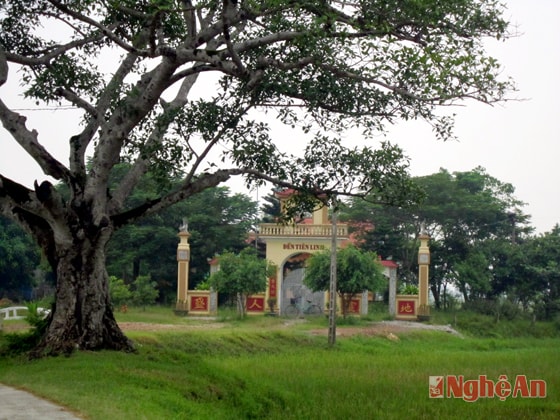 |
| The banyan tree and the roof of Tien Linh temple in My Thuong village (Hung My - Hung Nguyen). |
My Thanh has the Ngoc Hot Temple.
In Hung My after the harvest, flocks of ducks frolic in the fields, and herds of cows graze peacefully. The village roads are straight, and rows of trees stand silently in the cool late autumn air. Ancient, moss-covered tiled roofs nestle beneath the trees, surrounded by lush vegetable gardens. All of this evokes a sense of tranquility and peace, yet is brimming with life. Looking towards Vinh, one can clearly see the towering buildings springing up. From here, it takes about 10 minutes by car to turn towards Hung Chinh commune, then follow National Highway 46 south; or take the Vinh bypass, then turn towards Cua Tien bridge to reach the city center. The North-South railway line runs through this area, and the Vinh bypass is bustling all day long. But upon entering the village, the sounds and rhythms of the city, of trains and buses, vanish without a trace, giving way to the sounds and rhythms of a tranquil countryside...
Upon arriving in My Thanh village, we came across a rather spacious and recently restored communal house, which the locals call Ngoc Hot Temple. Fortunately, an elderly man was standing in front of the temple gate, his eyes fixed as if in a dreamlike state. He was Phan Xuan Hap, nearly 90 years old, whose house was not far from the temple. Mr. Hap was one of the oldest people in the village, his mind still quite sharp, and he remembered a lot of information about the village temple. “Ngoc Hot Temple was built during the Late Le Dynasty, about six centuries ago. The deity worshipped in the temple is Trung Lang Bo Linh Dai Vuong (Ly Thai), a famous general of the Tran Dynasty, revered by the people of Ngoc Hot village as the village guardian deity. During wartime, the temple was severely damaged, and the villagers contributed money and donations to restore it, completing it in the last few years…”, Mr. Phan Xuan Hap explained.
According to the elder mentioned above, the ancient Ngoc Hot village belonged to Do Yen commune, Do Yen district, Hung Nguyen prefecture, Nghe An province (now My Thanh village, Hung My commune, Hung Nguyen district), a culturally rich rural area. It boasts numerous cultural and spiritual structures such as communal houses, temples, pagodas, shrines, as well as ancient banyan trees and a riverside landing. All of these create the scene of a prosperous, comfortable village with a strong cultural identity. Among them, the most magnificent and sacred is the Ngoc Hot Temple. Legend says that the famous general Ly Thai made great contributions to the Tran dynasty in fighting invaders, defending the country's borders, and sacrificed himself in this land. When the Tran dynasty declined and the Le dynasty succeeded in leading the country, the spirit of this general remained loyal to the nation. Whenever the Le kings and generals passed through this area on their way to war, Ly Thai would appear in dreams to guide them on how to fight and achieve victory. Therefore, he was bestowed the title of Pho Bac Dai Vuong Trieu by the Le king and ordered the village of Ngoc Hot to build a temple in his honor.
Since then, generations of people in Ngoc Hot village have taken turns offering incense and maintaining the temple, truly transforming it into a center of spiritual and cultural activities during festivals and holidays. Currently, the villagers still preserve seven royal decrees from the Le dynasty kings. The content of these decrees all affirm the merits of the renowned general Ly Thai to the country and its people. This is the content of the royal decree issued by King Le Du Tong in the 6th year of the Vinh Thinh era (1710), translated as follows: "...Mountains and hills are imbued with sacred energy, heaven and earth give birth to auspicious energy, warding off calamities and bringing peace and prosperity, secretly assisting the people, bestowing blessings and fortune for a long time, secretly protecting the nation's stability. The deity has rendered many services of protection, yet why is he not mentioned in the historical records? Because Tu Vuong ascended the throne, residing in the palace to protect the state, consolidating the great foundation, according to the ceremony, he is granted additional rank, worthy of being further honored. Therefore, he is bestowed the title of Trung Lang Bo Lanh Ong, Pho Bo Quang Te, Chi Nhan Don Tin, Hong An Vi Luoc, Ta Tich Phong Cong, Hien Trung Chuong Nghia, Thuy Huu Ho Quoc, Bao Tri Dien Khanh, Minh Cam Linh Thong, Anh Doan Cuong Truc, Hung Uy Phan Vu, Anh Dung Te The, Phu To Bao Dan, Anh Qua Thong Nghi Dai Vuong."
The Ngoc Hot Temple was restored with a total cost of over 600 million VND, largely based on social contributions. Every month, on the 15th and 1st of the lunar month, without being told, the villagers come here to clean and beautify the temple grounds, then light incense and offer prayers. In the middle of the 7th lunar month, a grand ceremony takes place at the temple, and villagers and their descendants who are working or studying far away return to attend the ceremony for blessings and peace. After many years of waiting, the people of My Thanh village now have a place for cultural and spiritual activities and community gatherings, from which to build and strengthen the village tradition and cultivate pride in their homeland's traditions for future generations.
My Thuong has the Tien Linh Temple.
From My Thanh village, we traveled up to My Thuong village. The village road was paved and spotless, and in the distance, a large, ancient banyan tree cast its lush shade. The banyan tree stood at the edge of the village, majestic and solemn, with a vast, open field stretching as far as the eye could see. A few dozen meters behind the banyan tree stood a small temple, recently restored in the ancient architectural style; its tiled roof and triple-arched gate still seemed to retain the scent of paint. It was the middle of the lunar month, approaching the full moon, so several elderly villagers from My Thuong gathered at the temple to mow the grass in the grounds and tidy up the worship areas. The sounds of drums and gongs suddenly rang out, echoing throughout the space. A fragrant aroma permeated the air, carried by the breeze across the open fields. Above the triple-arched gate, the words "Tien Linh Temple" were clearly written in Vietnamese. It can be said that the banyan tree and the temple roof have given My Thuong village an ancient charm, embodying the cultural values of traditional villages, evoking a sense of hierarchy and order that the ancients often called "local customs and traditions."
While cleaning the area in front of the temple gate, Mr. Ho Thuc Hanh (85 years old) greeted the visitors with a kind smile. Upon learning that they wanted to learn about the traditional culture of his village, Mr. Hanh was delighted and shared: “The village used to have many ancient structures, but time and war destroyed them. This Tien Linh temple was restored just four years ago. As for that banyan tree, it’s been there for a very long time. Last year, a research team came and determined it to be about 200 years old.” According to Mr. Ho Thuc Hanh, since he was a young boy, he had seen the banyan tree standing majestically and solemnly, not much different from how it is now. Under the tree, an old woman sold drinks and some snacks, and passersby would stop to rest in its shade and chat lively. As he grew older, he and his peers would climb the tree to catch bird nests or simply sit and sing. Then one day, the villagers gathered in large numbers under the banyan tree, holding banners, and marched towards the district town.
At that time, being very young, Mr. Hành didn't know what was happening. Later, his father told him that those were the turbulent days of the Nghe An - Thinh Hoa Soviet Uprising. Exactly 15 years later, that scene reappeared. By then, Mr. Hành was a young man, standing alongside the villagers in the general uprising to seize power. During the years when American bombs rained down on the village, countless houses were destroyed, countless gardens were devastated, but the banyan tree in My Thuong village still maintained its majestic posture, defying the destruction of enemy bombs and bullets. Today, the ancient banyan tree remains a spiritual "pillar" for the people of My Thuong, especially those who live, work, and study far away. Before leaving the village, they often stop under the banyan tree as if to bid farewell and silently make promises. Upon returning, they stop at the banyan tree again as if to share their feelings after years away. The banyan tree has become a historical witness to the village, having seen countless ups and downs and transformations.
Regarding the Tien Linh Temple, Mr. Ho Thuc Hanh said that it is a place of worship for Cao Son Cao Cac, the deity who has blessed and protected the village. The temple has existed for a very long time; when he was a child, he often followed his father here to watch the ceremonies. Many villagers came, each bringing offerings to present at the altar to pray for good fortune and peace. Then came two protracted and fierce wars; young men enlisted in the army, women and the elderly were busy with production to support the front lines, and bombs rained down for many years. In the urgency and busyness of wartime, the villagers did not have much time to renovate, so the temple gradually deteriorated. After the war ended, the villagers had to worry about food, clothing, and education, so they still did not have the means to restore the sacred temple.
That has always been a source of deep concern for the people of My Thuong village. About 10 years ago, it was Mr. Hanh who spearheaded the effort to build a donation box to restore the Tien Linh Temple. He involved his descendants, and even those living far away sent money to contribute, showing their heartfelt devotion to their homeland. In the year of the Tiger (2010), the temple was restored and became a cultural and spiritual center for My Thuong village. The villagers were overjoyed; after years of longing and waiting, their sincere efforts had been rewarded. Those who had left their hometown now had a place to offer incense, and the younger generation had another opportunity to learn more about their roots, to forever preserve the customs and traditions of their village.
Outside the main hall are four Chinese characters, which Mr. Hành translated for me as "A land of spiritual energy and flourishing people." He further explained that the more commonly used phrase is "A land of spiritual energy and outstanding people," usually referring to a large rural area with many talented individuals. However, the Tiên Linh Temple belongs exclusively to Mỹ Thượng village, limited to a single village, so the elders used "flourishing people" instead of "outstanding people," showing both humility and the aspiration for a prosperous and thriving village life. The temple also contains many couplets, mainly praising the merits of ancestors and expressing the gratitude of future generations. Among them, we particularly appreciate the couplet: "For eternity, the sacred spirits save the world / For a thousand years, the incense smoke is a sincere heart."
We continued our stroll through the villages of Hung My to experience the peaceful and rustic charm of this suburban area. Here, dedicated individuals like Mr. Pham Xuan Hap and Mr. Ho Thuc Hanh, along with the responsible spirit of the villagers, will surely preserve the beautiful traditions passed down through generations!
Cong Kien


