
The ancient charm of Trung Can village
(Baonghean) - Following the dike on the right bank of the Lam River, we arrive at Trung Can village (Nam Trung commune, Nam Dan district) - an ancient rural area with a rich cultural tradition that has gone down in history: "Our village has many scholars/Like trees on the mountain, like kites in the sky."
The village boasts Trung Can communal house – one of the four famous communal houses of Nam Hoa, initiated by Dr. Nguyen Trong Duong in 1781, dedicated to the tutelary deity, Duke Tong Tat Thang. The communal house features a triple-arched gate, a five-bay main hall, and a three-bay rear sanctuary, situated on a 1,750 m2 plot overlooking the Gia Rao rice fields. Inside, the carvings and sculptures are exquisite and sophisticated, considered one of the most beautiful communal houses in Central Vietnam. For over two centuries, Trung Can communal house has served as a meeting place and ceremonial site for the village, visited by historical and cultural figures such as King Quang Trung, the great poet Nguyen Du, and the scholar Nguyen Sinh Sac. During the revolution, the communal house was used by cadres to organize speeches, call for struggle, and seize power. During the resistance war, the communal house served as a training ground for militia and guerrillas, a weapons production facility for Military Region IV (1947-1948), a place for re-educating European and African prisoners of war (1954), and a liaison station for transporting cadres, soldiers, and wounded soldiers serving the Southern battlefield...
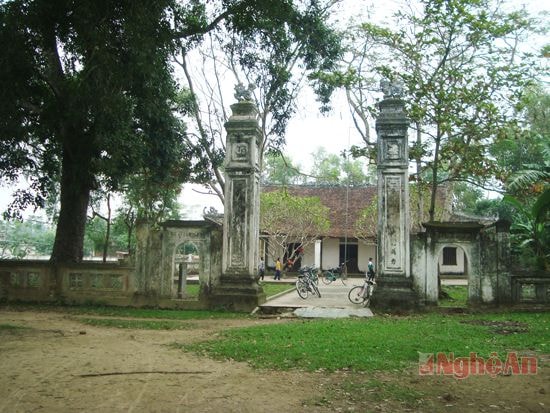 |
| Trung Can Temple. |
In front of the communal house is the tomb of Duke Tong Tat Thang (born 1487 - ?) - a child prodigy who passed the doctoral examination at the age of 18 and held the positions of Minister of Personnel and Grand Academician of the Eastern Pavilion during the Later Le Dynasty. He was a man of both literary and martial talents, who led troops to fight invaders several times, defending the southern border of the country; he also encouraged people to settle and establish villages, developing the land in Nghe An and Ha Tinh provinces. The tomb of Duke Tong Tat Thang and Trung Can Communal House have been recognized as National Historical and Cultural Monuments since 1996. To the right of the communal house is the memorial area for Minister Tran Quoc Hoan - the first Minister of Public Security of our country; all together they create a unique complex of historical and cultural relics.
Trung Can village is a place blessed with favorable conditions, attracting many families to settle and establish their livelihoods, fostering glorious traditions. The Nguyen Van family, proud of its "three generations of high-ranking scholars," is renowned for the Thám Hoa (third-ranked scholar) Nguyen Van Giao (1811-1863). The Nguyen Trong family, proud of its "three generations of five imperial envoys," is famous for three generations: Nguyen Trong Thuong (1681-1735), Nguyen Trong Duong (1724-1786), and Nguyen Trong Duong (1746-?), a father and grandson. All three Nguyen Trong family scholars from the Le dynasty were sent as envoys to the Qing dynasty, and their names are inscribed on the stele at the Temple of Literature in Thang Long (Hanoi)...
In the center of the village stands the Nguyen Nhan family ancestral temple, famous for Nguyen Nhan My, a high-ranking official and Duke of Trung Quan (during the Le Trung Hung period). He played a significant role in "supporting the Le dynasty and overthrowing the Mac dynasty," reclaiming barren land, and attracting people to settle and establish the village. The Nguyen Nhan family ancestral temple has a history of nearly 500 years and still preserves many ancient artifacts such as stone steles, royal decrees, and ceremonial objects (swords, dragon thrones, ancestral tablets, incense burners, etc.). During the feudal era, the temple received royal decrees from various dynasties; two decrees from the Nguyen dynasty still remain. The Nguyen Nhan family ancestral temple and the tomb of Duke Nguyen Nhan My were recognized as a Provincial-level Historical and Cultural Monument in 2004.
In Chùa hamlet, on the village fields, stands Quỳnh Hoa Pagoda (also known as Giai Pagoda), built during the Mạc dynasty with three imposing buildings, and Quỳnh Trai Temple (also known as Trúc Temple or Voi Mẹp Temple), dedicated to Trần Hưng Đạo, Tống Tất Thắng, and others. It features ancient stone bells and steles, listing the names of 15 dukes, princes, and marquises from the Lê-Trịnh period. In 2000, Quỳnh Hoa Pagoda was restored by the villagers right next to Quỳnh Trai Temple, creating a sacred temple-pagoda complex. In Bàu hamlet, next to a 7-acre lotus pond, hidden amidst dense trees, is Bàu Temple (Lum Tum Temple), built nearly 300 years ago, dedicated to Tống Tất Thắng and many other deities. According to the elders, in the past, south of the lotus pond was Hương Hiền Confucian temple, dedicated to Confucius and other sages. Opposite the lotus pond, further inside the village, is Võ Hội Shrine, dedicated to military generals, with majestic architecture, complete with a triple-arched gate, kneeling elephant statues, neighing horses, and three imposing buildings. The temple and shrine no longer exist; the old stele has been moved and re-erected at the village communal house. Today, these temples and pagodas have been renovated and beautified by the villagers, becoming centers of cultural and spiritual activity for the people in the region.
In Dinh hamlet, there is a well shaped like an inkstone, situated next to a strip of land resembling a pen. According to locals, these images symbolize the village's tradition of valuing education. In Chua hamlet, right on the inter-hamlet road, is the Quynh Trai well, which dates back to the hamlet's founding. The well not only provides a source of cool, fresh water for the village but also serves as an anchor for the soul of the homeland for generations. Today, the villagers have reinforced the well with stones, built a rampart, planted trees, and beautified the landscape.
Returning to Trung Can, it's gratifying to see this scholarly homeland flourishing day by day in its new rural landscape. Alongside the well-maintained roads and modern houses, the ancient charm of the village communal house, well, and temple courtyard remains. These relics and the notable figures of this "land of learning" have left a lasting impression of pride and admiration for the cultural and historical traditions of this region.
Huy Thu


