
The charm of Ha village
(Baonghean) - Following National Highway 46, on a journey to the countryside associated with the folk song "When will the Dung swamp end / When will the Rang swamp end / When will the Si swamp end," tourists should visit Ha village, Thanh Dong commune (Thanh Chuong district) on the left bank of the Lam River – a picturesque rural area with ancient structures…
The Lam River meanders through the alluvial plains, embracing the front of the village. Behind it are the Silver Mountain, the Temple Mountain, the Mua Mountain, and interwoven fields and villages, supporting each other. Ha Village has a long history, formerly known as Nguu Tu. It's unclear exactly when the village was founded, but it's known that the ancestors of the Nguyen Huu family settled here during the Mac Dynasty (15th century), and the village already existed then.
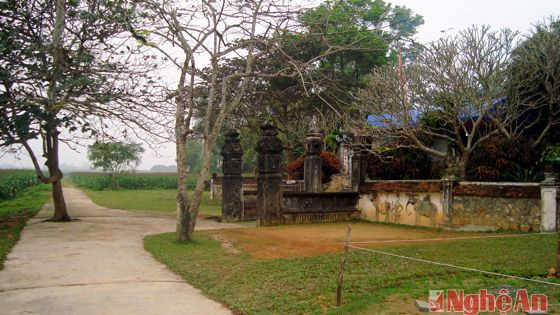 |
| Ba Chua Temple, Thanh Dong commune (Thanh Chuong district). |
At Chua Mountain, on the banks of the Lam River, was once the site of temples, communal houses, and pagodas, forming a complex of historical relics that were both beautiful in scenery and held a sacred place in the spiritual life of the people. At the foot of the mountain, under the shade of ancient trees, is the Ba Chua Temple, built by the people centuries ago to worship the Three Holy Mothers (Chua Lieu Hanh, Chua Thuong Ngan, Mau Thoai), Cao Son - Cao Cac, and Le Quy Cong. The temple has a symmetrical and harmonious architecture, consisting of a four-pillar gate, lower, middle, and upper halls, left and right wings; it is one of the most beautiful temples in Nghe An province. Ba Chua Temple was the place where the local uprising committee was established (July 1945); the weapons production site of the Military Region IV weapons factory (1947); and the place where the Central Military Political School was stationed and trained (1953-1954). This was a place where food, weapons, and ammunition were gathered and hidden during transport to the Southern battlefield (1965-1966)... Currently, Ba Chua Temple is a Provincial-level Historical and Cultural Relic; the Ba Chua Temple Festival is held annually in the third lunar month.
On the summit of Chua Mountain, right behind the Ba Chua Temple, lies the ancient Ngu Tu Pagoda. According to Mr. Nguyen Chi Tung (93 years old) – a pre-revolutionary cadre – Ngu Tu Pagoda had a large, beautiful gate facing the Lam River; the lower hall had three bays, with a set of wooden platforms on each side; the upper hall housed five Buddha statues… After more than half a century, only the stone bases of the old pagoda remained, silently nestled in the grass; in October 2014, the restoration of Ngu Tu Pagoda on the site of the old hall began.
Next to the Ngưu Tử pagoda is the Hạ village communal house, its gate facing the Cả temple in the center of the village. The old communal house was imposing: the upper house had two bays with three altars; the lower house had five bays, 24 pillars, brick flooring, surrounding walls, and a yin-yang tile roof. Inside, the rafters were intricately carved and sculpted, creating a light and elegant atmosphere. In the past, the communal house had drums, gongs, canopies, and ceremonial swords... Each year, two or three ceremonies were held at the communal house, praying for good health and a bountiful harvest. According to the elderly villagers, during the revolutionary days, the villagers gathered at the communal house before seizing power; afterwards, the communal house became a school in the "popular education" movement. Over the past few decades, the communal house is no longer in its original location; the upper house has been damaged, and the lower house, once used as a community hall, is now located within the grounds of the Thanh Đồng Commune People's Committee.
At Den Mountain, the remnants of the Ca Temple still remain, with its moss-covered walls and pillars. According to the elders in the village, the Ca Temple was once very sacred, with a triple-arched gate, statues of kneeling elephants and neighing horses, guards, and two shrines where people regularly offered incense. During the years when the French lost power, Japanese soldiers on their way back to Rang would still stop here to admire the temple. People participating in the revolution, from the village and the district, also came here to meet and discuss plans for the struggle… Ha Village is a “blessed land,” where many families settled and established their lives: Nguyen Doan, Nguyen Dinh, Tran Van… The Nguyen Huu family is famous in the village for its two sons: Nguyen Huu Giai, who studied at the National Academy and was appointed as the prefect of Gia Vien - Ninh Binh, and Nguyen Huu Xung (during the Nguyen dynasty), who was a successful scholar but refused a career in government to return to his hometown to teach. He lived a simple life, had many students, and was respected by the villagers.
On the outskirts of the village, there stands a centuries-old banyan tree with a gnarled trunk so thick it would take several people to encircle it. During the August Revolution, the people of Dai Dong gathered under this banyan tree before marching to the Thanh Chuong district headquarters to seize power. When Dung town was established (1984), a portion of the land of the former Ha village became part of the town. The banyan tree of Ha village, having weathered countless storms, remains lush and vibrant, a testament to the many changes that have taken place on this land. From the banyan tree, one can see the old Dung market with its bustling Nhot wharf. On the market, the French built a large communal house and rows of "muong" houses for traders. Dung market is one of the five large, long-standing, and famous markets of Thanh Chuong (Dung, Phuong, Chua, Rang, Ro). Six times a month, people from Dai Dong and surrounding areas, including Nam Dan and Do Luong, brought their produce from all over to exchange and trade here. After several relocations, the market has moved to the center of the village. Dung Market is not only a trading center, but also a place associated with countless joyful and sad memories for the people of Ha village.
In the countryside, which is gradually transforming into a city, there are still peaceful and tranquil spaces of banyan trees, riverside docks, and village communal houses. Visiting Ha village, the Lady Goddess Temple, and the Ngưu Tử Pagoda, tourists can admire the scenery of the Lam Giang River. The charm of the past, deeply rooted in the Vietnamese countryside, is sure to captivate hearts!
Text and photos:Huy Thu