
Unique features of Huoi Tu market
(Baonghean) - Huoi Tu market (Ky Son district) only has two market days each month, each lasting 3 to 4 days. Therefore, it's easy to understand why the market held at the end of December, just before Tet (Lunar New Year), was so crowded. From Muong Long, Na Ngoi, and Keng Du, everyone rushed to the market to shop for the upcoming Tet holiday.
On the first day of the year-end market in Huoi Tu, the sky blazed with the red hues of the sun. Although the sun couldn't completely dispel the lingering chill of winter, it was enough to draw the Mong people of Ky Son to the market. There were old and young, and even many students from the nearby secondary school, all dressed in vibrant, colorful traditional clothing. By midday, the entire market seemed to be dyed pink and green by the headscarves of the Mong girls. The Huoi Tu market, while not primarily a place to buy goods, is also known as a place for dating and matchmaking… Therefore, it's no surprise that the Mong people wear their most beautiful attire for this special occasion…
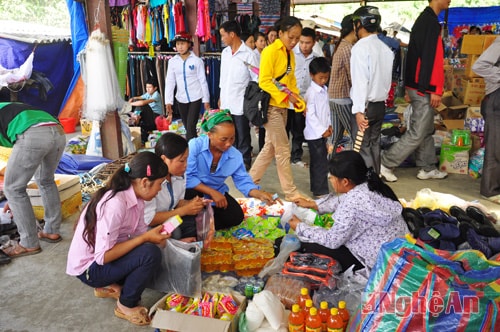 |
| A corner of Huoi Tu market (Ky Son) on market day. Photo: Tran Hai |
In terms of length, Huoi Tu market is only located along a short stretch of road. Therefore, if you just drive past, you can't fully appreciate the atmosphere of a highland market because the main stalls are often hidden behind other stalls. The market's appeal lies in these stalls themselves. Here, you can find both ginger and sweet potatoes – specialties of the highlands – as well as stalls specializing in dried goods like dried beef and sausages. However, the most popular stalls are those selling clothes. Usually, each stall is only about two square meters, so sellers have to make the most of every available space to display their merchandise. Because it's so cramped, it's difficult for customers to try on clothes, and people can barely walk through. On the last day of the year, the market was already packed with people, yet Ly Y Xenh, a student from Huoi Tu Boarding Secondary School, told me: "It's not even that crowded today." It was the last market day, and it was impossible to squeeze through the crowd.
Like many schoolgirls from the lowlands, Ly Y Xenh's favorite place to go is the stall selling imitation jewelry. The stall owner is Ms. Lau Y Co, a young woman from Muong Long 2 village. Y Co's goods aren't numerous, just a few hair clips, a couple of pairs of earrings, scarves, and hats, but it's always crowded because the owner understands the psychology of young girls. Speaking about her work, Y Co is quite shy because girls up here get married and have children as soon as they reach a certain age; few married women still go to the market like Y Co. Each market day, if she's lucky, she earns one or two hundred dong, but if there are few customers, only a few tens of thousands of dong. Thanks to that, Y Co has money to buy things for her family. She's much luckier during Tet (Lunar New Year).
Not far from Y Co's stall is the stall selling Hmong traditional clothing run by Ms. Gia Y Xua (Huoi Lien village, Dooc May commune). This stall also attracts many customers because most Hmong women love to beautify themselves. Whether rich or poor, whether they have many or few, they must have at least one traditional outfit to wear during Tet (Lunar New Year) or to festivals. The price of each outfit varies. A handmade outfit can cost from 2 to 3 million dong. As for items from Laos or China, a dress can be bought for just a few hundred thousand dong. Although Ms. Y Xua doesn't speak Vietnamese, she happily introduces her products to every customer. Many customers from the lowlands, seeing the unfamiliar Hmong clothing, ask to try it on, and she enthusiastically helps them…
The cases of Y Co and Y Xua are also rare at Huoi Tu market, because although it's known as a market for the Mong people, the vendors are mostly Kinh (Vietnamese). Le Viet Huan, who sells clothes at the market, is one of them. His main daily job is selling at Muong Xen market, but every month during the market day, he brings his goods to Huoi Tu. The journey is arduous, with many steep and winding roads, so trading in Huoi Tu is mainly handled by men. Only on occasions like New Year's do wives or children come to help. Another very special thing is that although there is now a paved road to Muong Xen, the Mong people don't have the habit of going to the town to buy goods; they still prefer going to the Huoi Tu market, even though the prices are higher and the goods aren't as diverse. Perhaps this is because the Mong people believe that going to the market isn't about shopping, but about going out to have fun, and only there can they truly experience the culture of their people. So it's not surprising to see a Hmong boy carrying his radio with him even while at the market. He walks along, playing lively music that fills the entire market with energy…
Vegetables, fruits, and mountain produce are another specialty of Huoi Tu market. This year, the weather has been quite favorable, so there's an abundance of vegetables for sale, each plant a vibrant green. People from the lowlands who come to Huoi Tu love buying pork, even though the fat is several centimeters thick. This pork comes from free-range pigs raised by the Mong people; despite the fat, it's not greasy but crispy, and the fat is white and fragrant. When stir-fried with green vegetables, the rendered fat is incredibly flavorful. Children are very happy at the market; some boys are carried on their mothers' backs, some hide behind their mothers' legs when they see strangers, and others clutch bags of popcorn, afraid someone might take them away… Young men look forward to market days to go to the food stalls, sip corn wine, and enjoy local specialties like grilled chicken, mooc (a type of fish), and lam nhong (a type of leafy vegetable)… The market gradually thins out after midday. At this time, those who had transported goods from the lowlands were also preparing to rearrange their cargo and head home, and the shops along the roadside were gradually closing. Only on the mountainside remained groups of people, burdened with heavy loads, making their way back up the mountain.
My Ha


