
Sacred features of Thua Sung village
(Baonghean) - The ancient and majestic Nguyen Trung Minh Temple in Thua Sung village, Dien Xuan commune (Dien Chau district), has been a source of pride for generations of the local people and their families. With its ancient architecture and various royal decrees and ritual objects preserved for hundreds of years, the temple truly deserves to be recognized as a Historical and Cultural Relic by the Provincial People's Committee.
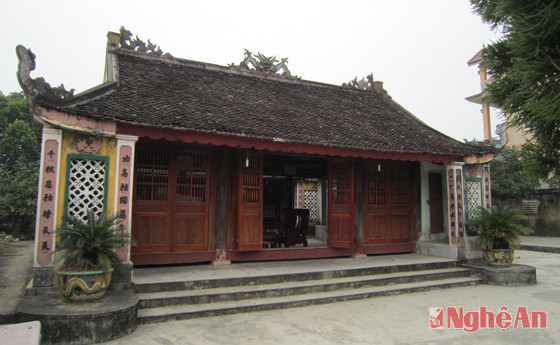 |
| The temple dedicated to Nguyen Trung Minh is located in Thua Sung village (Dien Xuan - Dien Chau). |
According to the genealogy of the Nguyen family in Thua Sung village and other preserved documents, this ancient temple is dedicated to Nguyen Trung Minh, a historical figure who served as the Protector of the Restoration. When the Le-Trinh feudal dynasty entered a period of decline, various factions rose up vying for power and profit, leading to prolonged warfare. The country fell into chaos, the people suffered from hunger and hardship, and were forced to migrate to various places to survive and escape disaster. The Nguyen family from Thua Sung, from the North, moved to Hoan Chau and chose the area as their settlement, establishing a village beside the Bung River. The descendants of the Nguyen family worked hard to reclaim land, build dams, and cultivate rice and corn, developing supplementary occupations. Thanks to this, hunger and poverty were gradually overcome, and life became increasingly peaceful. Seeing this, more and more people from the surrounding areas came to settle and establish their livelihoods, eventually forming the village of Ke Suong, belonging to Ly Trai commune, Dien Chau district. When the fields were fertile, the houses were full of rice and corn, life was prosperous, and the villages were peaceful, the descendants of the Nguyen family began to focus on studying and taking examinations, hoping to make a name for themselves in life. During the reign of Emperor Canh Hung, three members of the Nguyen family from Sung village were inscribed on the golden list of successful candidates.
As a fifth-generation descendant of the Nguyen family in Thua Sung village, Nguyen Trung Minh was renowned for his intelligence, quick wit, and profound knowledge of classical literature, as well as his compassionate and selfless nature. During his lifetime, he worked as a teacher and a traditional medicine practitioner, helping people dig ponds and wells, expand roads, build temples and shrines to care for their spiritual lives, and organize ceremonies during festivals and holidays. With his unwavering devotion to his village and clan, Nguyen Trung Minh wholeheartedly worshipped his ancestors and helped the common people, earning their respect.
Once again, the country was plunged into chaos and war, the people suffered greatly, and invaders threatened the borders. Despite his advanced age, Nguyen Trung Minh volunteered to join the army to save the nation. With his inherent talent and virtue, he gathered a large number of militia and people, and proceeded to build a base. Recognizing the unwavering loyalty, devotion, and strategic brilliance of this man from Hoan Chau, the imperial court entrusted Nguyen Trung Minh with the position of Governor of Son Tay, a strategically important area. In a fierce battle against a large and powerful enemy, he sacrificed himself to defend the city. To express his sorrow and commemorate his contributions, King Le Than Tong (Thinh Duc era, 1653-1657) bestowed upon him the title: "The local tutelary deity, upright and intelligent, bestowed with the title of Protector of the Restoration, further honored with the title of Protector of the Righteous, Valiant, and Wise, Virtuous and Benevolent Deity."
Later, King Lê Hiển Tông (1717-1786, reign name Cảnh Hưng) bestowed the title of Dực Bảo Trung Hưng upon Nguyễn Trung Minh and granted land to the people of Thừa Sủng village and descendants of the Nguyễn family to build a magnificent temple and mausoleum. During the Nguyễn dynasty, King Thành Thái issued a decree conferring upon him the title of “Dực Bảo Trung Hưng Linh Phù Chi Thần,” which included the following passage: “By imperial decree, in Nghệ An province, Đông Thành district, Lý Trai commune, Thừa Sủng village, we respectfully worship the deity ‘Bản cảnh thành hoàng chính trực linh thông chi thần,’ who has shown great efficacy and has never been honored before. Now, I, inheriting this great mandate, consider the merits of the deity as a general commanding troops, achieving outstanding results and glorious accomplishments, worthy of being conferred the title: ‘Dực Bảo Trung Hưng Linh Phù Chi Thần.’ May he continue to be worshipped as before. May the deity protect and safeguard my people.”
The Nguyen Trung Minh Temple faces the East Sea, nestled against a high and sacred dragon-shaped ridge. Its architectural style is considered characteristic of the Late Le Dynasty. Through centuries of upheaval and change, the temple still retains its rear hall, central hall, and worship hall, all constructed of ironwood. In 1999, the temple was recognized as a Historical and Cultural Relic by the Provincial People's Committee. Since then, the local government and descendants of the Nguyen family have continued to protect, preserve, and beautify the temple, ensuring its enduring presence and preserving the sacred heritage of Thua Sung village. Every year, on Tet (Lunar New Year) and the anniversary of the ancestor's death, descendants from all over return to express their gratitude and reverence for their ancestors. This is the cultural source that shapes the good character of the people, who, no matter what they do or where they live, always uphold the customs and traditions of their homeland.
Cong Kien


