
Russia 'won' the election in Türkiye.
(Baonghean.vn) - For the West, cooperation between Russia and Türkiye has always been considered a kind of "constant," an inevitable consequence. The British newspaper Newsweek commented: "Putin has won the Turkish election."
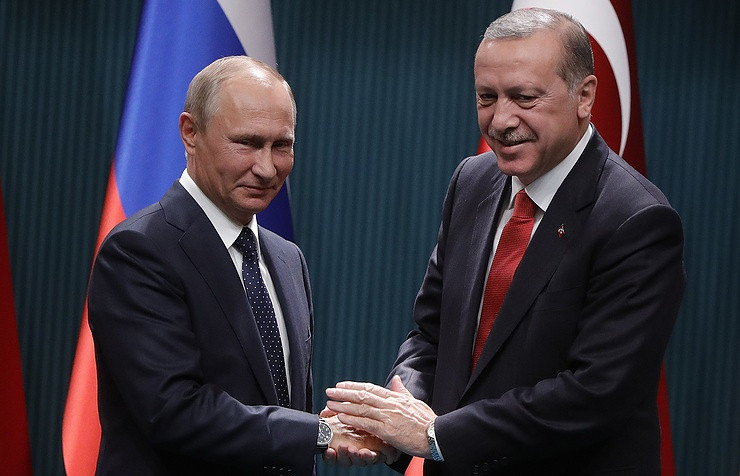 |
Russian President Vladimir Putin and Turkish President Recep Tayyip Erdogan. Photo: Tass |
Russia's most important foreign policy partner, Turkish President Recep Tayyip Erdogan, won a third term. This result was met with little joy in Western capitals, as they had secretly hoped throughout the Turkish presidential election that Erdogan's 20-year reign would come to an end. However, for Russia, this was highly significant.
In a telegram published on the Kremlin website, Russian President Vladimir Putin congratulated Tayyip Erdogan on his re-election as President of Türkiye.
"The election victory is a natural result of Erdogan's selfless work as the head of Türkiye, and clear evidence of the Turkish people's support for Erdogan's efforts to consolidate national sovereignty and pursue an independent foreign policy," President Putin congratulated in his message.
The Russian leader expressed his readiness to continue constructive dialogue on bilateral, regional, and international agendas. President Putin emphasized that Russia attaches great importance to the consistent implementation of planned joint projects, primarily the construction of the Akkuyu nuclear power plant and the establishment of a gas center in Türkiye.
For the West, this bilateral cooperation is seen as a kind of "constant," an inevitable consequence. The British magazine Newsweek commented: "Putin has won the Turkish election."
Western countries and the Turkish opposition believe that Moscow did indeed intervene to help Recep Erdogan win, including extending the Black Sea grain deal for another two months – which was seen as generating revenue for Turkish flour, as well as boosting Erdogan's reputation and standing as a mediator.
However, in reality, Russia did not interfere in any elections. The majority of Russian political scientists support President Erdogan, not because they see the Turkish leader as a "pro-Russian" politician, but because they see him as a "less harsh" figure. To Russian politicians, Erdogan is a pragmatic politician who has tried to avoid participating in the US and Western collective's plans for sanctions against Russia.
"Ankara has tried not to anger Moscow and to stay away from a sanctions war as much as possible. Türkiye, at the same time, has sought to protect its economic interests and assert itself as an 'honest mediator,' maintaining relative neutrality and good relations with all parties. Economically, this has helped double trade turnover with Russia, placing Turkey second, after China, in terms of trade with Russia in 2022," commented Pavel Shlykov, Associate Professor of the Department of History of Near and Middle Eastern Countries.
Either way, President Erdogan's re-election is of significant importance not only to Türkiye, but also to NATO, and to any world order that may follow the end of the Russia-Ukraine conflict.
The immediate problem facing the West is preventing President Erdogan from getting any closer to Russian President Vladimir Putin.
Immediately after winning the election, President Erdogan also pledged to implement the project to build an international gas hub in Türkiye, as previously proposed by Russian President Vladimir Putin.


