
Russia asserts its leading role in the fight against IS.
(Baonghean) - Iraq has just announced that Iraqi, Russian, Iranian, and Syrian military officials have agreed to cooperate on security and intelligence to counter the threat from the self-proclaimed Islamic State (IS) militant group. While public opinion is still speculating about the possibility of the US agreeing to expand the anti-IS coalition with the participation of Russia and Iran, Russia has shown its decisiveness and proactiveness. Furthermore, the fact that this information was released just before the meeting between Russian President Vladimir Putin and US President Barack Obama on the sidelines of the UN General Assembly meeting today (September 28) shows that Putin is indeed a formidable opponent.
The "preemptive strike"...
In recent days, there has been widespread speculation about Russian President Vladimir Putin proposing an initiative to build an expanded coalition to attack ISIS, including Russia, Iran, and Syria. The proposal suggests that if the US rejects this, Russia is prepared to unilaterally declare war on ISIS without being under US control. Of course, everyone understands that, given the extremely complex current Russia-US relationship, President Obama will have to consider this initiative very carefully. Especially since the intention to include Syria in the international effort against ISIS is completely contrary to US wishes. With the Russian and US foreign ministers having frequent phone calls about the situation in Syria recently, and with Putin and Obama set to meet bilaterally on the sidelines of the UN General Assembly, it is thought that the two leaders will discuss in detail the cooperation against ISIS, including the form in which Russia will participate in the fight against ISIS. This assessment is further reinforced by the recent statement by US Defense Secretary Ashton Carter that the US and Russia can find ways to cooperate in the Syrian crisis.
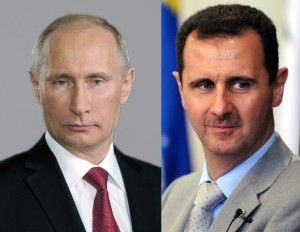 |
| President Putin will defend the Assad regime. |
However, once again Putin proved himself to be an extremely unpredictable figure – just as he was when he made the swift and unexpected decision to annex Crimea. Just two days before the meeting – whether intentionally or unintentionally – Iraq announced that its military officials had agreed to security and intelligence cooperation with Russia, Iran, and Syria to counter the ISIS threat. The announcement from the Iraqi Joint Operations Command stated that the cooperation agreement had been approved “in response to Moscow’s growing concern about the presence of thousands of Russian terrorists carrying out criminal activities alongside ISIS.” According to Russia’s Interfax news agency, the Baghdad Cooperation Center on security issues will be led by officials from the four countries on a rotating basis, starting with an Iraqi official. In addition, these countries will also establish a committee in Baghdad to plan military operations and command armed units participating in the fight against ISIS.
Of course, cooperation between Iraq, Syria, Russia, and Iran is not about announcing a new coalition against ISIS like the US did before, but this move is a very clear message from Russia: whatever the US plans, Russia is the one that decides its own course of action in Syria!
...and strategic calculations
Before this cooperation agreement was made public, there were reports that Syrian President Bashar Al Assad's forces had begun using Russian weapons, particularly drones, against ISIS. Russia also openly acknowledged its military presence in Syria, claiming that its arms supply and military personnel advisory roles were entirely consistent with international law. However, US intelligence predicted that Russia would not only provide military support to Syria but would soon order airstrikes to support the Syrian army and halt the advance of ISIS and other rebel groups. The cooperation with Iraq, Syria, and Iran against ISIS, without prior consultation with the US, demonstrates Russia's unwavering commitment to protecting President Assad's government – whether against ISIS or any other force.
For nearly four years, President Assad's ability to withstand and survive the crisis has exceeded international expectations, especially those of Western powers led by the United States. However, Russia has never publicly demonstrated its support for Syrian President Bashar al-Assad. But now that the Syrian army only holds 30% of the territory, and the international community recognizes resolving the Syrian crisis as an urgent matter—partly due to the extremely serious migration crisis in Europe—Russia has found it necessary to take a tough approach. Combating ISIS is one of three ways Russia is intervening in Syria, alongside providing weapons and transforming the Tartus naval base into a naval base and the Latakia air base into an air base. In this way, Russia not only protects the Damascus government from the threat of IS, but also from the danger posed by airstrikes from the US-led coalition.
Russian Foreign Ministry spokeswoman Maria Zakharova once stated that Russia's support was not for Bashar al-Assad personally, but for the legitimacy of the Syrian state. Russian President Vladimir Putin also emphasized: "Simply strengthening the current legitimate government, encouraging dialogue with healthy elements of the opposition, and implementing reforms will build a strong coalition in the fight against ISIS." Therefore, with his "quiet" approach to cooperating with Iraq, Syria, and Iran – close allies of Russia in the Middle East – Putin demonstrates Russia's strategic role in the region and its willingness to use military force to defend that role.
According to a White House statement, during today's talks with President Putin, U.S. President Barack Obama wanted Russia to clarify its initiative to form a multinational coalition against the Islamic State in Syria. From the U.S. perspective, "Russia's claim that increasing its military presence in Syria will stop the Islamic State is an untenable argument." But perhaps mere reasoning is no longer necessary, because Russia's actions are the most powerful message: whatever happens in Syria, Russia will be involved. And once again, Russia has proven to be a formidable player on the international stage that the U.S. cannot ignore in any political calculations, at least in Syria.
Thuy Ngoc


