
Russia and the US clash again over Syria.
(Baonghean.vn) - Last week, Russia's unexpected move to increase its presence in the Middle Eastern hotspot of Syria caused unease among the US and NATO. A war of words also resumed between Russian and American leaders. Why did Russia take such unexpected steps in Syria at this time? And does it reflect the West's fear that Russia will intervene militarily in Syria?
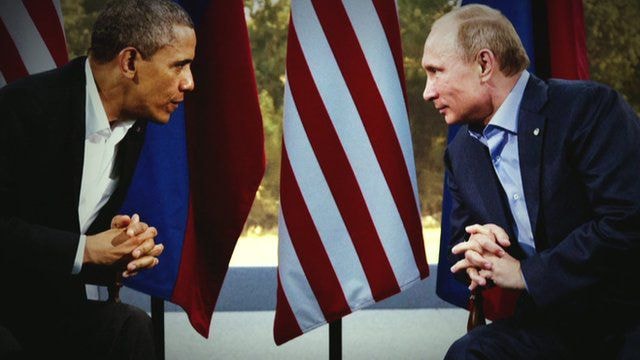 |
| Russian President Putin and his American counterpart Obama |
The war of words is heating up again.
After nearly five years of relative silence in communication and dialogue regarding the situation in Syria, the US and Russian foreign ministers have held multiple phone calls in the past week concerning reports of a sudden increase in Russia's military presence in Syria. For example, in a phone call with Russian Foreign Minister Sergei Lavrov on September 5th, US Secretary of State John Kerry stated that Washington was concerned by unconfirmed reports from the US media claiming that Russia was increasing its military presence in Syria. However, on September 7th, Russian Foreign Ministry spokeswoman Maria Zakharova commented: "The Russian side has never concealed the fact that Moscow is sending military equipment to the Syrian government to help them fight terrorism."
Later on September 10th, in an interview with the TASS news agency, Russian Foreign Minister Sergei Lavrov reaffirmed this, emphasizing, “Russia is sending military equipment and humanitarian aid by aircraft to Syria in accordance with the contract signed between Russia and Syria. Depending on the type of goods transported by the aircraft, Russia will request permission from the relevant parties in accordance with international law.” In his statement, Lavrov also rejected the US accusation that Russia's support for President Bashar al-Assad's government only increases violence and that it condones the use of terrorist groups against a regime unpopular with the West.
On the US side, the tough stance was evident in President Barack Obama's statement on September 11th, when he said that Russia's decision to send advisors and military equipment to Syria would expand a "failed" strategy and could undermine efforts to restore peace in Syria. German Foreign Minister Frank-Walter Steinmeier also warned Russia against increasing military intervention in Syria, while NATO Secretary General Stoltenberg stated that Russia's actions would not contribute to resolving the conflict in Syria. Not stopping at warnings, in response, the US pressured countries near Syria, such as Bulgaria and Greece, to close their airspace to Russian flights last week.
What does Russia want by increasing its support for Syria?
Beyond the heated verbal exchanges and warnings between Russia and the US, Western and Arab media outlets last week published detailed accounts of Russia's concrete actions in increasing its military presence in Syria. Sources from Lebanon and Israel even claimed that Russian forces had actually participated in the fighting, deploying air power and small infantry units. For example, the Israeli military news site Debkafile reported that the world's largest nuclear submarine, the Dmitri Donskoy, departed from the North Sea on September 4th, escorted by two anti-submarine vessels, heading towards the Mediterranean and potentially reaching the Syrian coast in 10 days.
This submarine carries 20 Bulava intercontinental ballistic missiles with approximately 200 nuclear warheads. This information comes after Russian President Vladimir Putin's statement leaving open the possibility of military intervention in Syria. Previously, American media also reported that Russia had erected temporary housing for hundreds of people and mobile air traffic control stations. The US claims these temporary structures are intended to allow Russia to bring approximately 1,000 military advisors or soldiers to an air base in Syria.
In response to these reports, Russia issued a statement to clarify any doubts, stating that Russia's assistance to the Syrian government was nothing unusual. Simultaneously, reacting to information about the possibility of Russian involvement in the military campaign against ISIS in Syria, Russian President Vladimir Putin affirmed that Russia was considering all possibilities. The question now is, what is Putin calculating by publicly announcing support for Syria at this time, and do these recent actions mean that Russia is planning a worst-case scenario in Syria?
According to analysts, Russia, at its core, does not want war in Syria, for any reason whatsoever. On September 11th, Russian Foreign Minister Sergey Lavrov even called on other world powers to arm the Syrian army, arguing that this is the most effective way to combat the Islamic State (IS) militants wreaking havoc in the Middle Eastern country. Lavrov even emphasized the need for cooperation between Russia and the United States to avoid "unforeseen events" in Syria.
Observers explain this by suggesting that Russia is seeking to preserve its interests in Syria, which were established in the early 1970s. Specifically, Russia has a naval base in Tartus, its only one in the Mediterranean region, established in 1971. However, this strategic interest is under serious threat as recent developments in Syria have been unfavorable to President Assad's Damascus government.
Furthermore, Russia's declared support for the Syrian government also helps maintain a balance with the opposition forces. Not only that, Moscow's expressed willingness to join the anti-ISIS coalition is also aimed at improving Russia's relations with the US and Europe, leading to the lifting of Western sanctions and the normalization of relations with the US and the European Union (EU). In addition, President Putin is believed to be seeking to gain greater acceptance of Russia's role in the Ukraine crisis from the West, while strengthening Russia's influence and counterbalancing its power against the US in the Middle East.
What scenario does Syria face?
Clearly, at this time, ISIS terrorism, as well as a solution for peace in Syria, is a common concern for both Russia and the United States. However, despite having a common target, the methods and strategic goals of these two superpowers have long been, and continue to be, inconsistent. The crux of the matter is the removal of Syrian President al-Assad, which remains an unresolved issue. While Russia and Iran support Syria establishing a power-sharing government with the participation of opposition parties and allowing President Assad to remain in power, the US, European countries, and Saudi Arabia want Assad to leave.
For this reason, international diplomatic efforts to find a peaceful solution for Syria have been launched repeatedly over the past few years, but have not yielded the expected results. In his speech in Vladivostok, Russian President Putin called on all parties, especially the West and its allies in the Middle East, to cooperate with President Assad to definitively resolve the bloody civil war in Syria and jointly fight the common enemy, ISIS. According to the Russian leader, if the US responds to this call, the chances of success in the fight against ISIS will be higher, and it will also contribute to resolving the root cause of the current migration crisis from the Middle East and North Africa to Europe. However, this scenario is clearly unlikely to happen because the strategic interests of the US in Syria are unlikely to change; while the Obama administration is also under considerable pressure from its Middle Eastern allies to "force" Syrian President Bashar Al Assad to step down.
From Russia's perspective, while it has no desire for conflict and war in Syria, a country with significant interests, the increasing expansion of ISIS, coupled with the US and Western countries simultaneously launching airstrikes against ISIS and targeting President Assad, means that preparing for a worst-case scenario is not unnecessary for Moscow. However, if Russia, the US, and other major powers cannot regulate their attitudes and reduce their national interests, a Syrian civil war that has claimed over 250,000 lives and forced millions to flee their homes will likely continue. According to political experts, for many years, many governments have neglected human security for the sake of national interests. The current European immigration crisis is the clearest consequence of this. Therefore, there is probably not much time left for countries to hesitate in adjusting their strategies for Syria in particular and the Middle East in general. Otherwise, it will be too late!
Khang Duy
| RELATED NEWS |
|---|


