
Six-Way Intersection - The Crossroads of Childhood
(Baonghean) - When I was little, I lived with my grandmother. Her house was on Tran Phu Street, right overlooking the old Nga Sau market - now the city's central park. Every evening, my grandmother and I would walk hand in hand to the Labor Culture House, stroll around a few times, and have a glass of sugarcane juice. Every morning, she would get up early and ride her bike to do her morning exercises. I would sit behind her, drowsily yawning, and when we arrived, I would stand next to her and do my exercises like a little old lady. When the sun rose, we would ride home together, stopping by the Nga Sau market to buy vegetables and meat. My childhood flowed peacefully and regularly like the turning of the bicycle wheels as my grandmother carried me on a clear, pristine summer morning…
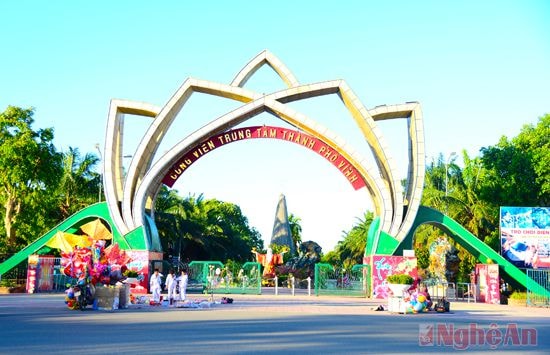 |
| Vinh City Central Park was built on the site of the old Nga Sau market. |
Perhaps the most boisterous and chaotic thing during my time in "Ngã Sáu"—the way people used to refer to the area where Trần Phú Street intersected with Lê Mao Street at that time—came from the mischievous antics of the neighborhood kids. It was a "group" of about ten kids, the youngest around my age, the oldest in middle school, who would excitedly call out to each other to play every evening. That's just a fancy way of saying it; in reality, we'd just sit in front of one of our kids' houses, play games, or chat aimlessly. Our favorite topics back then were only two things: bragging or badmouthing our parents and grandparents. Something like this:
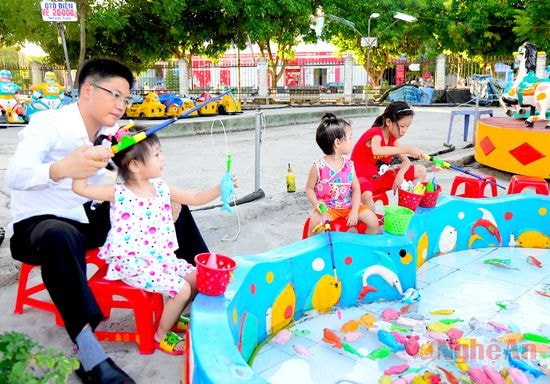 |
| A children's playground within the grounds of the Provincial Labor Cultural Center. |
"Today, my grandmother went to the Nga Sau market and bought me the best spring rolls in the world! She had to sneak me out into the yard so my mother wouldn't see!"
This is the story of the boy next door, whose mother made him go on a diet because she was afraid he would gain weight and wouldn't fit into his new uniform for the first day of the new school year.
-What's so great about spring rolls? My parents took me to ride the bouncy castles at the Club (the Provincial Labor Culture House)! I even got to ride the carousel!
-Going to the Club is still not as far as going to eat ice cream at Quan Lau Market! The ice cream in cups and by the scoop is absolutely delicious, my grandpa rewarded me for getting four perfect scores last week!
But this part is the real "climax" of the debate:
-Today, my dad was on leave and came home to visit, so he took me to the bookstore in front of the Nga Sau market to buy comic books…
That's Tí, who lives just across the alley from my house. His father works far away in the West and rarely comes home. His mother sells groceries in the Ngã Sáu market, and every afternoon after school, Tí rushes to the market to help her set up her stall. On parent-teacher meeting days, his mother has to frantically ask everyone she knows to look after the stall so she can attend. But mostly, she asks the teacher for permission to be absent, because the meetings are on Sundays and everyone is busy with their shops. The kids in the neighborhood always wish they were like him, because every time their parents come home from a parent-teacher meeting, they all get a good beating. At those times, Tí always sits at the front of the house, waiting for his sad-faced friends to come out, sobbing and complaining. Once, he couldn't take it anymore and blurted out, "I wish my mom would beat me once after a parent-teacher meeting..." The whole group, who had been shedding tears, fell silent, glaring and shouting, "You idiot! Of all the things you could wish for, you wished to be beaten!" He just chuckled, a laugh that sounded more like a grimace!
Yet, that time, he smiled brightly, pulling a Doraemon comic book from his pocket – the greatest dream of all the children in the neighborhood. They passed the magical book around, inhaling the scent of new paper and ink, gently flipping through a few pages before closing it again as if afraid the characters inside would be blown away by the wind. That day, Tí was overjoyed. But only for a few days, he was seen sitting dejectedly on the porch, his chin resting on his hand. The neighborhood children gathered around to ask what was wrong, and he burst into tears: “My dad has flown away to the West again…” So the characters in the comic book were still there, but Tí’s father had been swept away by some unknown gust of wind. Life was so sad!
All those memories flooded back into my mind on a summer afternoon standing in front of my grandmother's house on Tran Phu Street. Now, she's sold it to someone to open a wedding dress shop, and moved back to her hometown to enjoy her old age. Over a decade has passed, and this neighborhood seems to have lost all its old charm. The familiar neighbors have all disappeared; now, all I see are strange, unfamiliar shops and businesses… I recall the melancholic demeanor of the neighborhood children from the past, sitting with their chins propped up, gazing towards the Nga Sau market. But where is that familiar little market now? Across from me now is the Central City Park, built in 2005. Before that, in 2000, Ho Chi Minh Square also began construction, giving the city center a completely new look.
If there's any lingering trace of my childhood, it's probably the Provincial Labor Culture House, which we simply called the Club. The children's play area with its rocking horses, carousel, and electric cars is still there... And the spacious courtyard in front of the main hall – where I used to do morning exercises with my grandmother – is also still intact. I sighed, my heart overflowing with nostalgia and longing. Startled by the sound of cicadas, I looked up and saw the lush green foliage of the mango tree in front of the house, which has stood silently there since I was old enough to remember and understand.
No, perhaps the summer days of childhood still linger, leaving behind more than just fragments of memory. The rhythm of life in the houses along the street, the closeness and shared customs of the neighborhood culture, the hustle and bustle of the city center – the hub of major festivals and entertainment activities… all will remain forever in the minds of those who have lived, left, and come. Just as the name "Ngã Sáu" (Six-Way Intersection) will always be there, as an invisible landmark guiding us back to a gentle and dreamy realm of memories.
For some reason, when I think about that neighborhood, a place keeps appearing in my mind—both tangible and elusive, both distant and familiar. It's the sidewalk where little Tí sat crying after being scolded by his mother, stubbornly turning his face west so his father could hear him calling, "Dad, Dad!" It's the Ngã Sáu market where I used to trail after my grandmother every morning and evening, waiting for her at the bánh bèo stall, devouring everything without a trace, yet still not seeing her. It's the rooftop of the chubby boy's house—the highest in the neighborhood—where everyone gathered on New Year's Eve to watch the fireworks as if they were right before their eyes. A feeling so natural yet so powerfully binding, transcending the changes in space and time. It is family: each person's small family and the larger family where we were born, grew up, and grew old together on the same path, under the same canopy of trees. And so, without knowing when, a bond has taken root within us to the place where we belong - the land and its people.
Text and photos:Hai Trieu


