
Russia and China: Cooperation is inevitable.
(Baonghean) - Chinese Premier Li Keqiang's stop in Russia during his European tour is attracting international attention with 38 economic contracts worth tens of billions of dollars between the two sides. However, along with these large economic contracts, what the public is more interested in is the continuously strengthening relationship between Russia and China amidst Moscow's strained relations with the US and the West.
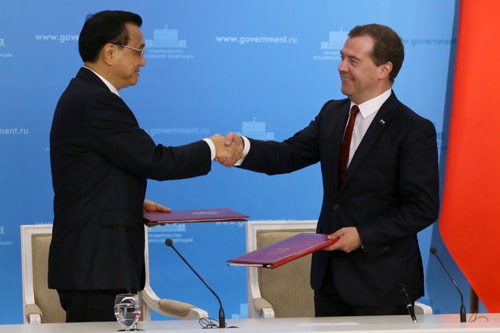 |
| Russian Prime Minister Dmitry Medvedev (right) and Chinese Premier Li Keqiang exchange cooperation documents in Moscow. Photo: AFP/VNA. |
The success of Li Keqiang's trip to Russia was not only marked by major economic agreements, but also by the flattering words exchanged between the leaders of both sides. Upon arriving in Russia, Li Keqiang boldly declared that the image of Russia's famous Matryoshka doll represented the immense potential for future cooperation between the two countries. The Chinese Prime Minister also affirmed that both Russia and China are determined to develop a lasting friendship, working together to maintain peace and stability in the region and the world. Furthermore, during his meeting with the Russian President and Prime Minister, China reiterated Beijing's support for Russia, consistently expressing its opposition to European sanctions against Moscow. In response to these statements, his counterpart Medvedev did not forget to express Russia's confidence in China, stating that cooperation with China and other Asian countries would open a way for Russia to avoid being affected by sanctions imposed by the US and the EU. Medvedev used the words of the Chinese Prime Minister to emphasize the relationship between the two sides, noting that Prime Minister Li Keqiang pointed out that both Russian and Chinese people enjoy playing chess, and those who know how to think strategically about the future are also very good at chess, and that is why we need to think about promoting relations between the two countries in the coming years.
It is perfectly understandable that Russia and China need each other and are drawing closer. With Russia facing significant pressure from the US and EU over the Ukraine issue, strengthening relations with other Asian countries, including China, is a natural progression. As each other's largest neighbor and a rapidly developing emerging market economy, China has been Russia's number one trading partner for the past four consecutive years and its fourth-largest source of investment. Especially in the context of increasing sanctions from the US and Europe against Russia, China's cooperation with Russia is also seen as a step to help Russia overcome its current financial and monetary difficulties.
"Joining forces" with Russia naturally brings significant benefits to China. While Russia may turn to China due to various pressures, China also has many reasons to do so. China's thirst for resources compels it to seek them out, and Russia is a crucial partner in diversifying its energy sources. The 30-year, $400 billion Russia-China agreement involving 38 billion cubic meters of natural gas, signed last May, and the 50 agreements signed this time, are a testament to the substantial progress in the strategic partnership and alliance between Russia and China. Furthermore, according to many analysts, this is also a "golden opportunity" for China. On the one hand, Beijing can reduce its energy dependence on suppliers from the Middle East and Africa; on the other hand, Chinese businesses can seize the opportunity to fill the gap in agricultural and consumer goods that are banned from import from Europe into Russia. This would also be a "once-in-a-lifetime" opportunity for China to become a key trading partner of Russia.
It is evident that the rapprochement between Russia and China not only opens a "new phase" in bilateral relations but is also seen as creating a new counterweight to the US and the West in both political and economic spheres. However, according to analysts, despite this mutual need, the results achieved between the two sides are only the tip of the iceberg. Behind this success, the Russia-China relationship still harbors many challenges, with trust being the most important factor. Clearly, Russia and China still need to continue building trust to accurately define their current relationship.
Thanh Hien


