
Preventing fishing using electric shocks.
(Baonghean)Fishing using electric shocks from batteries is a deadly threat to aquatic resources, yet this method of fishing has gone largely unchecked for a long time. This necessitates intervention from relevant authorities to prevent this situation.
The gloomy sky signaled an approaching thunderstorm. Scattered across the fields bordering Hamlet 9, Hung Loc Commune, and Phong Hao Hamlet, Hung Hoa Commune (Vinh City), seven or eight people, with batteries slung over their backs and electric shock devices in their hands, waded through ponds, ditches, and fields, using electric shocks to catch fish. Joining the "electric shock" team, I followed a man in his early 40s, tall and slender, with a friendly face. When asked his name, he simply replied: "Sy. Sy Diep." In Hamlet 9, Hung Loc Commune, Sy is considered a "professional" electric shocker.
Because, regardless of whether it's sunny or rainy, you can always see Sy with his fishing rod and battery immersed in the fields. When asked, Sy said he's been doing this job for 7 years. "I go fishing whenever I feel like it, but generally I go every day. On lucky days I earn a few hundred thousand dong, but normally it's only a few hundred thousand." As if to prove his point, Sy stopped and opened his basket of fish for me to see; it contained 10 snakehead fish and 2 eels. "Anyone who wants them, I'll sell them for 250 thousand dong," Sy said.
Catching fish using a battery-powered electric shock device requires a very simple setup: just one 12-volt battery, and two bamboo or reed poles about 1.5m - 1.7m long. The ends of the poles are fitted with two metal rods about 40cm long (usually steel or stainless steel) connected to the battery terminals by two electrical wires. The battery itself is placed inside a half-cut plastic container to prevent it from getting wet. Additionally, a battery charger is needed to charge the battery before going out to sea. Mr. Sy said that the cost of such a kit is about 2 million VND. It is known that in Hamlet 9, Hung Loc Commune, not only Mr. Sy but also many other households practice this fishing method. In Mr. Hien's family, both father and son work in this profession.
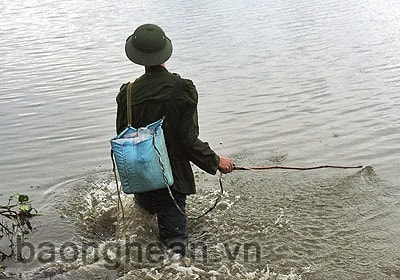
Using electric shocks to catch fish has become a "killer" in the rice fields.
Nowadays, using battery-powered electric shock devices to catch fish has become a daily habit for many households living near ponds, lakes, and rice fields. For example, in Phong Hao hamlet, Hung Hoa commune, many residents claim that every household owns a battery-powered fish shocker. On days with heavy rain and flooding, the whole village goes out to use the electric shock device. Some even use fishing rods or electric nets to catch fish. Mr. Nguyen Xuan Chung, from Hung Hoa, said: "The best part is on rainy and flood days, when the carp come to the water's edge to spawn."
"Some fishermen 'shock' the water and catch a ton, earning 3-4 million dong a day!" According to him, those who specialize in fishing with battery-powered electric shocks usually only catch snakehead fish, carp, eels, or other large fish. Tilapia and other small fish are largely ignored. However, when the electric shock is applied to the water, all fish and crabs within the shock range are affected. Therefore, this fishing method is considered a major contributor to the extinction of aquatic resources.
After days of searching, I finally found the house of a "specialist" in manufacturing electric fishing devices in Phong Hao hamlet, Hung Hoa commune (Vinh City). When I arrived, both Mr. and Mrs. Luu Vy were home. Seeing me inquire about buying a battery charger for the electric fishing device, Mr. Vy went inside and brought out a set, introducing it as a "rare, original type" salvaged from a Japanese electronic device. Meanwhile, his wife kept boasting: "Don't worry, sir, my family has been doing this for 30 years. All the electric fishing device battery chargers in this area are made by my family." A retired Level 4 mechanical engineer, Mr. Vy said that he began manufacturing and using electric shock devices to catch fish in 1975-1976.
He was the first to introduce this "method" of fishing to the community. He claims to have made thousands of battery chargers to date. "The machines I made are in Quang Binh, Ha Tinh, and within the province, in the districts of Quynh Luu, Dien Chau, Quy Chau, Tan Ky…". To further solidify her husband's reputation, Mrs. Vy added that several communes, including Hung Hoa, Hung Loc, and Hung Dung, use the chargers made by Mr. Vy. "Batteries need a charger; commercially available ones don't last more than 3 years, but mine is still working well after more than 5 years," Mrs. Vy said, adding impressively. According to the couple, making a charger usually takes more than half a day. Each charger sells for 400,000 to 450,000 VND. The original, high-quality Japanese models are offered for 500,000 VND.
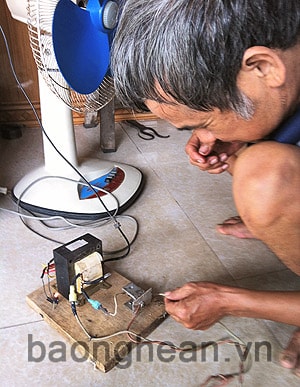
A battery charger.
It can be said that fishing using electric shocks is destructive. Aquatic life affected by electric shocks will not develop normally; small fish will die, and larger ones will have difficulty reproducing. Meanwhile, this fishing method has existed for many years without being stopped by any authorities. Naturally, not only are fish and crabs in rice fields at risk of disappearing, but many other aquatic species, organisms, and microorganisms are also facing the same fate. The risks of ecological imbalance, soil changes, and land degradation are also consequently high.
Text and photos: Dao Tuan


