
Preventing abuse of power and arbitrary actions in land management.
Discussion session on the draftamended Land LawYesterday afternoon, in the National Assembly hall, a series of frank opinions were expressed regarding the need to clarify when the state can reclaim land, the conditions and criteria for reclamation, the purpose of reclamation, and how to determine compensation values...
While the majority of speakers expressed strong approval ofland regulationsWhile land is owned by the entire population, some representatives also reflected the voters' aspirations regarding land ownership and management.
According to Huynh Van Tiep, Deputy Head of the National Assembly Delegation of Can Tho City: “Through gathering the vast majority of people's opinions, it is believed that the history and origin of land use, as well as the implementation of land policies, are a revolutionary achievement. Moreover, land is the result of the efforts of the entire Vietnamese nation in reclaiming and cultivating it, and the sacrifices made with blood and sweat. Therefore, I agree to continue to stipulate in the Constitution and the Land Law that land is the property of the entire people. However, to express the will of the entire people, with the National Assembly as its representative, I propose that the National Assembly should hold a vote on this issue.”
The Tien Lang Incident - A Lesson in Responsibility When Enforcing Laws
Regarding enforcement, implementationland reclamationThe draft law stipulates that the Chairman of the People's Committee at all levels has the authority to issue decisions on land reclamation and forced eviction; the People's Committee at the district level is responsible for implementation… Representative Nguyen Thi Kha (Tra Vinh) suggested that more specific regulations are needed, because in reality, if the Provincial Chairman issues a decision on land reclamation and forced eviction but many people disagree, a direct dialogue should be organized with those affected by the forced eviction to understand the reasons why, whether it is because their rights have been violated or because they have been incited by malicious individuals. “This will minimize financial losses and loss of human lives, as seen in recent cases, most notably the Tien Lang incident,” Representative Kha proposed.
Regarding the handling of land law violations, Representative Kha expressed the opinion that the law needs to further clarify the specific responsibilities of individuals and organizations in leadership positions who intentionally or unintentionally show irresponsibility when advising, proposing, or making incorrect decisions, as well as the responsibility of the head of the organization for violating land laws. Representative Dong Huu Mao (Thua Thien-Hue) pointed out that Chapter 6 of the draft law clearly stipulates the responsibilities of land users, but the responsibilities of state agencies in management are too vague. Representative Mao suggested that while the law grants significant authority to public agencies, it must also clearly define responsibilities to prevent abuse of power, misuse, and wrongdoing against those whose land is confiscated. According to Representative Mao, the provincial People's Committee's enforcement actions were inadequate, causing damage to people's interests—a very serious matter affecting the people—yet there are no specific provisions to restrict or ensure that the agency acts correctly.
Representative Bui Sy Loi (Thanh Hoa) pointed out that Article 12 of the Draft stipulates seven prohibitions, with six prohibiting land users while only one prohibits land management agencies. To prevent abuse of power, the representative proposed adding a clause prohibiting competent agencies and individuals from: refusing to provide information, providing false information, or obstructing or causing difficulties that affect the rights and interests of land users. "This would create equality, transparency, and prevent abuse of power by public authorities in land management," the representative suggested.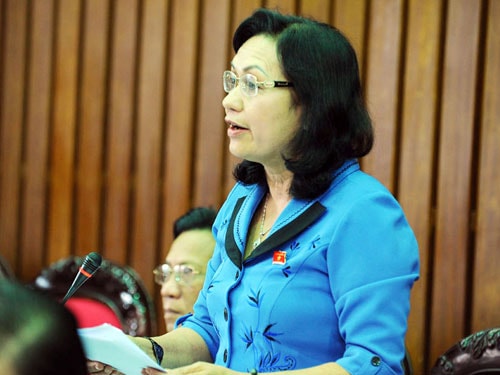
Photo: Ngoc Thang |
According to Tran Ngoc Vinh, Deputy Head of the Hai Phong City National Assembly Delegation, although the drafting committee has tried to incorporate feedback, revise, and make amendments compared to the current law, the content on land prices in the draft remains "a bottleneck, reflecting the confusion of the drafting agency and lacking a fundamental breakthrough." Accordingly, the regulations on land prices in the draft law still heavily favor protecting the rights of the state as the representative owner in imposing land prices. There are no specific criteria for determining land prices, no land valuation mechanism; it remains only the government stipulating the land price framework and the principles and methods for determining land prices, after which provincial People's Committees base their local land price tables on these.
To address this, Mr. Vinh proposed establishing an independent agency to determine land prices, separate from the land management authority. This would ensure a clear separation of land-related decision-making authority and land-price determination authority, preventing a situation where one agency is both playing the game and acting as the referee. Simultaneously, he suggested incorporating a mechanism for self-negotiation between businesses and citizens into the law, as these are two independent and equal economic entities that deserve fair treatment. The state should not compensate for land for economic projects using its own issued land price list.
| We will seek the opinions of National Assembly deputies on issues where there are differing viewpoints. Speaking at the presiding session of the Land Law (amended) debate yesterday morning, Vice Chairwoman of the National Assembly Nguyen Thi Kim Ngan stated that, to date, nearly 7 million opinions have been contributed by agencies, organizations, and the public regarding the draft Land Law. Based on a comprehensive, objective, and truthful compilation of public opinions, "the Standing Committee of the National Assembly has directed the verification agency to coordinate with the drafting agency to research, incorporate, and revise the draft law for submission to the National Assembly with a serious spirit of acknowledging many contributions, researching, and selecting reasonable opinions to reflect the will of the people." BC |
According to Thanh Nien - TH


