
The coal industry is struggling.
Poor business results, especially high inventory levels, have led to problems for businesses.coal industry businessesin turmoil.
Inventory is piled up like a mountain.
Much is said about output, such as the selling price of coal for electricity or export, but managing input costs, a crucial factor, is being neglected. | ||
PhDNguyen Thanh Son | ||
Mong Duong Coal Joint Stock Company - Vinacomin (MDC) reported a loss of 12 billion VND in the second quarter of 2013, bringing the cumulative loss for the first six months of the year to 11 billion VND, compared to a profit of 14.5 billion VND in the same period of 2012. Besides the decline in revenue, the company's financial costs increased significantly. In the first six months of the year, MDC incurred short-term loans exceeding 114 billion VND, despite having zero at the beginning of the year. Therefore, interest expenses amounted to 35.86 billion VND, a 59% increase compared to the same period last year.
Similarly, Cao Son Coal Joint Stock Company - Vinacomin (TCS) and Deo Nai Coal Joint Stock Company (TDN) incurred losses of VND 69.4 billion and VND 56.54 billion respectively in the first half of 2013. While revenue for both companies did not decrease significantly, TDN's operating and administrative expenses increased considerably, rising by 148% and 18% respectively compared to the first quarter of 2013, leading to losses. More seriously, both TDN and TCS have high levels of inventory. As of the end of June 2013, TDN's inventory was valued at VND 347.6 billion, a 66.36% increase compared to the end of 2012; while TCS's inventory was VND 277.4 billion, a 222% increase compared to the end of 2012.
According to the explanation from Deo Nai Coal Company, the consumption situation of the Vietnam Coal and Mineral Industry Group in the second quarter of this year...
According to Ms. Nguyen Thi Ngan Tuyen, Head of Analysis Department at Maybank Kim Eng Securities, coal companies are incurring losses due to a common reason: high debt levels and interest expenses eroding company profits. Most listed companies in this sector have a high debt-to-equity ratio, around 2-3 times, with some companies having debt up to 15 times their equity.
Particularly for coal companies, high cost of goods sold is the main reason for their losses. “There are many explanations for the recent increase in coal industry costs, mainly revolving around high inventory levels, but we believe the cause is outdated mining technology and poor management. Most listed coal companies operate open-pit mines, but their mining costs are four times higher than the world average,” analyzed Ms. Nguyen Thi Ngan Tuyen.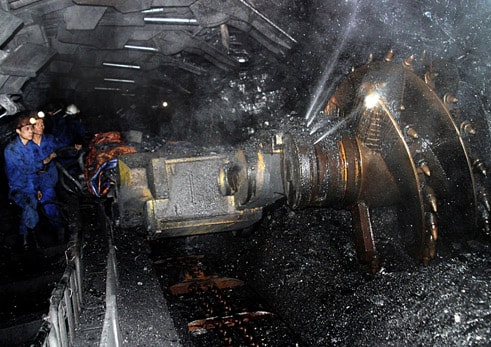
Coal companies are incurring losses due to an unsuitable management model.
- Photo: Mai Ha
A radical restructuring is needed.
According to Vinacomin, in the first six months of the year, the group's revenue only reached 47,600 billion VND, equivalent to 45% of the annual plan. Profits in the first half of the year were negligible, leading to a decrease in employee income. Vinacomin's leadership explained that these difficulties stemmed from several factors, particularly the fact that the selling price of coal for electricity generation is lower than the production cost and the export tax on coal has increased significantly. The selling price of coal for electricity generation has increased by 37-41% since April 20th, but it is still only 85-87% of the coal production cost in 2013. Meanwhile, coal exports – still considered Vinacomin's mainstay – are also facing difficulties due to the increase in the export tax from 10% to 13%, causing the projected export volume for 2013 to decrease to 9.5-10.5 million tons, a decrease of 4-5 million tons compared to 2012.
Dr. Nguyen Thanh Son, Director of the Red River Delta Coal Projects Management Board (Vinacomin), stated that the current difficulties faced by Vinacomin and its member coal enterprises are the low quality of coal, making it difficult to sell and resulting in low prices. The proportion of standard coal is decreasing, now only around 30-40%. Coal mining costs are increasing, but natural mining conditions are deteriorating due to the need to mine deeper. Increasing the selling price of coal for electricity generation is only a short-term support measure for the coal industry. In the long term, the coal industry must improve efficiency and reduce production costs by tightening input cost management, improving coal quality, and fundamentally changing its technology.
Mr. Son analyzed: People talk a lot about output, such as the selling price of coal for electricity or export, but managing input costs, a crucial factor, is being neglected. For example, the volume of overburden removal – the largest cost component in coal mining – is not accurately controlled. Many open-pit mines have unsuitable technological models; some mines nearing closure are still investing in new vehicles, resulting in huge waste.
Therefore, the coal industry needs a thorough restructuring aimed at improving efficiency, but unfortunately, the restructuring has been largely superficial. “Looking at the macro level, production capacity and scale have increased dramatically, tenfold compared to 1995 in terms of both production and coal processing… But the management model hasn’t changed much. A series of subsidiary companies that haven’t yet been privatized have been brought under the direct management of the parent company – the conglomerate – going against market principles and making management more difficult,” emphasized Dr. Nguyen Thanh Son.
Furthermore, the coal industry is also subject to economic cycles; periods of high GDP growth (8-9%) lead to coal shortages, as in the early 2000s, while periods of 5-6% GDP growth result in coal surpluses, as seen in the past year. And if the economy does not improve, coal inventories will continue to rise.
According to Thanh Nien - HV


