
In Nghe An province, 13 traditional craft villages have ceased operations.
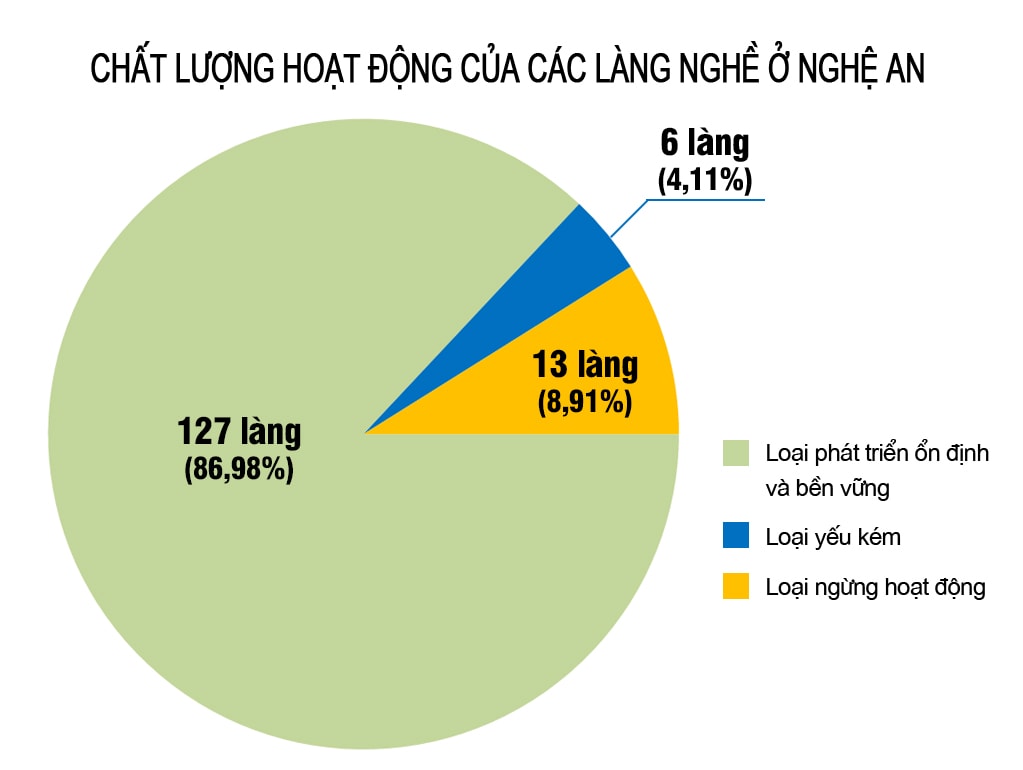
(Baonghean.vn) - From 2003 to the present, the People's Committee of Nghe An province has recognized 153 craft villages in the province. However, to date, 13 craft villages have ceased operations, including 8 rattan and bamboo weaving villages.
 |
| Graphics: Huu Quan |
According to the report of the Provincial Cooperative Union, in 2017, 7 new craft villages were recognized, bringing the total number of craft villages in the province to 153. Of these, 127 villages are currently developing stably and sustainably (accounting for 86.98%).
However, there are currently 6 villages operating inefficiently, including: 1 weaving village, 1 silk reeling village, and 4 rattan and bamboo weaving villages.
Thirteen craft villages have ceased operations, including eight rattan and bamboo weaving villages: Xuan Tinh export rattan and bamboo weaving village, Dien Loc commune (Dien Chau); Dong Luyen export rattan and bamboo weaving village, Hamlet 5, Quynh Giang commune (Quynh Luu); Van Nam export rattan and bamboo weaving village, Dien Van commune (Dien Chau); Quyet Thang export rattan and bamboo weaving village, Dien Truong commune (Dien Chau); Son My export rattan and bamboo weaving village, Quynh My (Quynh Luu); Trung Hau export rattan and bamboo weaving village, Hamlet 3, Quynh Giang commune (Quynh Luu); Ngoc Son export rattan and bamboo weaving village, Hamlet 4A, Ngoc Son commune; Ngoc Son export rattan and bamboo weaving village, Hamlet 4B (Quynh Luu).
In addition, there is a yarn-making village in Quynh Luu district, a silk reeling village in Anh Son district, an incense-making village in Dien Chau, a fish sauce processing village in Cua Lo town, and a mat-weaving village in Hung Nguyen.
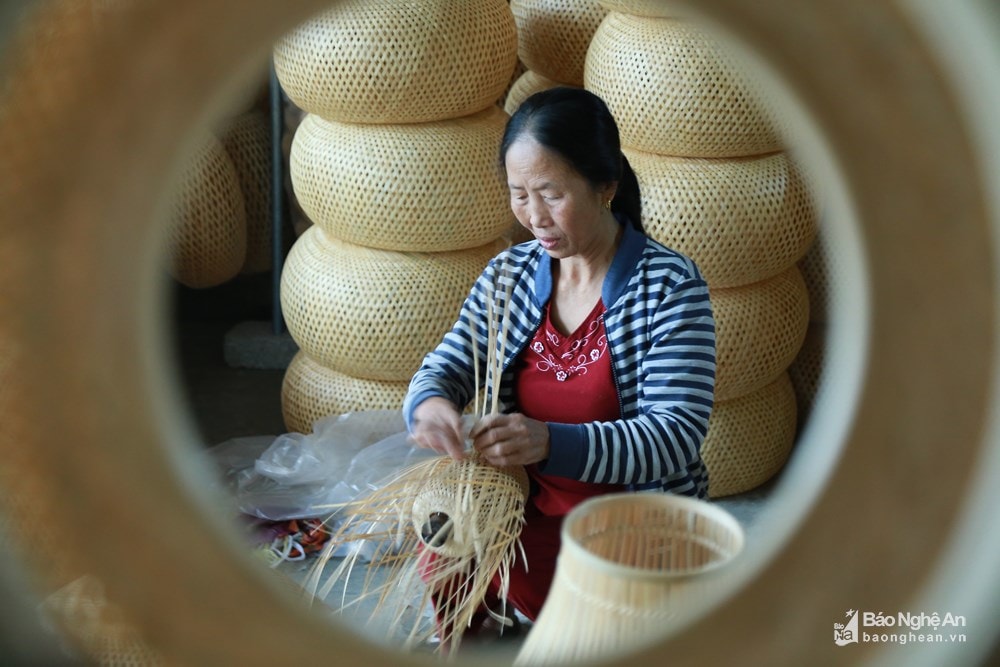 |
| Production takes place in the rattan and bamboo weaving village of Nghi Phong commune, Nghi Loc district. (Photo: Archival image) |
Although rattan and bamboo weaving villages account for 30% of the total number of craft villages in the province, with 44 villages, the number of workers only accounts for nearly 14%; and the production value accounts for only over 4% of the total production value of all craft villages in the province.
According to Mr. Nguyen Van Duc, Head of the Policy Consulting Department of the Provincial Cooperative Union, rattan and bamboo weaving products from craft villages in Nghe An have unique characteristics from raw materials to techniques and designs. However, these craft villages are currently facing many difficulties such as not being able to proactively secure raw materials; products are mainly made by hand without modern production equipment; craft villages lack young labor; there is no policy to support the training and development of craft village managers, artisans, and skilled craftsmen; craft village products are not effectively promoted, have not built brands, and have low prices...".
The total annual production value of craft villages in Nghe An province reaches approximately 160 billion VND; average income is over 30 million VND per person per year. Currently, the total number of regularly employed workers in these craft villages is over 20,000.
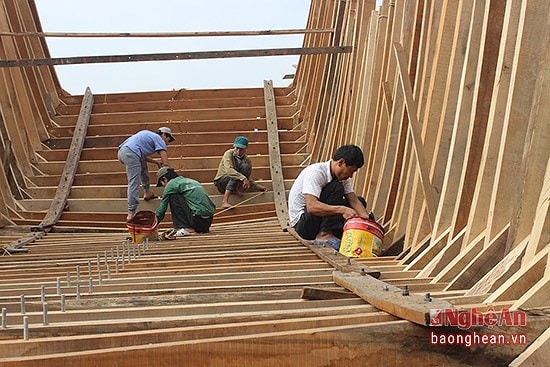 |
| Shipbuilding village in Quynh Lap - Hoang Mai town. (Archival photo) |
In order to effectively promote the rattan and bamboo weaving craft village in particular, and to preserve and develop traditional crafts and introduce new crafts in the area, the Provincial Cooperative Union, in coordination with relevant departments and localities, is implementing comprehensive solutions such as: training and improving the skills of workers; planning raw material areas and supporting the search for consumption markets; focusing on quality, design, and labeling; investing in infrastructure and technology; and paying attention to the environment and food safety and hygiene…
Simultaneously, strengthen the role of local authorities in implementing planning and development plans for small-scale industries and craft villages; build clusters and zones of small-scale industries and craft villages in districts and cities. Include targets for craft village development in the annual socio-economic plans of localities; develop production and business scales, develop new industries and products; develop craft villages in conjunction with tourism to develop small-scale industry products…
The goal is to achieve an average annual growth rate of 15% in the value of industrial production by 2020, accounting for 15% of the province's total export turnover; to create jobs for 250,000 workers; and to develop 5-7 new craft villages each year, bringing the total number of craft villages to 180-200 by 2020.


