
Nghe An province has 4 communes and 25 villages that have been removed from Program 135.
(Baonghean.vn) - Despite significant investment and support for poverty reduction,There are only 4 communes and 25 villages.They were removed from Program 135 during the 2011-2016 period, but conversely, the list of communes belonging to Program 135 was updated.continue adding 1 moreThis raises concerns about solutions for sustainable poverty reduction.
This was the issue raised at the working session between the Standing Committee of the Provincial People's Council and the Ethnic Affairs Committee on the morning of April 20th, as part of the plan to monitor the implementation of the sustainable poverty reduction program.
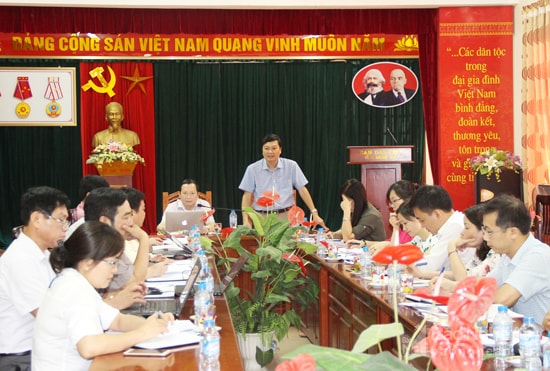 |
| Comrade Le Hong Vinh - Member of the Standing Committee of the Provincial Party Committee, Chairman of the Provincial Inspection Committee, and Head of the Economic and Budget Committee of the Provincial People's Council - chaired the meeting. Also attending were Comrade Nguyen Thanh Hien - Member of the Provincial Party Committee, Deputy Head of the Provincial National Assembly Delegation; and representatives from several provincial departments and agencies. Photo: Mai Hoa |
According to the report by Comrade Luong Thanh Hai - Head of the Provincial Ethnic Affairs Committee: In mountainous areas, ethnic minorities account for over 83% of the province's land area and 41% of its population, with ethnic minorities making up 15.3%. The entire region has 101 communes in Zone III, 59 communes in Zone II, and 92 communes in Zone I, with 1,163 particularly disadvantaged villages and hamlets.
To date, Program 135 has been implemented in four phases, creating positive changes in the appearance and lives of people in mountainous and ethnic minority areas of the province. Specifically, in Phase III (2011-2015), the program's beneficiary areas received over 666 billion VND in support for the construction of various projects. These included the construction of 75 new irrigation works and the renovation and upgrading of many dilapidated ones; 806 km of new roads and 496 inter-village/hamlet roads; 151 school buildings; 11 electricity projects; and 249 community centers...
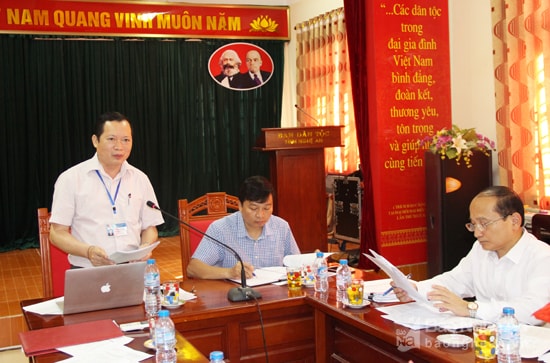 |
| Comrade Luong Thanh Hai - Member of the Provincial Party Committee, Head of the Provincial Ethnic Affairs Committee, said: In 2016, Nghe An had one commune added to the list of communes eligible for the Government's Program 135 and one commune added to the list of communes eligible for the program. Photo: Mai Hoa |
Support for ensuring livelihoods and reducing poverty for people has been implemented through: agricultural and forestry extension training; support for crops and livestock; model building; and purchasing equipment for production, with a total budget of nearly 115 billion VND.
The poverty rate in the 172 communes benefiting from Program 135 decreased from 50.22% (according to the old standard in 2010) to 36.93% (according to the new standard in 2015).
However, during the meeting, both sides discussed existing shortcomings and inadequacies in practice. Giving several examples, Ms. Nguyen Thi Lan, Deputy Head of the Culture and Social Affairs Committee of the Provincial People's Council, stated that support from various sectors and localities for some poverty reduction models has not been focused; some models exist only due to spontaneous family initiatives. Support for purchasing plows for production in mountainous and ethnic minority areas has not been effective. Furthermore, there are limitations in developing and replicating models and supporting certain crops and livestock that are not suitable for the climate and soil conditions, hindering their effectiveness.
Meanwhile, Ms. Thai Thi An Chung - Deputy Head of the Legal Affairs Committee, Provincial People's Council, and Mr. Nguyen Duc Thanh - Head of the Democracy and Law Committee, Provincial Fatherland Front Committee, raised issues related to the low quality and effectiveness of investment-supported projects in mountainous and ethnic minority areas, questioning the role of people's participation in construction projects as well as the role of community investment supervision...
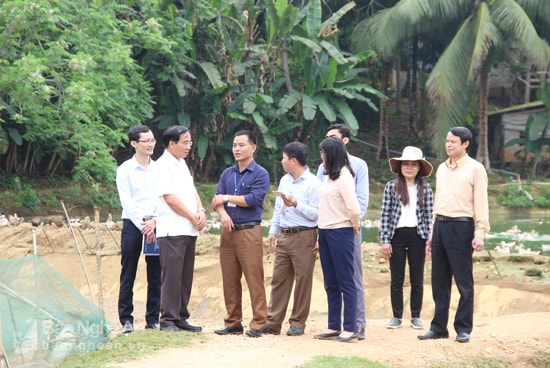 |
| The delegation from the Standing Committee of the Provincial People's Council visits and learns about the economic model in Que Son commune, Que Phong district. Photo: Mai Hoa. |
Concluding the meeting, in addition to affirming the effectiveness of the implementation of poverty reduction programs and projects and acknowledging the participation of the Provincial Ethnic Affairs Committee in this work, Comrade Le Hong Vinh emphasized: To achieve sustainable poverty reduction, the most important thing is the role of functional agencies in issuing appropriate and practical mechanisms and policies, and coordinating their effective implementation.
In particular, local authorities need to change their mindset and awareness to resolutely lift their localities out of poverty, avoiding the situation of dependence and reliance not only among the people but also among officials to benefit from investment support policies. Emphasis should be placed on accurately assessing and classifying poor households; clarifying poverty caused by labor shortages, lack of capital and production knowledge, laziness, social vices, etc.; thereby implementing specific and appropriate interventions, avoiding indiscriminate, general, and ineffective approaches.
According to Comrade Le Hong Vinh: To achieve sustainable poverty reduction, investment in infrastructure projects is necessary; however, the implementation methods need to be changed. Particular attention must be paid to the selection of investment items and the appraisal of designs to ensure the effectiveness of the projects. Attention should also be paid to training, transferring scientific and technological knowledge for production, and building and replicating sustainable livelihood and poverty reduction models.
Mai Hoa


