
Nghe An, the "balancing pole" between the two ends of the country.
(Baonghean) - The name Nghe An is believed to have appeared since the Ly Dynasty, in 1030, when Nghe An was a border region (including the present-day Nghe An and Ha Tinh provinces).
According to researcher Thai Kim Dinh, no historical records mention the origin of the name "Nghe An," only that the name "Nghe An" means "peace and security." It is likely that the Ly Dynasty named this region this way to ensure stability on the border and to establish lasting prosperity, because ultimately, every era needs stability for development. And strangely enough, throughout the nation's development, amidst countless ups and downs leading to human civilization, Nghe An has consistently played a key role in building, developing, transforming nature, providing livelihoods, and protecting the borders… In every era, it has been the starting point for paths, both intellectual and ideological, as well as concrete material paths, shaped within space and time.
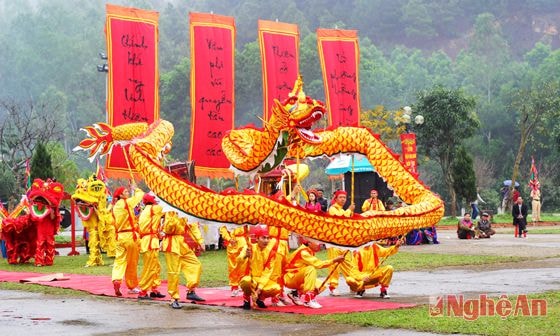 |
| King Mai Temple Festival 2015. Photo: Bui Van Dung |
Since the 1930s, the French scientist E. Saurin discovered the evolutionary path of humankind at the Tham Om site (Chau Thuan, Quy Chau), dating back to the Paleolithic era. The archaeological remains at Tham Om are rare fossils in the evolutionary process of humankind in general and the primitive society of Vietnam in particular. The evolutionary path of ancient Vietnamese people in Nghe An province, from Tham Om (Quy Chau) to Lang Vac (Thai Hoa) and Quynh Van (Quynh Luu), is evidence of the emergence of Stone Age civilization, then Iron Age, and Bronze Age civilization, a long journey of generations transforming nature and renewing themselves. The rice-farming civilization, originating from the Hieu and Chu rivers and the vast forests of Pu Huong and Pu Hoat, has left behind countless tangible and intangible cultural heritages for today's generation. These legacies bear the indelible mark of our ancestors' creativity in farming practices, animal husbandry, handicrafts, architecture, and a rich religious life, including epic poems like "Giving Birth to the Land, Giving Birth to the Village," "Lam," and "Khap," as well as in the art of crafting production tools, musical instruments, and jewelry. Rituals such as harvest festivals, rice planting ceremonies, and offerings of new rice at the beginning of the season and spring recreate the path taken towards the sea, expanding the land and territory. Vivid evidence of our ancestors' journey towards the sea can be seen in the Lang Vac ironworks (Thai Hoa) and the Quynh Van pottery (Quynh Luu), which are quite sophisticated handcrafted and date back approximately 6000 years.
The Vietnamese people were ruled and invaded by northern powers for more than ten centuries, which also meant that for those same ten centuries, they fiercely refused to be enslaved, with successive generations carrying out uprisings to assert their national sovereignty. In the uprisings of the Trung Sisters (42-43), Lady Trieu (248), Ly Bi (571) establishing the Van Xuan Kingdom, and Mai Thuc Loan (713-722), the people of Nghe An either directly took up arms to fight the invaders or indirectly contributed provisions and weapons. The ethnic communities of Nghe An, then belonging to Cuu Chan district, all demonstrated the role of a region of "spiritual land and outstanding people," a "borderland," a "fortress of hot ponds," a solid rear base of "Advancing to attack, retreating to defend." The "black king" - Mai Hac De - transformed the long, arduous journey of the common people to the Central Plains to pay tribute with precious cloth into a path of rebellion, overthrowing the Tang dynasty's rule and establishing the Van An Kingdom.
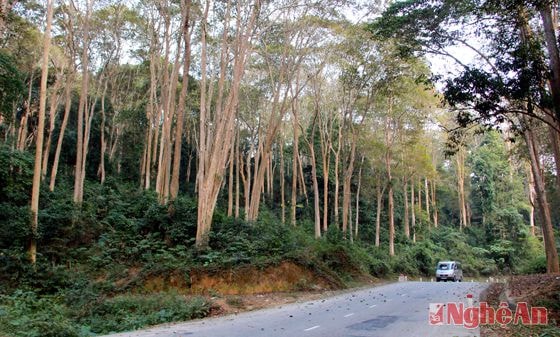 |
Along the treacherous mountain road from Nghe An to the North, the footprints of Mai Thuc Loan's militia were deeply imprinted. Nearly 700 years later, the resistance war against the Ming invaders (1418-1428) broke out again. After the oath at Lung Nhai, Le Loi led his army into Nghe An, capturing Luc Nien citadel, annihilating Truong Phu's army, and regaining independence. And then, 360 years after Le Loi's victorious uprising, on December 26, 1788, Nguyen Hue – the hero in simple clothes from Phu Xuan, Hue – led a large army to Nghe An, then followed the main road to Thang Long, annihilating 290,000 Qing troops with lightning speed, sweeping away the enemy and securing the borders.
The history of the Vietnamese people's resistance against foreign invaders is inextricably linked to the Trans-Vietnam Highway. Every road passes through the land of Nghe An, a region glittering with glorious historical chapters. This imprint is not only evident in the ten centuries of resistance against the expansionist forces from the North who attempted to assimilate the Vietnamese people.
In the dark, stagnant night of history, the burden of searching for the nation's future path fell upon the most outstanding sons and daughters of the homeland. Nguyen Truong To knocked on the door of history, proposing new paths in thought and understanding. Phan Boi Chau was a "messenger" with the mission of laying the crucial bricks that led the patriotic movement into the 20th century, grappling with the search for new truths. Then came Nguyen Ai Quoc – Ho Chi Minh, the founder, trainer, and leader of the Party and the Vietnamese Revolution, the great "architect" who charted the course for the nation to enter a new era. Nghe An, along with the rest of the country, embarked on this great historical path to protect and promote the values of the nation and the times.
The resistance road against French colonialism, which lasted for nine years, began construction in early March 1953. Spanning 149 km, it connected Highway 48 with Bai Chanh (Thanh Hoa). The route originated in Nghe An, extending from the rear of Military Region 4 to the Hoa Binh battlefield, Highway 6, and the Northwest. Hundreds of thousands of civilian laborers, volunteer youth, and main army units from Nghe An, Ha Tinh, and Quang Binh followed Highway 15A to the Northwest liberation front in 1953 and destroyed the Dien Bien Phu stronghold in May 1954, ending the arduous nine-year resistance war.
The history of Highway 15A reached another milestone when the entire nation went to war to fight back against the bombing campaign in the North, providing manpower and resources to liberate the South and unify the country. The starting point of Milestone 0 of the Truong Son Road – Ho Chi Minh Trail – on September 9, 1964, in Tan Ky town, was also the starting point for the strategic Tan Ky - Van Mai (Thanh Hoa) road in 1953. Within the Truong Son road network, with a total length of nearly 19,000 km, Highway 15A, though only 672 km from Milestone 0 (Tan Ky), served as the "main artery" connecting the front lines with the vast rear area of the North for 11 years (1964-1975).
Throughout the years of devastating bombing in Nghe An and Zone 4, the 3,000-kilometer-long pipeline carrying gasoline and oil from the North to the battlefield, with its starting point, considered milestone number 0, being the N1 pumping station in Nam Thanh commune (Nam Dan district), served as the starting point. The pipeline crossed the Lam River, traversed the bomb-strewn Ru Tret and Nam Dong areas, followed Highway 15A, passed through Duc Tho, reached the N2 pumping station in Nga Loc, Can Loc district (Ha Tinh province), and then extended all the way to the Southeast region, creating the legend of the Truong Son Road – the immortal Ho Chi Minh Trail.
Following the victory of April 30, 1975, the path of reunification, integration, and development towards democracy, civilization, justice, a prosperous people, and a strong nation has taken on a new stature and aspiration. For Nghe An, the birthplace of the paths that led to victory in the war of national liberation and the preservation of our beloved borders and islands in the 21st century, there is also the added path of the intangible cultural heritage of Nghe Tinh folk songs (Vi and Giam), recently recognized by UNESCO.
History seems to have chosen Nghe An as the place to test, entrust, and rely on the destiny of the nation through every event and upheaval. Nghe An is the birthplace of legendary roads, enriching the historical value and spiritual life not only for today's generation. From the past, these valuable roads will continue to be the foundation and driving force to open up new paths and take firm steps towards a beautiful, prosperous, and strong future.
Van Hien


