
Nghe An: Rare case of a worm entering a person's eye.
(Baonghean.vn) – On the afternoon of May 10th, Saigon Eye Hospital performed a rare surgery on a patient with a parasitic worm infection in the eye.
According to Dr. Hoang Trung Kien, Deputy Director of Saigon Eye Hospital, this is a rare case where the causative agent is Toxocara - a type of roundworm, commonly known as "dog roundworm," which has invaded a person's eye. The patient is Ms. Vo Thi P, residing in Cua Lo town.
.
 |
| Dr. Hoang Trung Kien, Deputy General Director of Saigon Eye Hospital, is examining patient Vo Thi P. |
Doctors determined the cause was that the patient had eaten undercooked food, leading to worm larvae entering the body and parasitizing the eye.
The surgery was completed in 20 minutes. Doctors successfully removed two worms from patient P's eye. Doctors said that the patient will be re-examined after one week and the chances of recovering their vision are very high.
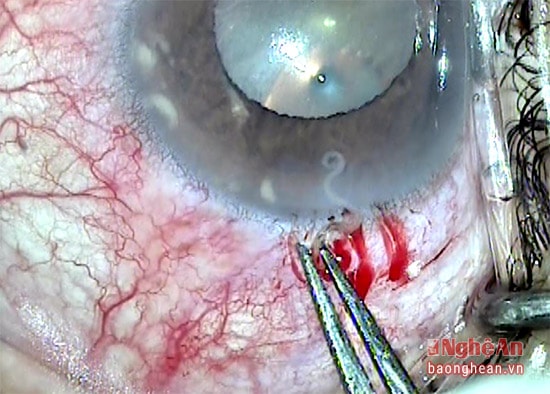 |
| Worms were removed from the patient's eye. |
According to doctors, after entering the human body, Toxocara worm larvae are released, penetrate the intestinal wall, and travel through the bloodstream to the liver, lungs, and central nervous system. There, the larvae can survive in the human body for many months. Patients will exhibit clinical symptoms such as itchy skin and hives, making it difficult to detect and often mistaken for other skin diseases, but the consequences are very serious. In children, symptoms include weight loss, diarrhea, nausea, vomiting; muscle and joint pain; coughing up sputum containing eosinophils; asthma-like shortness of breath; pulmonary infiltration; red patches or urticaria, erythema multiforme; enlarged, firm, smooth, painless liver; and sometimes slightly enlarged spleen. Adults may experience itching, asthma-like shortness of breath, and possibly unilateral vision loss due to granulomatous inflammation of the retina or chronic endophthalmitis. Additionally, the disease can manifest in the joints, muscles, skin, heart, or central nervous system due to larval invasion of the brain, leading to seizures, paralysis, convulsions, and spinal cord dysfunction. For infected patients, after conducting serological tests, ultrasounds, or CT scans, doctors will determine the appropriate treatment plan. |
Duc Anh - Thanh Quynh


