
Nghe An strives to achieve sustainable poverty reduction in mountainous areas.
(Baonghean) - Nghe An is one of the localities where the Government's Committee for Ethnic Minorities Affairs recently issued a Decision adjusting the classification of communes in areas I, II, and III of ethnic minority and mountainous regions, and simultaneously approved the list of particularly difficult villages and hamlets that have achieved the goals of Program 135. Regarding this issue, a reporter from Nghe An Newspaper interviewed Comrade Luong Thanh Hai - Member of the Provincial Party Committee, Head of the Provincial Committee for Ethnic Minorities Affairs of Nghe An Province.
PV:Could you please tell us what conditions are required for communes and villages in our province to have their area classification adjusted and for the Committee for Ethnic Minorities to be recognized as having completed the objectives of Program 135?
Comrade Luong Thanh Hai:Along with the efforts of the people, in recent years, in implementing the policies of the Party and the State, Nghe An has focused on promoting programs and projects associated with sustainable poverty reduction, prioritizing investment in this area.
In particular, in resource allocation, in addition to the general policies enjoyed according to regulations, the province annually prioritizes capital for the new rural development program to invest in production development and build essential infrastructure for especially disadvantaged communes, villages, and hamlets. According to statistics, on average, each commune, village, or hamlet in an especially disadvantaged area benefits from over 20 types of policies each year.
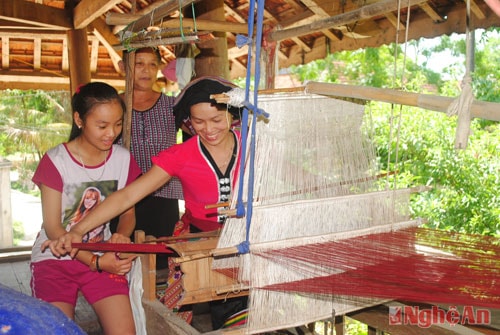 |
| The craft of weaving brocade contributes to increasing the income of the people in Hoa Tien 1 village (Chau Tien commune, Quy Chau district). |
Poverty reduction policies have been implemented in accordance with the Party and State's guidelines, thus yielding positive results, successfully eliminating hunger and reducing poverty, making a significant contribution to achieving the province's socio-economic development and national defense and security goals, and directly impacting the quality of life of the people.
| On February 29, 2016, the Committee for Ethnic Minorities Affairs issued Decision No. 73/QD-UBDT adjusting the classification of communes in areas I, II, and III of ethnic minority and mountainous regions. Specifically, in Nghe An province, Thach Giam commune in Tuong Duong district was reclassified from area III to area II; Nghia Long commune in Nghia Dan district and Nghia Xuan commune in Quy Hop district were reclassified from area II to area I. |
It can be affirmed that, thanks to these programs and projects, many welfare facilities such as electricity, roads, schools, health stations, water supply facilities, projects supporting production development, housing and production land support, and housing and water supply support have been newly built for thousands of households.
Specifically for Program 135 (2011-2015), the state budget provided 1 billion VND per year per commune for infrastructure investment projects in phase III; and 200 million VND per year per particularly disadvantaged village. The state budget provided 300 million VND per year per commune and 50 million VND per village for production development projects. This does not include integrated funding and funds mobilized from other projects, organizations, and individuals.
In addition, the province has a policy and directs the assignment of agencies, units, and businesses to assist poor communes in border areas in building infrastructure and welfare facilities to serve the people and support production development. For example, implementing the "Joining Hands for the Community - Cattle Breeding Program to Help the Poor in Border Areas," from August 2014 to the present, the Provincial Border Guard Command has coordinated with Viettel Company to organize 10 donation drives with 3,659 breeding cows, each valued at 15 million VND, to 3,659 poor households in border communes in the province. Specifically, Thanh Chuong district received 750 cows, Anh Son 200, Que Phong 610, Con Cuong 450, Tuong Duong 430, and Ky Son 1,219. The total cost amounted to 54 billion 885 million VND...
These conditions create the foundation and basis for particularly disadvantaged communes, villages, and hamlets to have the motivation to rise up and meet the criteria to be included in the list of areas for adjustment by the Committee for Ethnic Minorities, as well as to achieve the goals of Program 135.
However, it should also be added that the criteria for communes, villages, and hamlets to exit Program 135 are not solely based on the number of poor households, but also include many other criteria. Meanwhile, practice also shows that the infrastructure and socio-cultural systems in areas benefiting from Program 135 still face many difficulties and inadequacies. This is also one of the challenges in maintaining the results achieved in the past.
PV:According to you, to what extent has the economic awareness and mindset of people in the Mekong Delta region changed, given that some households still harbor a mentality of dependence and reliance, unwilling to escape poverty? And is it true that some local authorities are "giving the green light" to this mindset?
Comrade Luong Thanh Hai:In fact, not only in the highlands and ethnic minority areas, but in some mountainous localities in general throughout the province, there exists a paradox: people want to be classified as poor, and "the poor don't want to escape poverty." For many households, to "become" a poor household, they have to "strive," "enter" the poverty list but don't want to "leave."
Due to limited awareness and a mentality of dependence and expectation of "liking" to be poor, the support from poverty reduction policies and programs has become fertile ground, giving rise to schemes of "lobbying" to be classified as poor or wanting to remain poor... This has made the assessment of poor households in many localities harsh and has not ruled out negative practices in the assessment of "entering" and "exiting" poverty.
Echoing the sentiments of the people, it cannot be denied that in some places, local government officials are reluctant to be removed from the list of investment areas under Program 135 so that their localities can continue to benefit from the policies and regulations...
PV:So, in the long term, what needs to be done to maintain sustainable poverty reduction results and prevent households from falling back into poverty?
Comrade Luong Thanh Hai:It can be said that the results of poverty reduction in our province are still not sustainable. While the poverty rate has decreased rapidly, the rate of re-poverty remains high. In particular, a segment of the poor do not want to escape poverty, and many families who are not classified as poor voluntarily apply to be classified as poor in order to receive preferential treatment from the Party and the State.
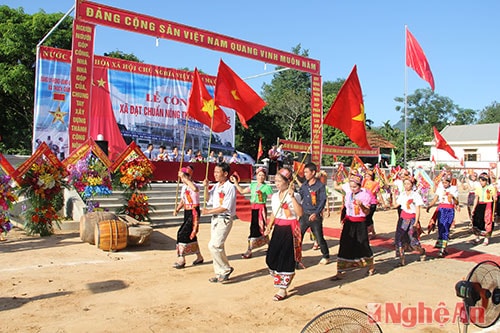 |
| Thach Giam commune, Tuong Duong district - the first commune under Decree 30a in the country to achieve the new rural standard. |
To address this situation, Party committees, government agencies, and mass organizations need to pay more attention to improving propaganda work so that people understand and firmly grasp the State's policies, awaken their will to strive and be determined to escape poverty, and give poor households confidence that they can escape poverty, thereby pushing back the mentality of waiting, relying on others, and passively accepting things, which has become deeply ingrained in people's minds.
| In Decision No. 74, the Committee for Ethnic Minorities also approved the list of particularly disadvantaged villages that have achieved the goals of Program 135 in 2015. Accordingly, Nghe An province has 25 villages removed from the list of particularly disadvantaged villages, including: Huu Van (Chau Kim commune); Phong Quang, Na Cong (Que Son commune); Na Cay (Tien Phong commune) in Que Phong district; Xop Nhi (Huu Lap commune, Ky Son district); Ban Cay Me, Ban Phong, Ban Mac (Thach Giam commune, Tuong Duong district); Ban Hoa Tien 1, Hoa Tien 2 (Chau Tien commune, Quy Chau district); Minh Tien, Minh Quang villages (Minh Hop commune); Xom Dot Tan, Xom Va, Xom Mo, Xom Mo (Nghia Xuan commune) in Quy Hop district; Nam Thai, Nam Hoa, Nam Son, Nam Khe villages (Nghia Long commune); Village 5 (Nghia Trung commune); Dap Danh village (Nghia Loc commune) in Nghia Dan district. Lien Hong village (Thanh Lien commune), village 13 (Thanh Ha commune), village 2 (Thanh My commune), Thanh Chuong district. |
To achieve this, it is necessary to focus on innovation and improving the effectiveness of propaganda work through various forms such as direct communication via conferences at the commune, village, and household levels. Accordingly, emphasis should be placed on training and capacity building for poverty reduction officials through the implementation of training and capacity building projects for poverty reduction officials with funding support from the National Target Program on Poverty Reduction.
Simultaneously, guide people on methods and techniques for economic development; encourage, motivate, and commend poor households that use capital effectively and escape poverty early; promptly encourage households facing business risks, and mobilize community and social attention to help and support them. Seriously implement the assessment of poor households from residential areas, ensuring transparency and democracy in the assessment process; resolutely eliminate the practice of "sending" relatives or close friends to be included in the poor household list due to favoritism...
Along with the above approaches, it is thought that the goal of sustainable poverty reduction and policies need to go hand in hand. For households in particular, and villages and communes in general, that have recently escaped poverty, the Government needs to maintain basic policies on capital, technical training in production, healthcare, education, etc., for 2-3 years. This will both provide a basis for poor households to have the opportunity to escape poverty sustainably and prevent the emergence of a reluctance to escape poverty.
PV:Thank you, comrade!
Dang Cuong (compiled)


