
Nghe An province will convert over 5,000 hectares of rice land to cultivate other crops and raise aquatic products.
(Baonghean) - Since the beginning of this year alone, the province has successfully converted over 7,700 hectares of land. However, to effectively and sustainably implement crop restructuring, many comprehensive solutions are still needed.
Initial effectiveness
The policy of restructuring crop patterns, implemented from 2014 to 2016, resulted in a total area of over 7,700 hectares of rice land being converted to other crops throughout the province. The majority of this area was converted to cash crops such as corn, peanuts, sweet potatoes, and chili peppers. Thanks to this crop restructuring, investment costs for irrigation were reduced, and the economic value per unit area was higher.
To encourage farmers to implement crop restructuring, the Provincial People's Committee issued Decision 87/2014, providing a one-time subsidy of 5 million VND/hectare for areas where crop restructuring is carried out on low-yield rice land; provided that the conversion area is 2 hectares or more. As a result, many localities have implemented this effectively.
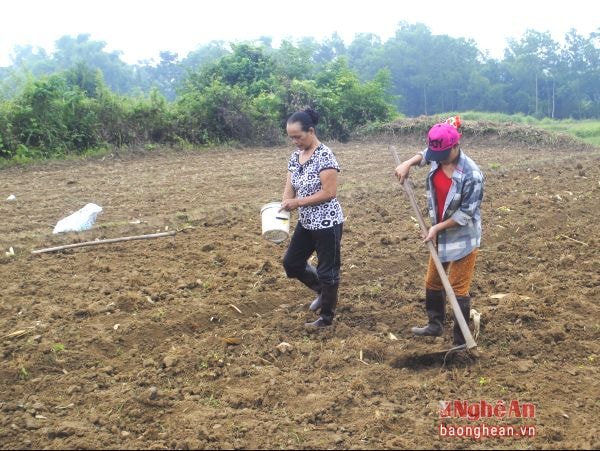 |
| Farmers are converting rice fields to corn cultivation in Chau Dinh commune (Quy Hop district). Photo: VT |
Chau Quang is a key rice-growing commune in Quy Hop district with over 430 hectares of rice fields. Of these, dozens of hectares yield very low rice productivity (10-12 tons/hectare/season), and 3 hectares are unharvestable. The cause is the upstream mineral exploitation causing muddy water. In 2015, the commune collaborated with Na Su Sugar Company to convert 15 hectares in Con village to sugarcane cultivation. The District People's Committee allocated over 300 million VND to support the commune in consolidating land plots, replanning fields, and constructing drainage canals to ensure each household has one plot of land for cultivation.
Mr. Phan Van Nguyen's family, one of 70 households in Con village, has converted 6 sao (approximately 0.6 hectares) of rice land to sugarcane cultivation using the QD 93 variety, intercropped with soybeans, yielding high economic returns. Mr. Nguyen happily stated: "Thanks to training in sugarcane cultivation techniques and the company's guaranteed purchase of our produce, we feel secure in our production. Last year, the average yield reached 6 tons/ha, generating an income of 6 million VND/sao. Overall, the income from the converted land (soil intercropped with soybeans) is 10 times higher than the previous rice cultivation. This season, we anticipate an even higher sugarcane yield of 7-8 tons/ha."
The entire Quy Hop district has 5,133 hectares of rice fields for two crops per year. Some areas are polluted by mineral exploitation, and areas in the highlands frequently suffer from water shortages, resulting in low rice yields. To date, the district has encouraged communes to convert nearly 100 hectares of low-yield rice land to other crops; mainly corn, peanuts, soybeans, sugarcane, and oranges.
Mr. Hoang Van Thai, Head of the Agriculture Department of Quy Hop District, said: From 2014 to the present, the district has supported localities with over 450 million VND to improve land, build drainage ditches, internal field roads, and provide plant seeds... The district's Agriculture Department also guides people in applying scientific and technical advancements to production; and links with some businesses to consume products. The district will continue to direct localities to review and convert inefficient rice land areas to cultivate cash crops, forming specialized farming areas based on the advantages of each locality.
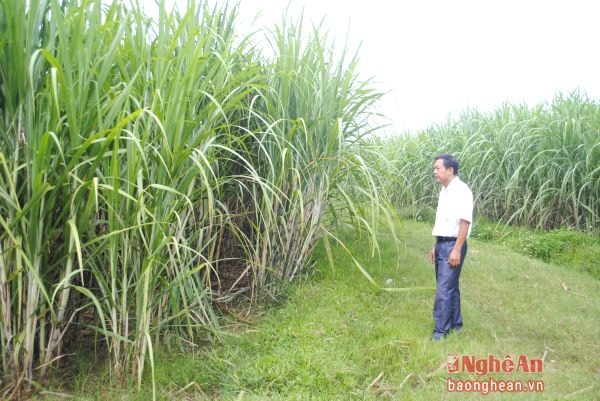 |
| Sugarcane fields converted from rice paddies in Con village, Chau Quang commune (Quy Hop district). Photo: VT |
Hung Nguyen district has a large area of low-lying, mainly heavy clay soil, making agricultural production difficult. To adapt to the natural conditions, the district has implemented crop rotation and restructuring of crop patterns. On average, Hung Nguyen converts 50-70 hectares annually. To date, the district has converted approximately 200 hectares of high-lying land to autumn-winter crop production on land previously used for 1-2 rice crops; low-lying areas have been converted to fish farming in the third cropping season. For example, Hung Dao commune has converted 67 hectares of low-yield rice fields to fish farming. In addition, the commune maintains about 30 hectares of rice land annually for fish farming in the third cropping season.
According to Mr. Phan Xuan Hiep, Vice Chairman of the People's Committee of Hung Dao commune: The area converted from low-yield rice cultivation to aquaculture yields 1.5 to 2 times higher economic efficiency compared to rice cultivation. The commune is continuing to implement land consolidation and exchange to expand the area of rice land converted to cultivate other crops with high economic value.
Continuing the conversion of over 5,000 hectares of rice land.
In order to increase yield and income value per hectare of rice-growing land, the People's Committee of Nghe An province has approved the plan for restructuring crop patterns on rice-growing land in Nghe An province until 2020. Accordingly, the goal from now until 2020 is to convert 5,457 hectares of rice land to growing corn, soybeans, sesame, vegetables, flowers, fodder crops, other crops, and combined with aquaculture. Of this, 5,151 hectares will be double-cropped rice land and 306 hectares will be single-cropped rice land.
The total area of other crops converted from rice land during the period 2016-2020 was 7,500 hectares; of which, corn accounted for 3,562 hectares, vegetables and flowers 791 hectares, aquaculture 1,206 hectares, peanuts and sesame 784 hectares, fodder crops 633 hectares, soybeans 308 hectares, sugarcane 26 hectares, and other crops 90 hectares.
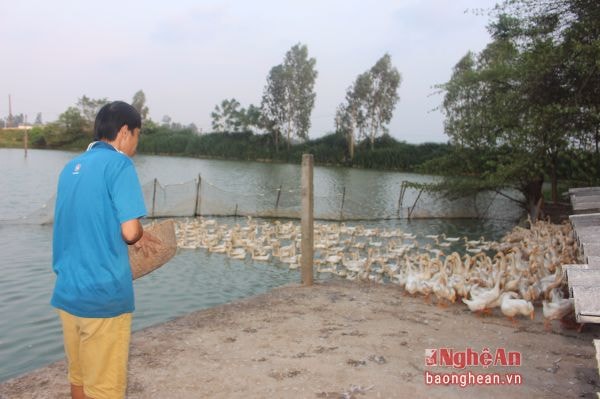 |
| The farm model of Mr. Luu Duc Quyet's family in Hamlet 7, Hung Dao Commune (Hung Nguyen District). Photo: D.N. |
However, the transition process still faces many difficulties. Mr. Hoang Duc An, Head of the Agriculture Department of Hung Nguyen district, said: Some officials and people are not yet bold enough to change their mindset in implementing the restructuring of crop patterns. Agricultural products do not yet have a stable market outlet, thus failing to create motivation for people to implement the restructuring of crop patterns on rice land.
According to Mr. Le The Hieu, Head of the Agriculture Department of Dien Chau District: Regarding the restructuring of crop patterns, over 210 hectares of low-yield rice fields in high-lying, downstream areas have been converted to other crops such as corn, peanuts, beans, green squash, and pumpkins. Although this crop conversion on rice land has yielded high economic returns, the irrigation system previously used for rice production is not compatible with other crops (drainage is limited). Furthermore, selecting suitable crop varieties for each specific area remains challenging.
"Another problem is that people in many localities still maintain the habit of rice production, so they are not very proactive in switching to other crops. In addition, the market for converted crops is not stable... which is also an obstacle to crop conversion on rice land today," added Mr. Nguyen Dinh Huong, Deputy Head of the Department of Crop Production and Plant Protection of Nghe An province.
To achieve the goal of crop conversion on rice land, in addition to provincial policies and mechanisms, localities need to focus on the following solutions: raising public awareness, concentrating on directing and implementing planning; reviewing land resources to develop conversion plans; applying advanced technologies and training human resources; encouraging and attracting investment resources to develop infrastructure, connect processing and consumption of products, contributing to the successful restructuring of the agricultural sector towards increasing added value and sustainable development.
Dinh Nguyet


