
Nghe An: Credit growth boosts economic development.
In the context of consolidating banking sector management, Nghe An province affirms its leading position, accounting for over 54% of total mobilized capital and nearly 56% of outstanding credit in the entire region in 2025. Entering January 2026, the province continues to record a growth in deposits reaching VND 4,706 billion and outstanding loans increasing by VND 4,400 billion.
This not only reflects market confidence but also affirms the vital role of the banking sector in driving sustainable economic growth drivers.
The numbers speak for themselves.
According to a report from the State Bank of Vietnam, Region 8, by the end of 2025, the total outstanding loans of credit institutions in the region reached VND 670,456 billion, a 14.7% increase compared to the end of 2024. This is an impressive figure compared to the 10.2% increase of the previous year. Capital flows were strongly concentrated in priority sectors, production and business activities, and new growth drivers such as green transformation and digital transformation. In particular, risk control was implemented rigorously. The non-performing loan ratio across the region was only 0.83%, significantly lower than the government's target of below 3%.
Within that overall picture, Nghe An continues to play a key role as a growth engine, accounting for an overwhelming proportion in most operational indicators.
.jpg)
In terms of mobilized capital, Nghe An accounts for 54.2% of the total capital in the region, achieving a growth rate of 16% in 2025. Regarding outstanding credit, the province accounts for 55.8% of the region's share, achieving a growth rate of 14.9%, higher than the overall average. Capital flows are not spread thinly but concentrated on key industrial projects, exports, and infrastructure development. Notably, thanks to rigorous risk management, Nghe An maintains an ideal non-performing loan ratio of 0.6%, contributing to the stability of regional financial security.
Continuing the positive momentum, early 2026 figures show an energetic start. In January 2026, the entire region recorded an increase of 8,688 billion VND in mobilized capital (a 1.5% increase); of which, Nghe An led with an absolute increase of 4,706 billion VND.
Similarly, in terms of credit, the total outstanding loans in the region increased by VND 7,333 billion (equivalent to 1.1%). Nghe An continued its breakthrough with a growth rate of 1.2%, higher than the average of 1% in neighboring localities such as Ha Tinh and Quang Tri. The increase in outstanding loans at the beginning of the year shows the proactive approach of banks in providing capital to people and businesses to promptly implement production and business plans for the Tet holiday and increased consumption.
Credit growth not only reached absolute figures but also marked a shift in the structure of capital flows. In Nghe An, outstanding loans are strongly concentrated in the production, business, trade, and service sectors. Social policy credit, especially through the Social Policy Bank, grew by 9.6%, making a significant contribution to sustainable poverty reduction and new rural development in the province's remote and disadvantaged areas.
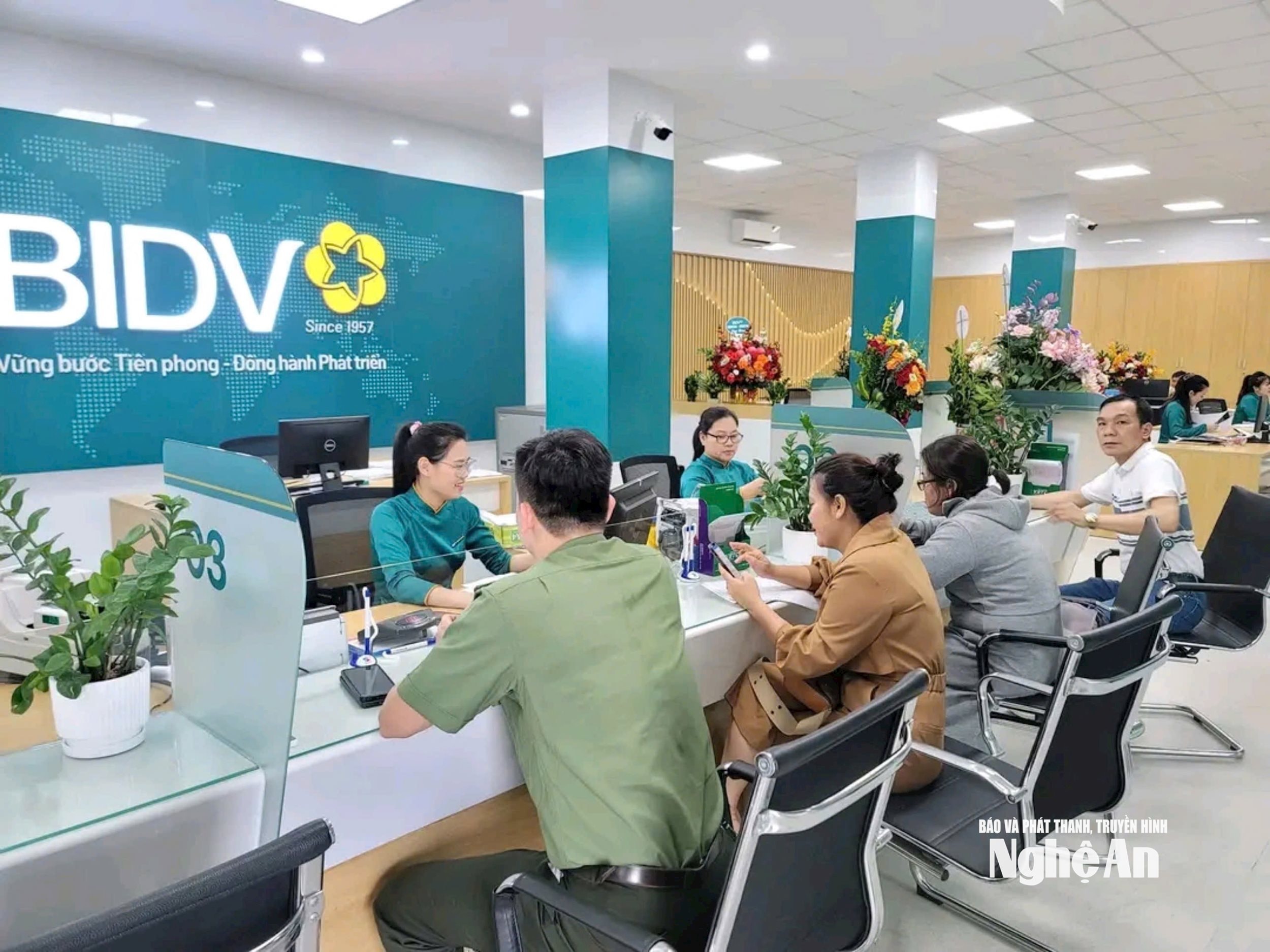
Ms. Le Thi Mong Ly, Deputy Director of BIDV Bank, stated: "In recent times, credit activities have continued to grow steadily, adhering closely to the orientation of safety and efficiency. BIDV Nghe An's outstanding loan balance at the end of 2025 is projected to grow by 7%, with medium and long-term loans growing by 11%, in line with business objectives. Loans are primarily concentrated in the production, business, trade, and service sectors. Non-performing loans are controlled within permissible limits, ensuring compliance with State Bank regulations and creating a foundation for sustainable growth in the following years."
To achieve these results, we strengthened our solutions for finding new corporate clients: proactively monitoring institutional reforms, streamlining the administrative apparatus, early outreach to restructured units, and simultaneously promoting the development of SME and FDI corporate clients. For retail clients: Card products, digital banking, cashless payments, and insurance continued to record good growth; the quality of service for individual customers was positively evaluated; customer satisfaction continued to improve, resulting in a significant increase in new individual loan customers.
Towards the goal of digital transformation and green development.

However, credit growth in 2026 is expected to face difficulties. These include high capital demand but limited capacity of businesses to meet it (collateral, project legal compliance). Inflationary pressure is narrowing the room for further deep reductions in lending interest rates. Meanwhile, key projects require stronger legal support from local authorities to qualify for credit disbursement.
For BIDV Nghe An, according to the assessment at the beginning of the year, credit outstanding showed signs of stagnation, due to corporate customers having more funds available for advances or payments for year-end projects, thus reducing debt repayments; meanwhile, individual customers also increased borrowing at the end of the year to stockpile goods for the Lunar New Year, so borrowing activity did not increase at the beginning of the year. On the other hand, due to the upward trend in market interest rates, customers still have a hesitant attitude.
In 2026, the State Bank of Vietnam projects a credit growth target of approximately 15% for the entire banking system. In Region 8, the goal is to maintain a growth rate equivalent to or higher than the overall average to meet the capital needs of key transportation and industrial infrastructure projects currently underway in Nghe An (such as VSIP II Industrial Park and the new phase of WHA).

According to the leaders of the State Bank of Vietnam, Region 8, 2026 will be a boom year for preferential credit packages for green transformation and sustainable development (ESG). Renewable energy projects and high-tech agriculture in the western region of Nghe An will be prioritized in accessing capital with preferential interest rates. At the same time, the 100% digitalization of the small-scale lending process will help shorten the time it takes for people to access capital.
The outlook for 2026 remains challenging due to inflation target pressure (around 4.5%) and exchange rate fluctuations. Therefore, the banking sector will continue to manage deposit and lending interest rates at reasonable levels, ensuring attractiveness to attract capital while supporting reduced capital costs for businesses. Simultaneously, it will strengthen thematic inspections and macroeconomic safety supervision, especially in high-risk areas such as speculative real estate, ensuring that capital flows directly into production and creates added value for society.
With strong growth in both capital mobilization and outstanding credit in 2025, coupled with a favorable start in the first month of 2026, credit growth is ready to provide financial resources and is expected to be an important lever for promoting sustainable socio-economic development in the locality.


