
The profession of selling plain water.
At 5 a.m., the women are already at the market preparing buckets, containers, and carrying poles of cold water to sell to the fish and meat vendors. Their job is such that when the sweat dries, the money is gone. Each day, they can't remember how many buckets of water they've carried or how many kilometers they've walked, only that their shoulders and legs are always aching.
(Baonghean.vn) -At 5 a.m., the women are already at the market preparing buckets, containers, and carrying poles of cold water to sell to the fish and meat vendors. Their job is such that when the sweat dries, the money is gone. Each day, they can't remember how many buckets of water they've carried or how many kilometers they've walked, only that their shoulders and legs are always aching.
I met them pushing water carts at the markets: Quan Lau, Kenh Bac, Quan Bau, and Hung Dung market. The first person I met was Hoang Thi Ly (31 years old) from Thuan 1 hamlet, Hung Hoa (Vinh city), who has been selling water at Quan Lau market for nearly ten years. "Each market only has a few people doing this job; at Quan Lau market, it's just me. Back then, the well was nearly a hundred meters from the market, and carrying a couple of buckets of water was exhausting. For the past three years, the well has been drilled closer to the market, saving me half the distance compared to before. That's compared to before, but selling cold water is still quite hard work," Ly confided.
Despite being five months pregnant, every morning, before the sun even rises, Ly has to get up and cycle to Quan Lau market to begin her day's work. With five mouths to feed, elderly and frequently ill parents-in-law, all expenses depend on her carrying water and her husband's wages as a construction worker. For the past five years, Ly has been "exercising" every day by carrying water for hire.
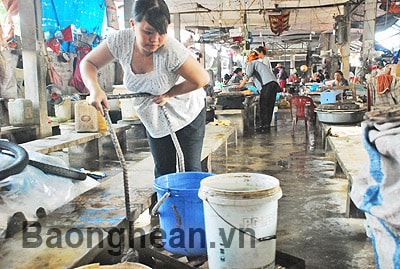
Despite being five months pregnant, Ly still delivers water to vendors in the market every day.
Ly recounted that she earns 100,000 dong a day carrying and pushing water for fish and meat vendors at the market. On busy days, it's better, but on slow days, when the water she carries back isn't sold, it's only enough to buy a few kilograms of rice, some vegetables, and a few shrimp for her family. Her job is such that as soon as the sweat dries, the money is gone. Ly said that as a woman, everyone wants to find a stable job that suits their health, but she only takes up this job out of necessity to make a living. Because, in her hometown, the land isn't vast, and since the reclamation of the sedge fields, farmers like Ly have been left unemployed. Her family only has a few acres of rice paddies, not enough to feed themselves. All the money, from her children's school fees to food and living expenses, depends on her husband's "water carrying" job and his construction work.
Ms. Tung (who sells water at Quan Bau market) has been doing this for nearly three years. Originally from the poor rural area of Dien Trung commune (Dien Chau district), she worked as a laborer in Vinh and met Mr. Phan Cong Hoan (a construction worker). They got married and now live in Hamlet 13, Nghi Kim (Vinh City). Since her "teammate" broke his leg while carrying soil up to the third floor for a homeowner to plant flowers, Ms. Tung feared a similar "occupational hazard" would befall her, so she quit her job as a laborer and switched to selling water at Quan Bau market. Her day is like any other normal day. While the market is still quiet, Ms. Tung is already sweating profusely as she gathers water to bring back to her "home." Calling it "home" is just for fun; in reality, her "home" is in a corner of the market, without a roof, just enough space for a dozen buckets of water.
She buys tap water from a family about a hundred meters from Quan Bau market. A couple of buckets of tap water cost 4,000 dong, while well water is free, and she only has to pay 50-70,000 dong for electricity each month. By dawn, dozens of buckets of cold water are already full. She can't measure how many kilometers she walks each day, only that after each day of carrying water, her shoulders, arms, and legs are aching. Especially when the weather changes, her knees ache because of her arthritis, yet she still refuses to take a day off work.
Ms. Tung said: "I get paid 6,000 dong per pair of tap water and 4,000 dong per pair of well water. If I take a day off, the women selling meat and fish complain."
Customers now also want to "free themselves up," wanting to eat fish cakes and meatballs by washing and grinding them right at the market, without having to painstakingly wash the fish, meat, and herbs at home, then chop them until their hands ache to make fish balls, meatballs, or spring rolls. Therefore, the business of selling tap water was born. However, not many people do this job; only a few people in a market do it because the work is too hard, requiring constant effort all day long, and the income is meager. Even with hard work, it's only enough to get by. The good thing is, this business doesn't require much capital; just a million dong to buy a few dozen buckets, a pair of poles, a carrying pole, and a water cart is all it takes to start.
Bidding farewell to Ms. Tung and Ms. Ly under the scorching summer sun, their figures trudged along, carrying buckets of water, their shirts soaked with sweat. Their silhouettes disappeared amidst the hustle and bustle of buyers and sellers. The sun was beginning to set...
Thu Huong


