
Weaving craft in Diem village
(Baonghean) - The weaving craft in Diem village, Chau Khe commune (Con Cuong district) was once in danger of disappearing. However, this traditional craft is now gradually reviving, contributing to helping the people of Diem village alleviate poverty.
From the town of Khe Choang (Chau Khe commune), following the winding road along the Khe Choang stream, passing through Chau Son, Chau Dinh, Bung, and Xat villages, we arrived at the peaceful and tranquil Diem village. The stilt houses stood silently under the shade of ancient trees, and elderly people sat on their porches, chewing betel nut and teaching their grandchildren to sing folk songs, traditional rhymes, and melodies – precious traditions passed down through generations. At the edge of the village, a house thatched with palm leaves and with bamboo walls bustled with laughter and conversation. This was the "workshop" of the Diem village rattan and bamboo weaving group, a gathering place for villagers who shared a passion for traditional weaving.
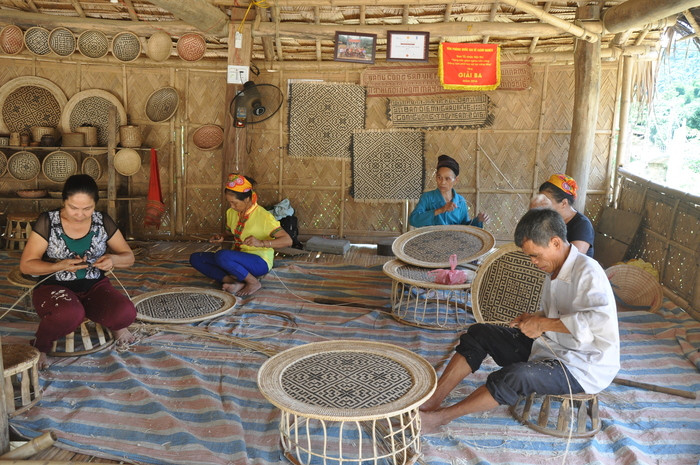 |
| Members of the rattan and bamboo weaving group in Diem village, Chau Khe commune (Con Cuong district) are diligently engaged in their weaving work. Photo: Cong Kien |
We entered the "workshop" while everyone was diligently working with knives, bamboo strips, and the products nearing completion. Baskets, rice presses, fish containers, wicker trays, and other finished household items were displayed on shelves and hung on the walls. Admiring these products, we could feel the passion, dedication, and affection poured into each bamboo strip and pattern. It was hard to believe that, under those rough hands, these simple yet sophisticated products could speak volumes about their value, becoming useful items with high aesthetic value.
While finishing a rattan tray, Ms. Lang Thi Hoa, head of the rattan and bamboo weaving group in Diem village, chatted: “In the past, the weaving craft was very developed in Diem village. Almost everyone, young and old, men and women, knew how to weave. Living in the mountains, the weaving materials were readily available, from bamboo and rattan to rattan fibers – just a few steps away from the mountains. Most household items were hand-woven by the villagers themselves, saving costs and ensuring safety.” But then, unexpectedly, the forest resources ran out. They had to go deep into the forest, spending an entire day just to gather a small amount of rattan and rattan fibers, causing a severe shortage of weaving materials. At that time, plastic and metal goods flooded the village. People brought them right to our doorsteps, selling them cheaply and conveniently, saving us the time and effort of traditional weaving. So, the villagers switched to using plastic and metal baskets, trays, and chairs. Consequently, the weaving craft faced difficulties due to both a shortage of raw materials and a lack of markets for its products. The artisans were disheartened, and the elderly passed away, carrying with them the deep-seated worry about the risk of their traditional craft fading away and being lost.
The government implemented a policy of forest conservation and protection, allocating land and forests to individual households for management, and the forests along the Choang stream gradually revived. Under the canopy of large trees, various types of bamboo, reeds, and rattan covered the forest areas, contributing to the green color – the color of life in this remote border region. Then, after a period of using household items made from plastic and iron, the villagers found them somewhat convenient but difficult to verify their safety. They truly trusted items hand-woven by themselves, crafted from readily available and environmentally friendly materials. This is the reason and motivation for the revival and development of the traditional weaving craft, helping the people utilize abundant raw materials and earn extra income during their free time.
The difficulty lies in the fact that after a long period of neglect, the master artisans passed away before they could pass on their skills, leaving a void. Those who came after them, before they had mastered the craft, had to abandon it, and now they are struggling to thread each strand and assemble each border. Weaving for family needs is easy, but selling to the market requires products that are both durable and beautiful to attract customers from all over the country.
As a child, Lang Thi Hoa often sat on the porch watching adults whittle bamboo strips and weave, and her passion for weaving was formed and nurtured from that time. With the desire and determination to revive the traditional craft, in 2013 she established the Diem Village Bamboo and Rattan Weaving Group, bringing together skilled artisans with a shared passion. Initially, only 5-7 people participated, but the number gradually increased and now has 22 members.
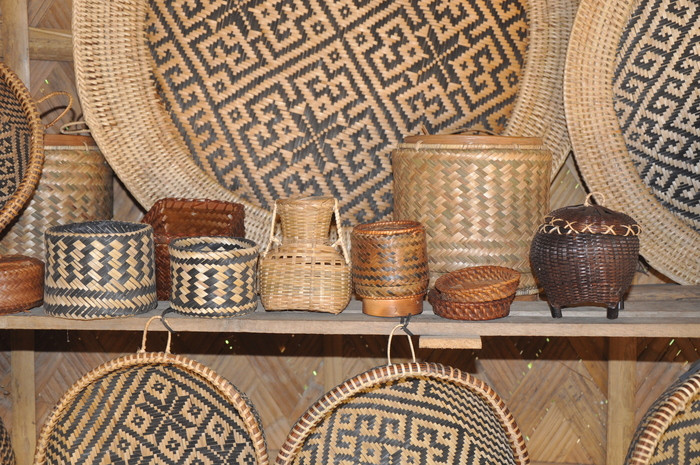 |
| The woven products of the Bamboo and Rattan Weaving Group in Diem village, Chau Khe commune (Con Cuong district) are constantly being improved in terms of design. Photo: Cong Kien |
There were times when Ms. Hoa neglected her household chores to travel around, seeking to open training classes in weaving techniques for her group members and exploring and searching for markets. Wherever handicraft fairs were held, she would go to display her group's products, hoping to meet customer demand. She has been to Vinh, Hanoi, and Da Nang to introduce her group's products. Participating in fairs also allowed her to understand market needs and learn from experience to share and guide her members back in her village. She even went to remote villages in Tuong Duong and Ky Son districts to meet with weaving artisans to learn more techniques and experience.
To continuously improve the product, she encouraged the team members to unleash their creativity, with each person proposing an initiative aimed at improving the design and enhancing quality. The members enthusiastically shared their ideas, with the ideas of artisans Vi Thi Noi and Luong Van Long standing out.
In her youth, Mrs. Vi Thi Noi was the most skilled weaver of skirts and blouses in her village, perhaps even in the entire Chau Khe region. The young woman from Diem village learned from her mother how to harmoniously and delicately combine colors and embroider patterns and motifs on skirts, making them popular among those around her. Now elderly, Mrs. Noi joins the weaving group with the hope of contributing to the restoration of the traditional craft, so that future generations can find another way to connect with their cultural roots.
She realized that, for a long time, the products had been conventionally woven, primarily focusing on utilitarian value, making it difficult to access the market, as they were readily available. Improving designs, enhancing aesthetics, and infusing "soul" into the products were the only ways to gain a foothold and find outlets to sustain and develop the weaving craft. An idea flashed through her mind: why not adapt the patterns and motifs of traditional brocade fabrics to woven products? She immediately put it into action. She went into the forest to gather medicinal plants, pounded and boiled them, dyed the bamboo strips in various colors to create colorful patterns, and then applied the colors to the product surfaces. The trays, baskets, and other items with their striking and eye-catching patterns impressed even the most discerning customers. This initiative was then implemented by the entire group, and sales increased significantly.
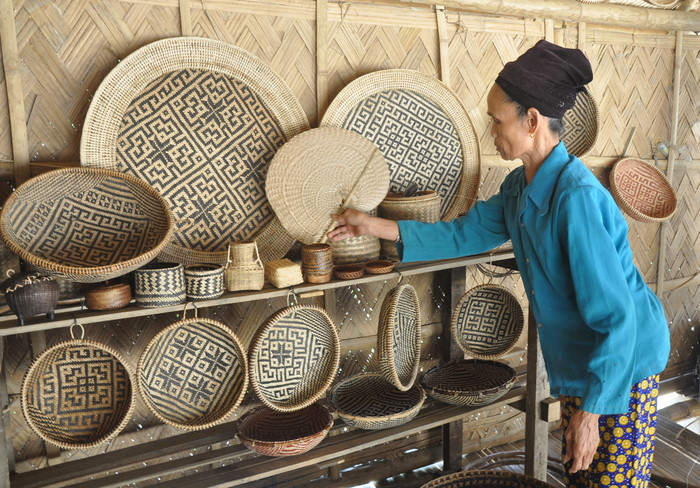 |
| Ms. Vi Thi Noi introduces the products of the rattan and bamboo weaving group in Diem village, Chau Khe commune (Con Cuong district). Photo: Cong Kien. |
Following in his grandmother's footsteps, Mr. Luong Van Long devised a way to weave dyed bamboo strips into products inscribed with meaningful messages. These messages could be slogans, proverbs, or simply the names of villages, hamlets, or customers. Mr. Long's initiative was quickly adopted, especially by customers from afar who often ordered personalized products as souvenirs. This increased the value of the products, helped establish their position at handicraft fairs, and expanded their reach in the market.
Cong Kien
| RELATED NEWS |
|---|


