
Resolution No. 43 is timely, in line with the people's wishes, and enjoys public consensus.
The implementation of Resolution No. 43 has been carried out with great urgency throughout the country...
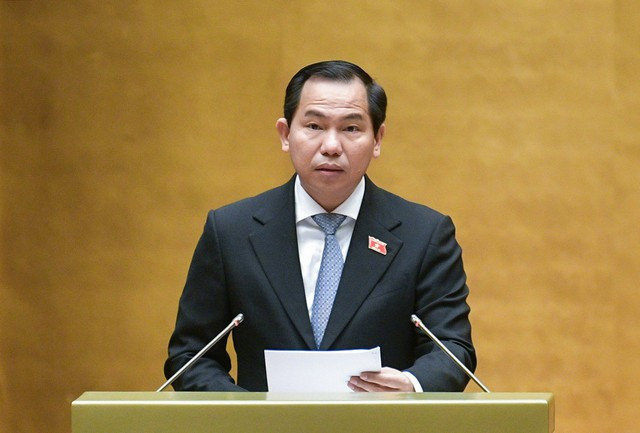
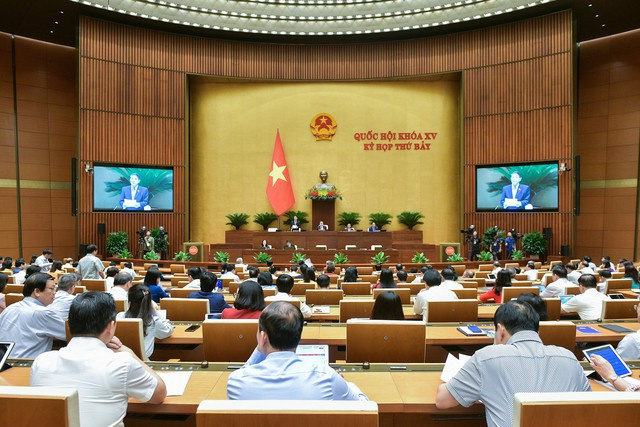
At a plenary session held in the assembly hall on the morning of May 25th, the National Assembly considered the report on the results of the thematic supervision on "The implementation of Resolution No. 43/2022/QH15 dated January 11, 2022, of the National Assembly on fiscal and monetary policies supporting the socio-economic recovery and development program and the resolutions of the National Assembly on a number of important national projects until the end of 2023".
Resolution No. 43 was issued by the National Assembly in a special context, when the COVID-19 pandemic, with its extremely complex and unpredictable developments, had a severe negative impact on people's lives and the socio-economic situation of the country.
Based on the Party's guidelines and the National Assembly's resolutions, at the first extraordinary session, after considering the Government's submission, the National Assembly voted to approve Resolution No. 43 with many strong, decisive, and unprecedented policies aimed at achieving the "dual goal" of supporting COVID-19 prevention and control efforts, supporting people and businesses, and helping to restore and develop the economy after the pandemic.
A crucial foundation for promoting socio-economic recovery and development.
Reporting to the National Assembly, the Chairman of the National Assembly's Finance and Budget Committee and Deputy Head of the National Assembly's Standing Supervisory Delegation, Le Quang Manh, stated that by the end of 2023, after two years of implementing Resolution No. 43, Vietnam had gradually reopened its economy and restored economic and social activities.
The country's economic and social activities, after adapting to the pandemic, quickly returned to normal and gradually recovered; macroeconomic stability was maintained, inflation was controlled, growth was promoted, and major economic balances were ensured; the investment and business environment continued to improve; social security, national defense and security were maintained; foreign relations were strengthened; and the restructuring of the economy, investment, trade, services, and the development of the digital economy continued to be promoted. These factors play a crucial foundational role in promoting socio-economic recovery and development in the next two years (2022, 2023) and beyond.
At its 5th session, the 15th National Assembly issued Resolution No. 90/2023/QH15 dated June 8, 2023, on the National Assembly's monitoring program for 2024, and Resolution No. 94/2023/QH15 dated June 22, 2023, on the establishment of a specialized monitoring delegation on "The implementation of Resolution No. 43/2022/QH15 dated January 11, 2022, of the National Assembly on fiscal and monetary policies supporting the socio-economic recovery and development program and the National Assembly's resolutions on a number of important national projects until the end of 2023".
Key national projects include: Long Thanh Airport Project; the North-South Expressway projects (Eastern section) giai đoạn 2017-2020 and 2021-2025; Ring Road 4 - Hanoi Capital Region Project; Ring Road 3 Ho Chi Minh City Project; Khanh Hoa - Buon Ma Thuot Expressway Project (Phase 1); Bien Hoa - Vung Tau Expressway Project (Phase 1); Chau Doc - Can Tho - Soc Trang Expressway Project (Phase 1).
These are projects whose investment policies have been decided by the National Assembly to accelerate the implementation of one of the three breakthroughs of the 10-year socio-economic development strategy (2021-2030) on infrastructure development.
"In implementing the National Assembly's Resolution, the Supervisory Delegation issued a plan and outline for supervision to the entities subject to supervision; assigned the National Assembly delegations of provinces and cities to conduct supervision; organized direct supervision in 10 localities, and worked with the Government and 12 ministries, sectors, and agencies. To date, the Supervisory Delegation has completed its assigned tasks, ensuring progress and achieving the set objectives," said Le Quang Manh, Chairman of the National Assembly's Finance and Budget Committee.
Responding to the urgent needs of the situation, with the consensus and active support of the people.
According to Le Quang Manh, Chairman of the National Assembly's Finance and Budget Committee, Resolution No. 43 was issued and implemented in a special context when the COVID-19 pandemic was ongoing and had a very negative impact on people's lives, the economy faced many difficulties, growth slowed down, production and business activities contracted, and social security, employment, and the livelihoods of workers were severely affected.
Under the leadership of the Party, the proactive and timely involvement of the National Assembly, the decisive management of the Government, the Prime Minister, ministries, sectors, and localities, and the active participation of the people and the business community, the implementation of Resolution No. 43 has been carried out with great urgency nationwide, achieving many positive results. This has significantly contributed to the effective implementation of the Party's, National Assembly's, and Government's policies and guidelines in the prevention and control of COVID-19, gradually controlling and ending the pandemic, bringing social life back to normal, promoting the economy to overcome difficulties, recover and grow, ensuring social security; and maintaining national security, defense, order, and social safety.
The results show that most of the policies and measures issued in Resolution No. 43 were timely, in line with the people's wishes, met the requirements of the urgent situation, and received the people's consensus and active support.
After two years of implementation, many goals and targets set out in Resolution No. 43 have been basically achieved. GDP growth in 2022 reached 8.12%, the highest growth rate in the period 2011-2022; in 2023, it reached 5.05%, a relatively high rate given the many new difficulties and challenges facing the world and the country.
Maintaining macroeconomic stability and ensuring major economic balances; flexible management and close, harmonious coordination between fiscal and monetary policies; the mobilization, allocation, and regulation of public investment capital help to bring resources into the economy rationally; inflation is controlled, interest rates and exchange rates are managed appropriately and stably; budget deficit and public debt remain within the limits permitted by the National Assembly and are lower than projected levels.
The economic and social achievements in the past two years (2022-2023) have created an important foundation for continuing to strive for the successful completion of the economic and social targets set by the 13th National Party Congress for the 2021-2025 period.
Many policies have been implemented effectively and promptly, such as: credit policies through the Social Policy Bank system, housing rental support for workers, and reductions in value-added tax rates, which have contributed to helping people, workers, and businesses overcome difficulties, maintain and restore production and business; special mechanisms approved by the National Assembly have been effective, strengthening the responsibility, management capacity, initiative, and creativity of ministries, central and local agencies, shortening implementation time, promoting capital disbursement progress, supplementing important and timely cash flow for the economy, and at the same time, maximizing the effectiveness of investment projects.
National key projects are being actively implemented.
Regarding the implementation of the National Assembly's resolutions on several important national projects, the Chairman of the National Assembly's Finance and Budget Committee, Le Quang Manh, stated that the Government has promptly issued documents to implement the National Assembly's resolutions on the investment policies for important national projects. These documents have assigned specific tasks to the relevant agencies, set timelines, and implemented special mechanisms as required.
The Prime Minister has established a State Steering Committee for key national and transportation projects to address and resolve numerous difficulties and obstacles in implementation, particularly in compensation, support, resettlement, and the availability of earth and sand for embankment materials. While the preparation and implementation schedule for these projects has not yet met the government's requirements, it has been significantly shortened compared to previous projects.
The projects have received strong attention and direction from the National Assembly, the Government, central ministries and agencies, and the People's Committees of provinces and cities. Local authorities have generally done a good job of disseminating information and mobilizing support from the people during the process of compensation, support, resettlement, and land clearance.
Many localities have involved the entire political system in the implementation process, promptly resolving difficulties and obstacles, accelerating project progress, promoting initiative, and effectively mobilizing local resources in investment and construction management. Decentralization has increased initiative, linked it with specific responsibilities, and at the same time, created conditions to improve the management capacity of many localities when they are assigned to implement important national projects for the first time.
To date, the component projects, which have been decentralized to local authorities as the managing agency, have been implemented largely according to schedule and have been allocated sufficient local budget funds as committed.
Amidst numerous difficulties in construction materials and the significant impact of the COVID-19 pandemic, the Government directed relevant agencies to make every effort to complete and put into operation 635 km of the North-South East Expressway construction project in the 2017-2020 period, raising the total length of expressways nationwide to 2,001 km. This will maximize investment efficiency, enhance national competitiveness, ensure national defense and security, reduce traffic congestion and accidents, save travel time and social costs, and meet the expectations of the people and businesses.
Along with the fiscal policies aimed at stimulating consumer demand under Resolution No. 43, key national projects have strongly boosted the overall investment demand of the economy, creating important momentum for promoting economic and social growth and development.
Besides the fundamentally positive results, the Chairman of the National Assembly's Finance and Budget Committee, Le Quang Manh, emphasized that the issuance and implementation of Resolution No. 43 still have some shortcomings and limitations.
Specifically, the preparation for investment in some projects has been slow, failing to ensure readiness for implementation and disbursement of capital according to the deadlines set in Resolution No. 43. Some policies have not met the planned targets. Policies supporting people and workers in some localities have been slow and inconsistent. The economy's capacity to absorb capital and the competitiveness of domestic businesses remain low due to high input costs, imported raw materials, and declining output markets, orders, and business revenue, affecting the ability to repay bank loans and posing a risk of bad debts. Many localities have lower credit growth compared to the same period in previous years and lower than the growth rate of the entire system. By the end of 2023, many businesses were still facing difficulties and challenges, and had not yet recovered from the impact of the COVID-19 pandemic…
Many lessons were learned.
Through an overall assessment of the implementation of Resolution No. 43, as well as an in-depth evaluation of each specific policy regarding achievements, shortcomings, limitations, obstacles, and their causes, the Supervisory Delegation drew the following lessons learned: A quick response and timely issuance of policies to address the practical situation, aimed at supporting businesses and people in the particularly difficult context of the COVID-19 pandemic severely impacting people's lives and the production and business activities of enterprises, is absolutely essential; adhering closely to the Party's guidelines and directions on the goal of socio-economic recovery.
Policy formulation needs to be closely linked to the requirements and the ability to balance resources for implementation. It is necessary to innovate and improve forecasting capabilities to propose and enact policies that are appropriate to reality and ensure feasibility.
The resolution needs to be implemented urgently and synchronously from the central to local levels with high determination, a correct understanding and assessment of the importance of the policies, mobilizing the strength of the entire political system, and ensuring the achievement of the policy objectives.
It is necessary to promote a proactive and creative spirit in the implementation of assigned tasks by ministries, sectors, and localities, and to enhance the coordinating role of units in implementing policies; promptly resolving difficulties and obstacles to ensure successful policy implementation.


