
Scientific research is at a "poor" level.
Resolution 29 of the Party on fundamental and comprehensive educational reform clearly states that the position of a university in the higher education hierarchy depends heavily on young scientific resources. However, in reality, policies to encourage this workforce have not been effective. Inadequate research conditions, such as outdated laboratory equipment and policies that are not attractive enough to young scientists, are fundamental reasons why many universities are facing difficulties in attracting young talent.
Concerns of those involved
Currently, some key universities have found their own path to development by applying experiments and research topics to real-life applications. The Shipbuilding Research Institute of Nha Trang University is one such example. Here, boats made by students and research groups are highly sought after in the market. Dr. Bui Van Binh from Hanoi University of Electrical Engineering stated that boats with composite hulls (called "plastic boats" by fishermen) are becoming the preferred choice for many fishermen in Khanh Hoa province, especially those who specialize in fishing in the Truong Sa (Spratly) Islands. This is a bright spot in the application of scientific research into practice, originating from the laboratories of universities.
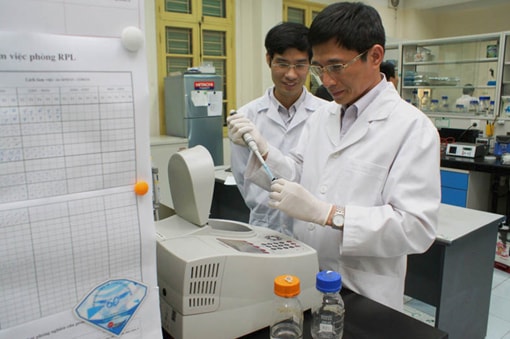 |
| National Key Laboratory of Enzyme and Protein Technology, University of Natural Sciences. |
| RELATED NEWS |
|---|
Returning with a PhD from France, NLM joined a prestigious university in Ho Chi Minh City. After graduating, he quickly wanted to return to Vietnam to fulfill his long-held dream of becoming a teacher. However, after a year of work, he began to have doubts about his decision. “My greatest wish was to conduct scientific research at a university. I hoped to pass on what I learned abroad to students and guide them. However, the research environment at the university hasn't been given enough attention. Some experimental equipment is no longer suitable but still needs to be used. We requested to purchase more modern equipment for experiments, but the university lacked the funds. The old equipment frequently malfunctions during experiments, significantly impacting the morale of the research team,” NLM explained.
“A university that is on the list of 17 key national universities, but whose scientific research has not yet ‘escaped poverty,’ cannot reach national status. Because when we talk about ‘national,’ it means being on a list in comparison to international standards. Internationally renowned universities prioritize scientific research. Admittedly, our country is still developing, but the education sector should know how to invest strategically, avoiding scattered investments, in order to have truly worthwhile investments,” the young PhD confided.
Dr. Bui Van Binh from Hanoi University of Electrical Engineering stated: "To complete a doctoral thesis or dissertation, the laboratories at universities are currently inadequate due to a severe shortage of equipment. Often, to complete a dissertation, students have to collaborate with training institutes or rent equipment. The cost of investing in a laboratory for a mechanical engineering department can reach 600-700 million VND. Even then, it's only a moderately sized laboratory serving small-scale research projects," Dr. Bui Van Binh added.
The main reason why scientific research at universities has not developed is the shortage of qualified young lecturers, despite some universities' efforts to attract a team of young lecturers. Statistics from the Vietnam Union of Science and Technology Associations show that during the period 2006-2010, only 8 lecturers under 45 years old from universities participated in leading research projects under key programs (accounting for less than 0.25%). Very few science and technology tasks were led by lecturers. Notably, in large universities, the number of young lecturers under 45 years old is constantly increasing. Hanoi University of Science and Technology has 52% of its scientific staff under 37 years old. At the University of Technology (Vietnam National University, Hanoi), the number of scientific staff under 35 years old accounts for 39%...
Strengthen incentive policies.
Analyzing this situation, reputable scientists and educators believe that the cause lies in the operating mechanism.
Dr. Nguyen Tien Thao, Deputy Head of the Department of Chemistry, Faculty of Science (Vietnam National University, Hanoi), believes that the most important thing for any scientist is the working environment. This environment must provide freedom in scientific research and have good equipment to support research. Only then should issues like salary and policies come into play. If these conditions are not met, it's easy to become discouraged and compare oneself to others.
“Besides the mechanisms, the large investment required for young scientists just starting their careers to build a research group in Vietnam is very difficult. The National Science and Technology Development Fund can only cover a portion of the project's funding for a short period (an average of 2 years). Meanwhile, they have to utilize existing equipment and facilities for their research and do not have access to modern, standardized equipment,” analyzed Dr. Ngo Duc The from the National University of Singapore.
Responding to questions about policies to attract young human resources for scientific research at the university level, Mr. Ta Duc Thinh, Director of the Department of Science, Technology and Environment, Ministry of Education and Training, stated that on October 25, 2014, the Government issued Decree No. 99/2014/ND-CP regulating investment in developing potential and encouraging scientific and technological activities in higher education institutions. The breakthrough in this regulation is the clear definition of rewards for the contributions of lecturers in scientific research. The decree also sets investment levels for laboratories.
“The Inter-Ministerial Committee will consider providing financial support for the use of national key laboratories, specialized laboratories, and interdisciplinary laboratories to carry out scientific and technological tasks, except in cases where this funding has already been included in the task's budget. Cooperation with businesses, organizations, and individuals in scientific research within universities is encouraged. Specifically, businesses, organizations, and individuals will be exempt from or receive reductions in corporate income tax, personal income tax, and import tax as stipulated by tax laws when importing equipment, machinery, and raw materials to invest in developing the scientific and technological potential of universities. This is a fairly open incentive and has been well received by many universities,” Mr. Ta Duc Thinh stated.
In addition, the reward levels for research projects are clearly defined. The Decree also specifies: A monetary reward not exceeding 30 times the general basic salary will be given for publishing one article in a prestigious international scientific journal. The reward will be taken from the science and technology budget allocated to the higher education institution; 50% of the copyright registration fee will be subsidized. The subsidy will be taken from the science and technology budget allocated to the higher education institution; Equivalent to 20 hours of theoretical teaching if one article is published in a scientific journal with a rating of 1 in the list of the State Council for Professor Titles.
"The level of state investment is immutable. Therefore, the regulations clearly define and focus on a few key areas. There will be no more scattered investment. With this clarity, scientific research in universities must certainly be a priority," Mr. Ta Duc Thinh emphasized.
Mr. Ta Duc Thinh also added that the adjustment of lecturers' teaching hours is determined by the universities themselves. At the same time, the Ministry of Education and Training is trying to balance enrollment quotas by reducing them, gradually moving towards reducing the number of in-service training positions so that teachers can focus on scientific research.
According to the News


