
Japanese Foreign Minister visits Russia: We still need each other.
(Baonghean) - Japanese Foreign Minister Fumio Kishida is on a four-day visit to Russia to discuss the territorial dispute between the two countries and to prepare for the upcoming visit of Russian President Vladimir Putin. Setting aside long-standing disagreements over territorial sovereignty, the trend towards dialogue between Japan and Russia remains on the rise. Both countries still have many potential areas for future cooperation.
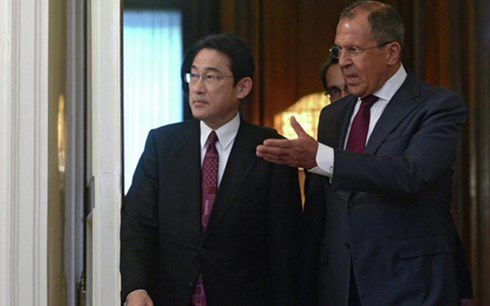 |
| Russian and Japanese foreign ministers discuss a peace treaty. Photo: Sputnik |
Prioritize dialogue.
The biggest topic in the recent meeting between Foreign Minister Kishida and his Russian counterpart Sergei Lavrov remained the territorial dispute. During the meeting, Foreign Minister Kishida expressed regret over a series of visits in August by Prime Minister Dmitry Medvedev and Russian ministers to the disputed islands that Japan calls the Northern Territories, while Russia calls them the Southern Kuril Islands. He stated that the two countries need to discuss an acceptable solution based on the joint statement issued after the 2013 Russia-Japan summit.
While acknowledging that territorial disputes remain the most difficult issue between the two countries, the Japanese Foreign Minister still hopes to find a breakthrough soon to pave the way for a peace treaty between the two nations – a document long awaited since the end of World War II.
And Japan achieved this goal when, at the recent meeting, both sides agreed to resume vice-ministerial-level talks on a peace treaty on October 8th. On the Russian side, Foreign Minister Lavrov acknowledged that relations between the two countries had been "frozen" in recent months, while emphasizing that both Russia and Japan must do more to expand relations in areas such as trade, investment, and economic development.
The benefits are undeniable.
These signals indicate that both Japan and Russia are aware of the need to resolve their territorial disagreements and disputes and seek a new approach to their bilateral relationship. First and foremost, this involves maintaining bilateral contact, despite strong territorial claims. Since returning to the position of Prime Minister of Japan, Shinzo Abe has met with Russian President Putin several times, including Abe's historic visit to Russia in April 2013.
Since then, the two sides have officially opened negotiations to end territorial disputes and established a 2+2 dialogue framework between the two countries' Defense and Foreign Ministers. This is a rare phenomenon, as Japan only maintains 2+2 dialogue with two other allies, Australia and the United States. Meanwhile, Japan is Russia's only 2+2 dialogue partner in Asia. This rapprochement can be explained from the perspective of national interests. For Japan, Russia has always been an important partner in the region, and Russia's significant voice on pressing global issues as a permanent member of the UN Security Council could be an advantage for Tokyo in its pursuit of a more important position on the world political map.
From Russia's perspective, the confrontation with the West over the crisis in Ukraine has forced the superpower to turn to Asia – a new strategic area with significant potential for cooperation.
Firstly, Japan is currently a member of the G7 group of industrialized nations, a group that is boycotting and imposing sanctions against Moscow. Therefore, maintaining a channel of dialogue and cooperation with Tokyo would help Russia open the door to Western members of the G7.
Secondly, Russia's energy sector is undergoing a dramatic transformation, with the development of direct pipelines to Asia via the East Siberia-Pacific pipeline. Russia plans to double its oil and gas exports to Asia over the next 20 years as part of a strategy to shift its oil and gas export routes away from Europe. This presents an opportunity for Japan, which is forced to import large quantities of fossil fuels to reduce its reliance on risky nuclear energy. Therefore, Japan could be a good partner, even potentially complementary to the Russian economy.
Currently, Gazprom and the Japanese Ministry of Energy are discussing Russia's gas supply to Japan, including the possibility of Japan participating in the construction of a natural gas liquefaction plant in Vladivostok. This would allow Japan to purchase additional liquefied natural gas from Russia, beyond the amount extracted from the Sakhalin Islands. This would help Russia diversify its energy export markets and increase its competitiveness in the global gas market.
Furthermore, accepting Japanese assistance is part of a broader program to modernize Russia's partnerships. Russia hopes to attract foreign investment to the Far East, a region in need of accelerated development. Additionally, Moscow has not concealed its intention to seek investment from Japan, as it does not want to be dependent on exclusive Chinese investment in its Asian energy infrastructure.
The recent signs of a "hard landing" for the Chinese economy serve as a clear warning to Russia about diversifying its business partners and balancing its economic relationships in the long term.
Setting aside disputes and the "frozen" relations, both Russia and Japan maintain high-level dialogue channels to explore possibilities for cooperation. Japanese Foreign Minister Fumio Kishida's visit to Russia, and possibly President Putin's trip to Japan later this year, are all geared towards these opportunities.
Thanh Son
| RELATED NEWS |
|---|


