
Cua Tiles - Quality builds the brand.
(Baonghean) - Cua tile-making village is one of the few craft villages in the province and the country that has survived sustainably in the market during times of economic recession. The village has known how to stay afloat by building its brand and producing a diverse range of products to meet the ever-increasing demands of the market.
Cừa tiles are made from a unique clay source in Nghĩa Hoàn - Tân Kỳ, a rare commodity. This abundant, smooth, and deep black clay, like a treasure trove, has transformed the lives of the people of Nghĩa Hoàn. In Tân Kỳ, even the most luxurious houses are roofed with Cừa tiles. Restaurants and bars even choose to showcase the underside of the tiles to tourists by leaving the ceilings uncovered. The underside of the tiles features the Cừa tile brand logo with sharp, embossed lettering. The tiles are a vibrant pink, smooth, cool, and durable. The villagers in the Cừa tile-making village even assured us that the tiles won't break when walked on. Indeed, Cừa tiles have been a source of pride for Tân Kỳ and Nghệ An for decades.
Cừa tiles are currently in high demand in many provinces such as Thanh Hoa, Nghe An, Ha Tinh, and Quang Binh; and were granted a trademark by the Intellectual Property Office on April 10, 2007. Despite having a brand and products that have won the hearts of consumers, the craft village continues to strive and invest in more machinery and equipment to make each tile produced more beautiful and of higher quality, while also reducing the labor required. In June 2012, the Cooperative's management board invested in five more modern, improved tile pressing machines to further enhance the quality of Cừa tiles. With this progress, the production of tiles in 2012 reached nearly 70 million pieces. In 2013, the total production reached nearly 200 million pieces.
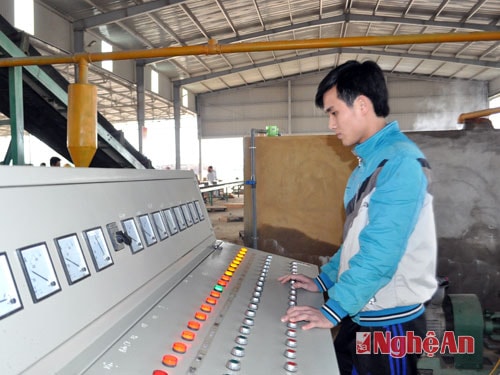 |
| Automated control system for the production line of roof tiles. |
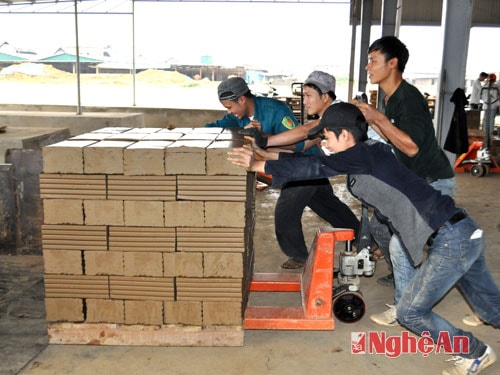 |
| Insert the tile blanks into the mold. |
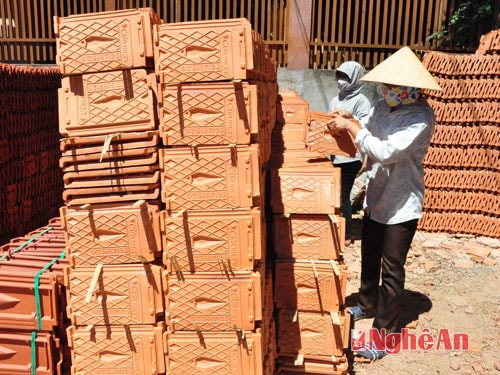 |
| Cừa roof tiles. Photo: Thanh Lê |
Dissatisfied with the achievements already made, and striving to produce smooth, glossy, grit-free, high-quality tiles that could fetch a high price on the market, after visiting and learning from many provinces in Northern Vietnam, the Tan Ky Department of Industry and Trade and the Cua Tile-Making Village recognized that the tile production model in Quang Ninh met the set criteria, was suitable for Tan Ky's conditions, ensured environmental protection, and had reasonable technology transfer and investment costs. Therefore, they proposed transferring and applying this model to the Cua Tile-Making Village in Tan Ky. To date, the production line has been successfully installed and is operating efficiently. The success of the new production line, which creates tile blanks for stamping and firing, has propelled Cua tiles to a new level of progress. Tiles produced are sold as soon as they are made. After being extracted from the raw material source, the clay is collected in the factory's storage facility, then fed into a hopper, followed by a coarse slicing machine, then a coarse grinding machine, a fine slicing machine, a fine grinding machine, and finally a vacuum-assisted shaping machine to produce the final product. As a result, the product has high cohesion, the tiles are glossy, smooth, beautiful, crack-free, and free of impurities because they are filtered out from the beginning. The production line operates automatically, safely, and with high productivity.
The high-quality tile production line was primarily formed from capital contributions by cooperative members, with a total investment of nearly 10 billion VND. Of this, 53 members contributed 8.9 billion VND, and the budget provided 309 million VND from scientific research funds. The participating members are those with strong economic potential and a desire for long-term production and business, and who comply well with the government's policy of eliminating manual brick kilns. Many borrowed from banks to secure sufficient funds for the investment. The factory has been upgraded, ensuring products are not damaged during the rainy season. A new power station has also been installed, reducing energy losses compared to before.
The Cừa tile-making village is one of the few traditional craft villages in the province and the country that has survived sustainably in the market during the economic downturn. The village has managed to stay afloat by building its brand and diversifying its products to meet the ever-increasing demands of the market. Each year, the village generates over 110 billion VND in revenue, pays over 1.5 billion VND in taxes, and creates jobs for hundreds of workers. However, currently only 50% of the households with tile kilns here have adopted new technologies, improved production, and complied with the policy of eliminating manual brick kilns. The work of educating and persuading the remaining households needs to be done more effectively.
Pearl


