
The school of teachers
(Baonghean) - In early April, we traveled to the remote border commune of Tri Le, Que Phong district, to visit a school with 40 teachers stationed in the village, where we heard touching stories filled with the love between teachers, students, and the local people…
Tri Le 4 Primary School has six remote and isolated school locations in the ancient villages of the Hmong people. Currently, the school has 31 classes with 528 students in six different villages. In previous years, the teachers had no choice but to walk all day from the center of Tri Le commune to these school locations, regardless of the weather. The roads wound along the mountainside, with deep ravines below... Because of these unique conditions, it was impossible to recruit female teachers who were considered "weak and delicate" to teach in these remote villages. Therefore, this is the only primary school with only male teachers.
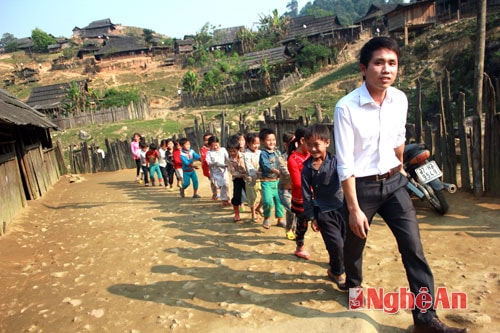 |
| Teacher Phung Van Mui and students during a physical education class. |
Although we had already conquered the winding, steep roads of western Nghe An province, we still broke out in a sweat crossing the summit of Pha Ca Tun mountain to reach the school located in Huoi Moi 1 village. Seeing my tense and nervous expression, Tho Mai Xong, a fellow traveler, joked, "This road is already very good; during the rainy season, it's very slippery. If journalists want to travel this way, they'll have to wrap chains around their motorbike wheels to be able to get through." After more than two hours of climbing mountains and wading through streams, Huoi Moi 1 Primary School, roofed with Pơ Mu wood, appeared before us. In the tranquil atmosphere of the mountains and forests, the sound of the children reading aloud echoed steadily and warmly. We were greeted with a firm handshake from teacher Tho Ba Sinh – the school's vice principal. To date, Mr. Sinh has spent 26 years working with students in the most remote villages of Tri Le commune. Looking at us with joyful eyes, the teacher emotionally shared: "It's been a long time since journalists visited the school. The road has been widened today, making travel much easier than in previous years, when it was very difficult and arduous. Due to its remote location, the school's facilities are still lacking, and both teachers and students have to work hard."
The simple classrooms are made entirely of cypress and fir wood. Because the roads are treacherous, making it impossible to transport steel, cement, or bricks, the school was built using makeshift bamboo and wood. Over time, the school has deteriorated severely, making learning and living extremely difficult for the teachers and students. “The villagers have discussed repairing the school and living quarters for the teachers several times, but now wood from the forest is scarce, and we don’t know where to find it. Seeing the teachers working so hard and enthusiastically to educate our Hmong children, we villagers are deeply grateful!” – said Tho Chia Chu, head of Huoi Moi 1 village.
A new day for the teachers in the mountainous region begins at 5 a.m. Because there's no communal kitchen, the teachers themselves act as cooks. In the morning, the most popular dish is instant noodles. On some days, due to rain and wind, they can't go out to buy them, so the teachers have to go to class hungry. Teacher Nguyen Van Khoa (from Quynh Phuong, Quynh Luu) confided: "It's far from the commune center here, so food is very unpredictable. During the rainy season, we have to eat rice with fish sauce and instant soup powder for a whole week. Life is hard for the teachers, but teaching the children makes us very happy." Teacher Khoa has been teaching in Que Phong for seven years now. Due to the long and treacherous roads, he only manages to return home to visit his wife and children every few months or during holidays.
Back home, many teachers didn't know anything about cooking or housework, but when they came here, everyone had to cook for themselves. "In the beginning, when we first came to the remote village, the dishes we cooked were terrible – burnt rice, undercooked rice, inconsistent saltiness. However, after a few years of self-sufficiency, now everyone can become a chef. All six schools are male, so everyone has to try to learn and adapt gradually to serve each other," said Mr. Ha Van Bon, a teacher at the Nam Tot school.
Fresh out of school, Mr. Phung Van Mui (from Chau Kim, Que Phong) was assigned to teach in a remote border region. In his youth, the lonely nights in the forest without electricity made the young teacher feel homesick for his family and girlfriend. Mui shared: “The schools are all male, so it’s a bit lonely. All the chores, from cooking and washing dishes to laundry, have to be done by hand. At first, it felt strange because we didn’t do much at home, but after a while, everyone got used to it.”
Most of the teachers at Tri Le 4 Primary School are Kinh and Thai ethnic minorities, while the students are mostly Hmong. Therefore, to teach and impart knowledge to the children, the teachers must understand the customs and traditions of the local people, especially the Hmong language. “Besides preparing lesson plans, we also have to learn Hmong from the villagers or the students. This place is isolated, and the children don't have much contact with the outside world, so if we only teach in Kinh, they sometimes won't understand. Learning and knowing Hmong makes us feel closer and more connected to the villagers and the children,” confided Mr. Hoang Van Quang, a teacher stationed in Huoi Xai 1 village. It's noticeable that on the teachers' lesson plan desks, notebooks are filled with Hmong notes, like little “dictionaries.” Thò Y Nu, a fifth-grade student, spoke to us fluently in Vietnamese: “Thanks to the teachers’ instruction, I now speak Vietnamese very well and understand lessons more quickly. My dream is to study at college or university and return to teach the Hmong children here.”
From these impoverished schools perched high in the Truong Son mountain range, generations of students have grown up, gone on to university and college, and then returned to teach, dedicating their youthful energy to their villages. In our conversation, young teacher Tho Ba Cho couldn't hide his pride: "When I first graduated, I had many choices, but in the end, I decided to come here to teach. With literacy, the lives of the Hmong people are less difficult, and the rice and corn we produce are healthier and more productive."
In the remote highlands of Que Phong district, the teachers of Tri Le 4 Primary School have overcome countless difficulties and hardships, working day and night to educate the Mong and Thai ethnic minority students. They hope that in the not-too-distant future, this education will transform the face of these impoverished villages.
Triều Dương


