
The scorching wind in my homeland
(Baonghean) - It's been 15 years, 15 years since I returned to the land of the Lao wind. On that bus 15 years ago, that slow, crowded bus filled with the excitement of a girl deciding to come and stay in Nghe An, after a bend in Thanh Hoa province, I suddenly felt myself falling into a hot, humid atmosphere, even though the wind was blowing fiercely. He told me: "That's the 'specialty' of the Lao wind in my hometown. When you get to Nghe An, the wind is even hotter..."
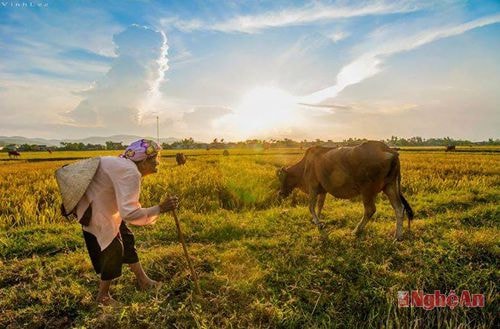 |
| Photo: Vinh Le |
“I’ve just arrived, I haven’t seen anything yet / Only sand and the Lao wind fanning the flames.” I arrived in Nghe An with an “encounter” exactly like those lines of poetry by the poet Xuan Quynh. Only this, I didn’t realize until now, is that within me, that Lao wind resided in the passion, intensity, the resolute, even prickly, and sincere frankness of the people of Nghe An that I love. That wind has blown for millennia on this land, to greet me amidst the swirling dust as I stood on the third floor of the old Quang Trung apartment building (Vinh City) looking down at the national highway below. Later, an older friend from Vinh, a resident of Ward 1 whom I mentioned in an article, told me that his most vivid childhood memories were also on this street, where his house used to be. It was a row of thatched houses built close together. The scariest time was the Lao wind season. Just one careless house catching fire was enough to turn the entire neighborhood ablaze. It was truly a scene of "torches of fire" soaring into the air, as the raging wind whipped up thatched roofs, throwing them high into the air. It felt as if the whole city was on fire. In the chaos and panic, people could only run, many silently looking back at the flames with a sense of helplessness. Every year, there were several fires, big and small, but the three biggest fires that many people in Vinh will never forget were during the hot, dry seasons of 1957, 1960, and 1961, which destroyed hundreds of houses.
Now, air-conditioned rooms have driven the stifling heat of the Lao wind out through the glass windows. My old colleague, nearing retirement, once told me, "I don't like air conditioning; I prefer to open the windows and let in the fresh air." He considered himself eccentric and out of place, but one day I caught that sudden realization in him: "Oh, the Lao wind!" There was a strange tone in his exclamation, as if he had rediscovered a dear childhood friend. I understand why many people leave this land but still yearn for it, and what they miss most is... the wind. The wind originates from the Bay of Bengal; as it crosses the Thai and Lao mainlands, it leaves behind some moisture. Reaching the Truong Son mountain range, it is blocked, blown upwards, encounters cold, and drops its last bit of moisture to the western side of the Truong Son range. In its final leg of its journey, only dry wind remains, combined with the moisture from the pebbles heated by the summer sun, as it passes through the villages of Central Vietnam before reaching the sea. Those were clear, bright summer days, with only a few wisps of white clouds in the sky, which suddenly seemed higher and deeper blue. “Can you taste the wind?” “It’s the taste of the heat, where even with your eyes closed you can feel that fiery tongue licking your face. It’s the taste of sand, of sweat mingled together. The taste of hardship, of silent toil…”
Fifteen years, I haven't fully witnessed the hardships carried by the winds that have blown for millennia, but I have seen the deep love that has settled within. Who sang to me, "If you love, love truly," who recited to me, "The Lao wind blows away the bamboo groves / Just hearing the voice, you can hear the hardship," so that with just a glance, I knew my fate was to return to Nghe An? To return to cherish the heavy, thin hands of my grandmother with her palm-leaf fan carrying the wind. To return to cherish my mother's shadow, swaying in the wind on the dike, scorched by the biting grass. To return to cherish my father's sweat-soaked shirt, dried into countless white salt stains. To return to know of a boy who, burying his face in the smooth earth every summer noon, dreamed of the canarium fruit, drawing flowers with outstretched petals. If you hadn't told me, how would I have known that, after eating the canarium fruit, the seeds, cut horizontally, were hammered upside down into the compacted earth to create decorative shapes in the old village houses? The season of the Lao wind, the season when the peach blossoms bloom in front of the house. The wind blows, scattering the peach blossoms, and the children, forgetting the sweltering heat, run out to gather them and string them into small, pretty white necklaces. Later, whenever I see a peach tree still standing in bloom, I see a pang of nostalgia in the eyes of the man whose hair has begun to turn gray. Then the young betel nut blossoms and unripe betel nuts also fall onto the yard. Grandma sends the children to gather them for chewing betel. The young nuts are so tender that Grandma's hands are less tired in the tiny betel nut mortar. The Lao wind blows so strongly that once it even blew away a dove's nest high up in the betel nut tree. The two doves fell onto the eggplant patch, their tiny beaks gaping as if pleading for help… The rustling wind in the fields seems to drown out Grandma's calls to "little boy" to get potatoes and water, urging his mother to rest. The wind punished the absent-minded boy; he took his torch to ask for fire, but unfortunately placed it near a pile of straw, and the fire flared up...
The Lao wind season begins, which is also the rice harvest season, and the peanut harvesting season. After the peanuts are pulled up and left in the fields, they dry completely in the sun and wind, making them easy to peel. After threshing the rice, the children, feeling incredibly hot, call out to each other and jump into the river for hours, playing in the water. Regardless of the scorching sun or the strong wind, their innocent chatter on the rippling water spreads far and wide...
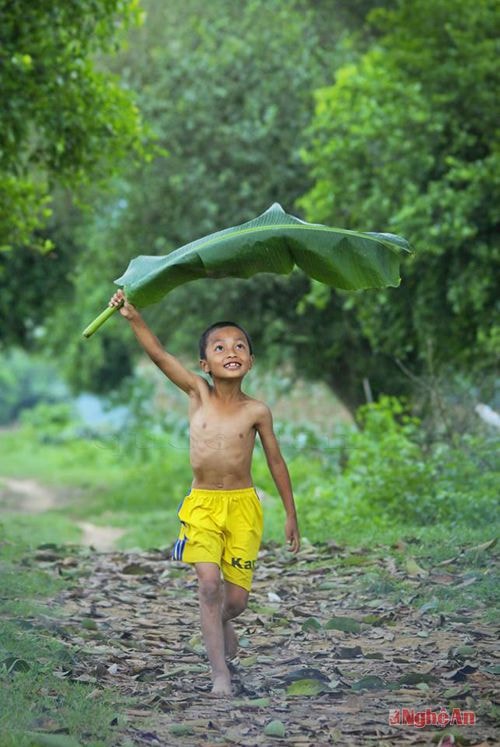 |
| Photo: Quoc Dan |
I returned to those "withered bamboo groves," grateful for the scorching heat that showed me resilience, dependence, and the enduring freshness of humble plants. Grateful for the "grains of sand in my mother's teeth" that nurtured her children. Composer Dinh Dac, the quiet composer who seems to harbor countless worries, the Deputy Director of the Center for Preservation and Promotion of Nghe An Folk Song Heritage, spontaneously sang me his song about the grains of sand of his homeland. Those tiny, seemingly insignificant grains of sand, yet they carry the soul of the land and its people. And even the grains of sand in this poor homeland "still do not deny their presence." Also at that gathering, poet Luong Khac Thanh recited his poem "Returning Home": "The poor homeland burns my feet / I cannot stop walking, and I return home again." That's it, poverty, but above all, a profound love that makes one unable to leave. Having lived more than half his life, his eyes welled up with tears, yet the vast sandy plains of Nghi Duc (Nghi Loc) during the hot, dry season of the past still burned vividly in his heart. Back when he was a child, his family was poor and he had to be adopted. Every time he traveled between his paternal and maternal sides, he passed through those same sandy plains. As a little boy, toddling along with his straw hat on his head, his feet red and blistered, he would take off his hat every five steps, stand with his feet inside, and wait for them to cool before continuing… And in those very "returns to his hometown" now, he realizes, "I miss the faded color of the soldier's uniform / But I haven't yet traveled the entire length and breadth of my homeland."
Like me, I haven't been able to fully comprehend it, even I, a native of this place, admit that I can't possibly go through all the hardships of my homeland, how can I possibly go through all the toil of my father and mother? But, I do know this: "The burning wind becomes a memory when you leave / The barren sand, if you stay, becomes love" (Xuan Quynh).
Thuy Vinh


