
Sweet and delicious oysters from my hometown.
"Sister, please buy some oysters from me. I've been shucking them all morning and only got this many, I'm selling them cheap to you," a young girl's voice called out. I looked at the shucked oysters and the pile of oyster shells beside them. Images of childhood, of a bowl of sweet and refreshing oyster soup to soothe a hot summer afternoon, suddenly flooded back...
(Baonghean)"Sister, please buy some oysters from me. I've been shucking them all morning and only got this many, I'm selling them cheap to you," a young girl's voice called out. I looked at the shucked oysters and the pile of oyster shells beside them. Images of childhood, of a bowl of sweet and refreshing oyster soup to soothe a hot summer afternoon, suddenly flooded back...
Oysters are mollusks that live in the sea and brackish waters, like clams, mussels, etc. But the sea produces hundreds of thousands of food sources within it, each with its own unique characteristics and flavor. Oysters seem like the ugly children of the sea, lacking the smooth, glossy shell or vibrant colors, instead appearing rough, spiky, and dark brown. Yet inside, they possess a creamy white, fragrant, and sweet oyster meat.
My people, born and raised by the sea, have known since ancient times how to live off the sea, making a living from the gifts it provides. The sea is vast and forgiving, but fishermen also pay the price with countless hours of sweat, with their tanned, strong skin, and with cuts that bleed from their hands and feet scratching the sharp shells of scallops, snails, and, not excluding, oysters. These oysters, like fish and shrimp, have helped sustain them through times of scarcity. In the past, oysters seemed like an inexhaustible resource beneath the sea, a readily available food that people could gather, scoop, and rake for themselves; where there were few, they would skillfully pry them open for their daily meals. Simple, yet wholesome, they were rich in nutrients and even known as a "food of love"!
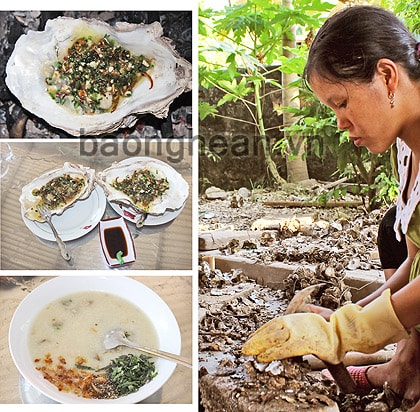
Grilled oysters with scallion oil and a bowl of fragrant, creamy porridge; it takes about 15-20 kg of oysters in their shells to get 1 kg of oyster meat.
However, due to excessive and indiscriminate exploitation, oyster resources are gradually depleting. Now, to find large oysters, people have to go to the deep sea, where the water is still strong, or dry them in the sun and carefully pry them off the rocks. People have started thinking about oyster farming with guidance and encouragement from the Quỳnh Lưu District People's Committee. The Mai Giang and Mơ rivers, flowing into the sea, have been where Quỳnh Lưu residents have been building stakes and laying ropes to cultivate oysters for nearly two decades. Oysters are easy to cultivate; they only need a place to attach themselves to, and they will naturally multiply without any special care. The water in these rivers near the sea has high salinity and frequent tides, which are very suitable for oysters, allowing them to be harvested after 6 to 8 months. Now, oysters are not only a food source for the local people but also a favorite delicacy for many tourists visiting the area.
For people living by the sea, the simpler the preparation of oyster meat, the tastier it is. The simplest way is to shuck the fresh oysters, mix them with vinegar or lemon juice, add garlic, chili, and pepper, and eat them like a salad. The sour, spicy, and sweet flavors of the oyster meat blend together, making it an unforgettable experience for anyone who has tasted it. Those from coastal areas, even after decades away, still remember and long to return home, to dive into the sea, to touch oysters with their feet, and to once again savor the taste of their homeland that nurtured them into who they are today.
However, there are dozens of other ways to enjoy the rich, creamy, yet refreshing taste of oysters. First, there's grilled oysters with scallion oil, a truly captivating dish. The oysters, partially shucked to reveal the plump, milky white meat inside, are placed on a charcoal grill. When the oyster juices begin to boil, golden-fried scallions and oil, along with some roasted peanuts and crushed chili peppers, are sprinkled on top. The heat must be carefully controlled to ensure the oysters are cooked just right, not overcooked, which would cause the meat to become tough and lose its natural sweetness. After removing from the grill, the oysters are served whole, and the aroma alone stimulates the taste buds. Even after finishing, the sweet, tender, and creamy flavor of the grilled oyster lingers in the air.
Oysters can also be cooked into porridge, a simple yet nutritious dish suitable for everyone. Fresh oysters are washed and marinated with spices. Rice is added to a pot and cooked until very soft and mushy; red brown rice or mountain rice is best. Thinly sliced shallots are sautéed until fragrant, then the oyster meat is added and stir-fried until cooked. The oysters are then added to the porridge, and seasoned to taste. When serving, spoon the porridge into your mouth and savor the sweetness of the oysters, the delicious aroma of the rice, the spicy kick of the pepper, along with the flavors of perilla leaves and coriander… In the evening, after a stroll along the beach, you can order a bowl of oyster porridge at any seaside restaurant to warm your stomach.
On scorching summer days in Central Vietnam, a bowl of oyster soup with mixed vegetables (a little amaranth, sweet potato leaves, jute leaves, etc.) makes for a delicious meal. Just 300-500 grams of oyster meat is enough to make a pot of soup, stir-fried with gourds, loofah, and daylily flowers... enough for a family of five. And there are countless other steamed, stir-fried, deep-fried, spring roll, stewed, sauced, and soup dishes made from that tiny oyster meat.
Now, along the 537B road that stretches through more than a dozen coastal communes in Quynh Luu district, we can easily see groups of people sitting in front of their houses, shucking oysters and selling them to passersby. Even children, sometimes at school, sometimes at home helping their mothers shuck oysters. With a small, sharp hammer, they skillfully and expertly pry open the shells and extract the meat. Looking at the oyster-shucking tools, then at the tattered gloves, I realized that getting a few kilograms of oyster meat is not easy at all. Ms. Nguyen Thi Phuong (32 years old, An Hoa commune, Quynh Luu) said: "It takes about 15-20 kg of oysters in shell to get 1 kg of oyster meat. This season, oysters are cheapest, each kilogram of oyster meat sells for 60,000 - 90,000 VND, depending on the size. And when it comes to skill, we have to mention those who dive for oysters out at sea." Now that oysters are scarce, you can only find them at a depth of about 3 fathoms (each fathom about 1.5m). Oyster divers submerge themselves for 1-2 minutes, then surface to breathe and rest for about five minutes before diving again. Each dive yields 40-50 kg of oysters in their shells, while others get 20-30 kg.
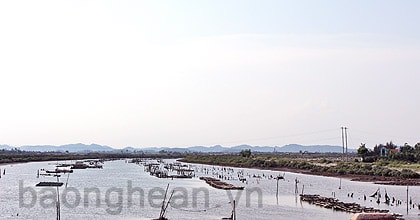
Quynh Nghia riverbank - where locals raise oysters.
Standing on the Quynh Nghia bridge, looking out into the distance, you see a long stretch of bamboo stakes driven into the ground to create oyster farms. Each year, these oyster farms generate an additional income of 10-15 million VND for local families. Despite the hard work, it provides a stable livelihood for the people of this coastal village. In the afternoon, the rising tide reflects the azure sky. About 2km away is a long beach lined with straight rows of casuarina trees. More and more tourists are flocking to the still-unspoiled Quynh Nghia beach. To relax by the sea, don't forget to try the sweet, delicious taste of fresh oysters...
Text and photos: Ho Lai


