
Sweet bee seasons
(Baonghean)Tay Hieu commune (Thai Hoa town) has over 5 hectares of coffee, over 6 hectares of rubber, and many other fruit tree areas, which are advantages for the local people to develop beekeeping for honey production. Thanks to this profession, the area is becoming increasingly prosperous.
The winding asphalt road, stretching endlessly beneath vast green coffee and rubber plantations, led us to Tay Hieu commune, known as the "capital" of beekeeping. Mr. Hoang Thanh Thuc in Phu Tan hamlet was carefully tending to his beehives. Dozens of beehives were neatly arranged under a sea of fragrant, creamy white longan blossoms, where swarms of bees buzzed, collecting nectar, creating a harmonious blend of nature and humanity. Mr. Thuc shared: "This fertile red soil region is home to hundreds of flower species from spring to summer, but most abundant are coffee, longan, lychee, and rubber blossoms... Initially, people only raised honey bees to utilize the local flowers for their own family needs. But due to market demand, since the 2000s, many households in Tay Hieu have switched to large-scale beekeeping. And thanks to beekeeping, the countryside is becoming increasingly prosperous."
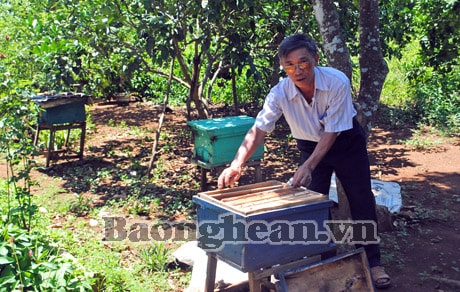
Mr. Hoang Thanh Thuc lives in Phu Tan hamlet, Tay Hieu commune, next to his bee farms.
Initially, Mr. Thuc's family only kept two beehives, but now they have raised 25. Mr. Thuc shared: "This profession requires a lot of effort, like raising a newborn baby. First, you have to identify a suitable 'flower source' to place the beehives appropriately. The flower source must always be abundant with nectar to ensure quality. Bees are sensitive to the environment; if they encounter a flower source with pesticides or growth stimulants, the bees will die. Not to mention, if it's too hot, the bees will leave, and if it's too cold, they will eat the nectar themselves and gradually die. That's why, during the hot summer, Mr. Thuc's beehives are placed under the shade of longan, orange, and mango trees, next to water tanks to 'cool down' the beehives. Beekeepers also have to watch out for larvae and animals that like to eat bees, such as lizards and snakes..."
According to Mr. Thuc, beekeeping, if things go smoothly, is very economical. From February to July in the lunar calendar, honey can be harvested, with each beehive yielding 10 kg. Over 250 kg of honey is harvested annually, selling at 240,000 VND/kg, bringing in over 60 million VND per year. Not to mention, Mr. Thuc also breeds queen bees and divides colonies; each season he sells 60-70 newly divided colonies, each worth over 1 million VND, totaling nearly 130 million VND in annual income. Thanks to beekeeping, Mr. Thuc's family has improved their lives, saved money to support their children's education, and invested in planting over 1 hectare of rubber trees. Not only has he become wealthy from beekeeping, but Mr. Thuc also helps his neighbors in the area with bee breeds and beekeeping techniques to alleviate poverty and become prosperous through this profession.
In his spacious and well-equipped house, Mr. Pham Van Minh, also from Phu Tan hamlet, confided: “This year, the coffee crop failed, and prices plummeted, leaving many households penniless. But thanks to the beehives, we've been able to improve our lives. My family raises more than 10 beehives, and including the costs of selling honey and creating queen bees, we've earned over 60 million VND.” According to Mr. Minh, beekeeping in Tay Hieu is very favorable. The wood used for making beehives is mainly cheap, and besides the abundant "flower source," the people of Tay Hieu have a lot of experience in beekeeping. Mr. Minh added: “Raising bees for honey is very useful. Besides having products like honey and royal jelly for personal use and sale, beekeeping also increases economic efficiency because bees help increase the pollination of coffee, longan, lychee, etc.”
It is known that Phu Tan hamlet has established the Tan Phu Beekeeping Club with over 140 participating households, approximately 800 bee colonies, producing over 4 tons of honey annually. The honey sales alone generate nearly 1 billion VND, not including the 500-600 million VND from selling newly separated colonies. Thanks to beekeeping, the lives of the people of Phu Tan are increasingly improving.
Mr. Kieu Dinh Lam, Secretary of the Party Committee of Tay Hieu commune, added: The commune has two beekeeping clubs, Tan Phu Beekeeping Club and Thuan Phu Beekeeping Club, with approximately over 1,200 bee colonies. The total revenue from selling honey and splitting new bee colonies reached between 2.5 and 3 billion VND. The market demand is quite stable, mainly serving the market within the province and some other provinces such as Ha Tinh, Quang Binh, Thanh Hoa, Hanoi, etc.
Although Tay Hieu commune has favorable conditions for beekeeping, it still faces difficulties, especially when trying to expand its scale, encountering numerous challenges related to capital, technology, and stable market outlets. Therefore, beekeepers in Tay Hieu urgently need government loans to develop their bee colonies, guidance for the development of beekeeping, and policies to stabilize prices so that beekeepers can confidently expand their colonies, increase their income, and achieve sustainable wealth.
Van Truong


