
Sweet and fragrant sticky rice cake from Beo village.
(Baonghean) - Since ancient times, Beo village (Quynh Hau) has been famous for its rich culinary culture with rustic dishes, imbued with the spirit of the countryside, created by the locals from readily available natural ingredients. Among them, cha lam is a specialty with a unique flavor found nowhere else.
The original name of chả lam was "đông Đính," which locals later mispronounced as "đồng Đính." However, perhaps due to its difficult and distinctive pronunciation, after numerous name changes, this local delicacy has become more palatable and simpler with the name "chả lam." Tracing the origin of "đông Đính," the word "đông" means to close, and "đinh" means mold, so "đông Đính" means to close into a mold.
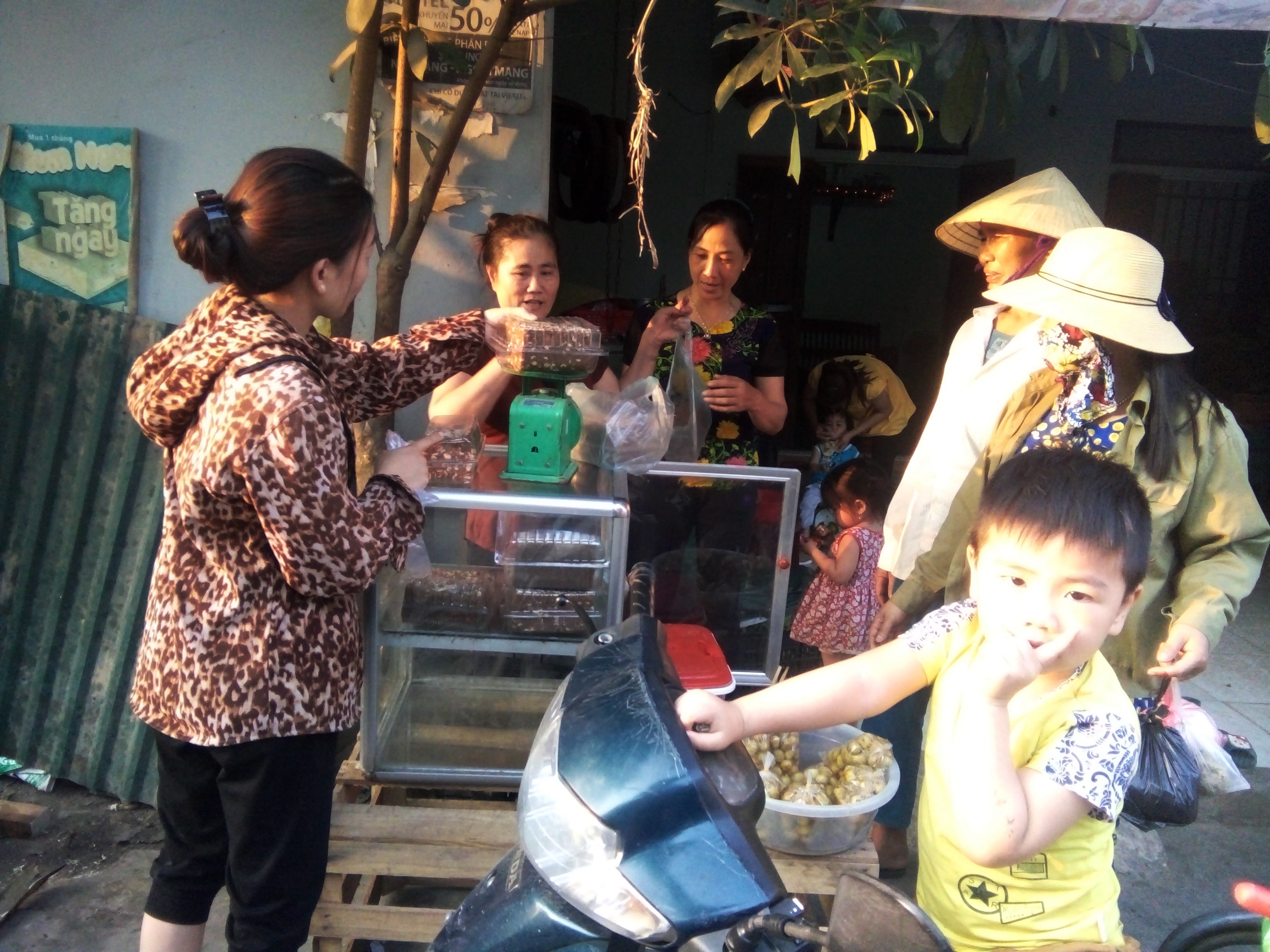 |
| Chả lam (a type of Vietnamese sausage) has become a popular local delicacy. Photo: Lê Gấm |
Nowadays, sticky rice cake (chả lam) is not only found in Quỳnh Hậu but can easily be found in many places. However, nowhere else has the unique flavor of Quỳnh Hậu's sticky rice cake. Making authentic sticky rice cake requires skill, patience in the preparation process, and meticulous attention to detail from the ingredient selection stage.
In the past, during the harvest season in the tenth lunar month, glutinous rice would be harvested, threshed, steamed, dried, and stored until the twelfth lunar month. Then, it would be milled to remove the husks, roasted, and ground into a fine powder. On the 28th or 29th of the lunar New Year, along with the glutinous rice powder, molasses, ginger, sesame seeds, and peanuts would be used in a traditional dish.
Currently, glutinous rice flour is made using a machine in two stages: first, the glutinous rice is pounded until cooked, then pounded into a fine powder, and mixed with peanuts, sesame seeds, ginger, dried coconut, and molasses. Ingredients such as peanuts and sesame seeds must be fragrant, delicious, and clean. Ginger should be of the small, moderately spicy, and strongly aromatic variety, then finely ground; the molasses must be thick and golden. The flour and molasses are mixed in a ratio of 2 kg of glutinous rice flour to 1 liter of molasses; other ingredients vary depending on the recipe.
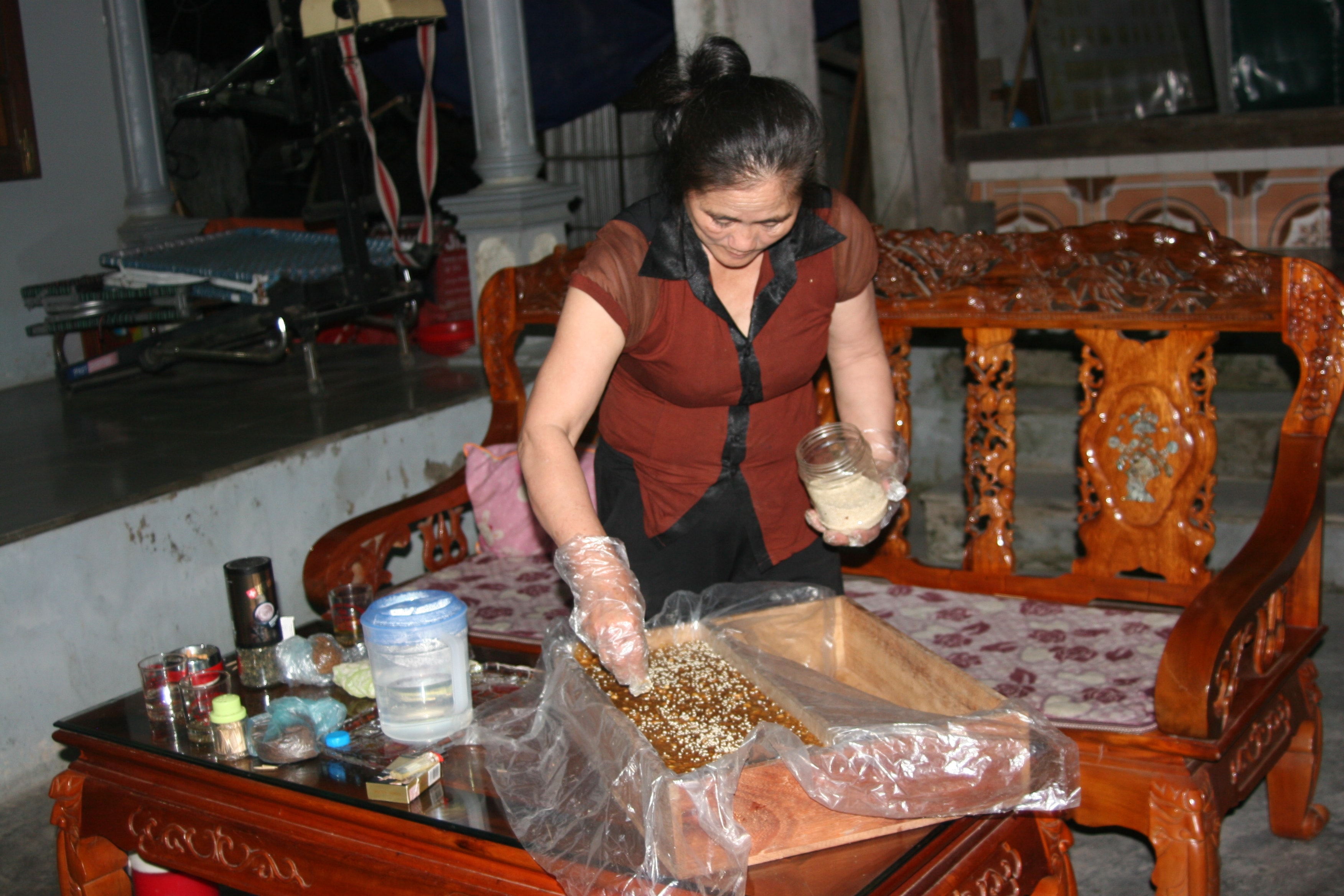 |
After mixing thoroughly, the finished product is poured into wooden molds and left to cool for 8 hours. Photo: Le Gam |
In the process of making cha lam (a type of Vietnamese sausage), the honey-heating stage is crucial and requires the most focused attention. Honey, along with finely minced ginger, is placed in a thick cast-iron pot to prevent burning and sticking during cooking. Heat over medium heat until the honey boils, then reduce the heat to very low and simmer for 30 minutes, from the time it boils until the flour is added.
During the honey-making process, prepare a wooden mold lined with banana leaves or a clean layer of plastic wrap. Check if the honey is ready by dropping a drop into a bowl of cold water; if it solidifies, the honey is ready. Then, add the ingredients to the pot and stir well until the ingredients and honey are thoroughly mixed into a homogeneous mixture with a honey-yellow color. Once the mixture is ready, pour it into the mold and let it set for 8 hours until the chan lam solidifies. Then, cut it into large or small pieces according to personal preference.
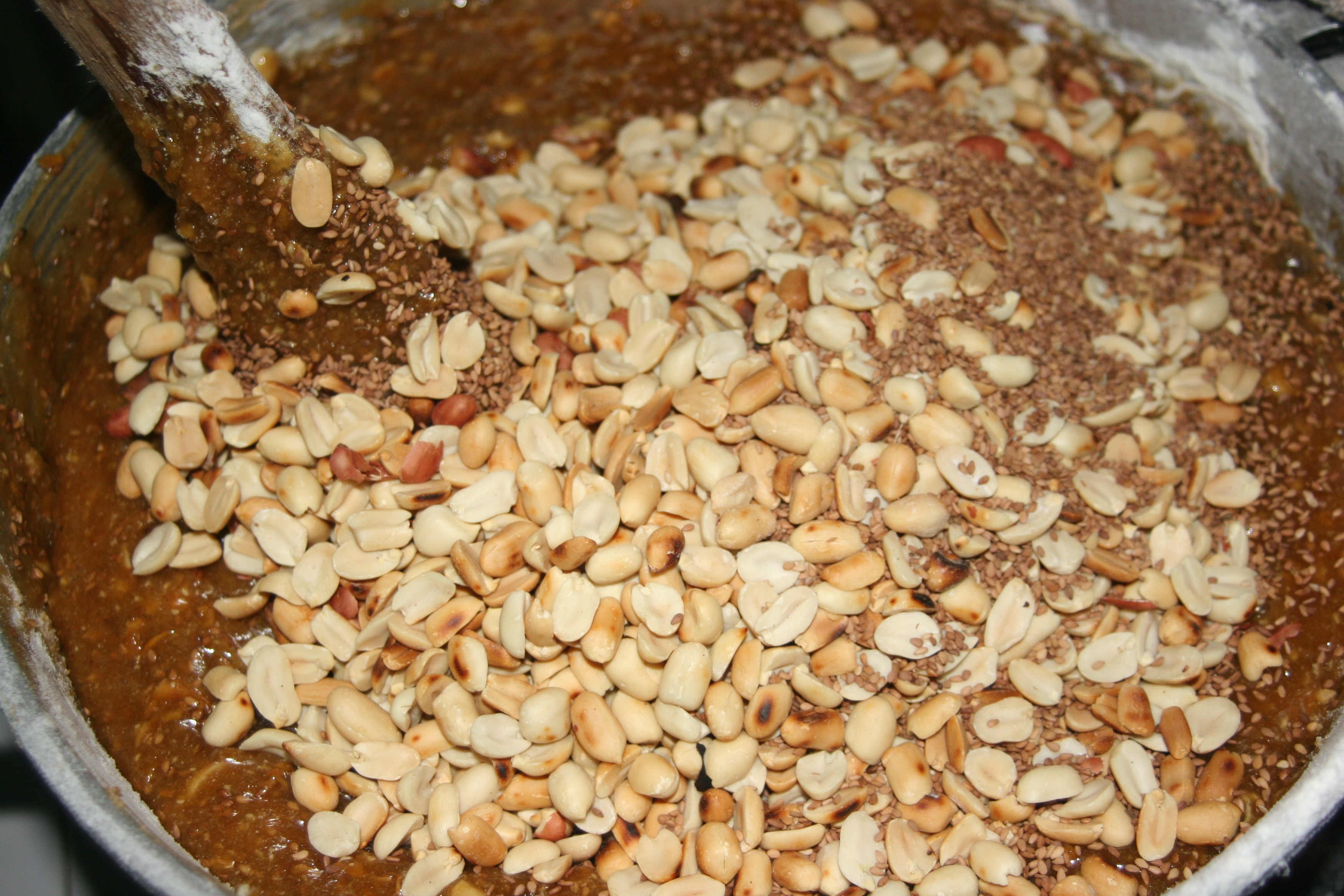 |
Peanuts and sesame seeds are indispensable ingredients in creating the fragrant and nutty flavor of cha lam (a type of Vietnamese sausage). Photo: Le Gam |
The finished product has a honey-yellow color, a chewy and sweet texture from the honey and glutinous rice, a nutty flavor from peanuts and sesame seeds, a hint of spicy ginger, and a rich, fragrant taste from dried coconut. According to the "taste" of the people of Quynh Hau, eating cha lam requires a pot of strong tea. On a chilly day, enjoying cha lam is considered unparalleled.
For those who live far from home, chả lam (a type of Vietnamese sausage) carries the flavor of their homeland. I remember when I was little, it was only made during Tet (Vietnamese New Year) or when someone had a family anniversary or a special occasion. The children would gather around, waiting for it to be finished so they could scrape the pot clean, excitedly competing with each other, their eyes crinkling with joy. Nowadays, it's not just made during Tet; people make it more often on ordinary days as well.
Previously, it was mainly made for family consumption, as gifts during holidays, and as souvenirs from the countryside. However, due to consumer demand, cha lam is now also made for sale. After tasting it once or twice, many people are so captivated by its flavor that they order in large quantities, turning cha lam into a profitable business that provides a stable income for local people.


