
Fishermen in need will be able to borrow capital.
Referring to the 10 trillion VND credit package recently announced by the State Bank of Vietnam (SBV) to support and encourage fishermen to stay at sea, economist Dr. Cao Sy Kiem said: “This is a credit package with streamlined loan procedures and a low interest rate of 3%. Previously, we had preferential policies for fishermen, and while we had the capital, the mechanisms were not yet complete. This time, with focused direction, we are likely to resolve any obstacles promptly.”
Low interest rates; loan applications processed within 4 days.
The Vietnam Investment and Development Bank (BIDV) is the first institution to participate in the program supporting fishermen to venture further offshore. Accordingly, BIDV announced it will allocate 3,000 billion VND for loans to develop the offshore fishing fleet, supporting ship owners (fishermen and businesses) in building/purchasing new, renovating, and upgrading large-capacity vessels for offshore fishing and providing logistics services.
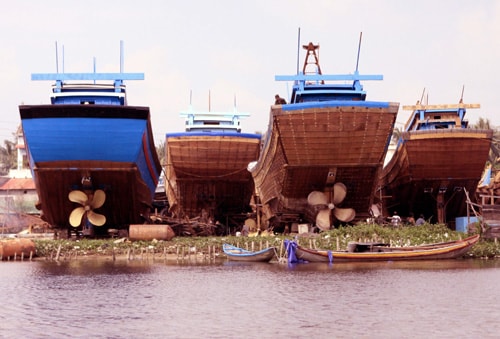 |
| A large-capacity vessel was recently built at Nghia Phu Mechanical Cooperative, Quang Ngai City. Photo: Thanh Long - VNA |
Mr. Tran Bac Ha, Chairman of BIDV, stated: BIDV is committed to providing customers with concise and simple loan procedures, processing them within 4 working days from the date of receiving complete loan applications. After conducting a survey, BIDV selected Binh Dinh and Quang Ngai, the two localities with the largest number of fishing vessels in the Hoang Sa and Truong Sa fishing grounds, as pilot areas for implementing the credit program. Accordingly, credit contracts for medium and long-term loans to invest in vessels will be signed in June 2014, after the Government is expected to issue the Decree on some policies for fisheries development.
According to Mr. Phan Duc Tu, General Director of BIDV, regarding loans for building steel-hulled fishing vessels, fishermen can borrow up to 90% of the total value of the vessel (including fishing gear and equipment) at an interest rate of 2-3% per year, with a loan term of 12 years. For wooden-hulled vessels, BIDV will lend fishermen 70% of the vessel's value at an interest rate of 5% for a term of 7 years. According to Mr. Tu, to ensure loan repayment, BIDV prioritizes experienced and skilled fishermen. Fishermen operating in organized groups and participating in associations and unions will be given priority access to loans.
“The preferential interest rates for fishermen are extremely reasonable, but for banks, they are not. From a business perspective, banks incur losses because the deposit interest rate is 6% while the lending rate is only 3%. However, because fishing at sea has national defense and security implications, the State must provide support. The difference in support from the State should not be in cash but should be included in expenses, reducing the amount the banks have to pay. Previously, instead of recording 6% as an expense, banks had to pay that amount, for example, 10,000 VND, but now, with only 3%, they only pay 6,000-7,000 VND,” said Mr. Cao Sy Kiem.
The credit mechanism provides synchronized loans and expands the target group.
According to Mr. Nguyen Viet Manh, Director of the Department of Credit for Economic Sectors at the State Bank of Vietnam: The reason why fishermen previously found it difficult to access capital was that building a ship capable of venturing far out to sea required a large amount of capital. A pilot project to build a steel-hulled ship in Quang Ngai showed that the required investment was 23 billion VND. Therefore, the fishermen's assets were insufficient to provide collateral. Even the fishermen themselves were hesitant to borrow such a large sum to build a ship, as going out to sea now involves many risks such as natural disasters and the tense situation in the East Sea. Even using the ship itself as collateral offered no guarantee against risks.
According to Mr. Tran Bac Ha, compared to Decision 393/QD-TTg (the previous program to support offshore fishing), the credit mechanism in the Draft Decree on some policies for fisheries development is more comprehensive, complete, and has a broader scope and target group. The new mechanism gives credit institutions more autonomy in selecting borrowers with experience, financial capacity, and the best management skills to ensure efficient use of capital and asset exploitation, increasing the likelihood of capital recovery.
Furthermore, some opinions suggest that the lack of coordination between ship owners, fisheries logistics facilities, and banks makes it difficult for banks to control the flow of loans and repayments. According to representatives of credit institutions, the capital banks lend through commercial credit comes from funds mobilized from the public. Therefore, lending for shipbuilding with large sums of money, long terms, high risks, and a lack of collateral has made credit institutions extremely cautious because it directly affects credit quality.
However, with this new credit package, many banking experts have high expectations for its feasibility. “This preferential policy differs from previous policies in three ways. Firstly, all loan conditions are more standardized. The money is available, the investment mechanism is in place, and most importantly, there is comprehensive support from the Government, banks, and local authorities. Secondly, lending operations can be said to be more standardized. Fishermen who need loans will certainly be able to borrow immediately.”
Specifically, the collateral will be the assets being built, interest rates will be significantly reduced, and not only will the State subsidize the interest, but the banks will also do so. This interest rate is half the current short-term loan rate and one-third the long-term loan rate. Thirdly, the loan term will be extended, specifically to 10-12 years, and all newly built ships will be insured, thus reducing the risk. These are favorable new conditions for implementation.”
Expert Cao Sy Kiem further shared: Typically, when lending to high-risk sectors, banks have regulations for risk sharing with insurance companies, especially in areas related to natural disasters and epidemics. Currently, the insurance mechanism for bank loans is very smooth, and insurance companies still meet the demand for insurance. Regarding this preferential loan package, the Politburo has also issued directives, so relevant units must implement it seriously and ensure smooth operation.
Specifically, all credit institutions will participate, and all organizations and individuals meeting the loan eligibility requirements as guided by the State Bank of Vietnam and regulated by commercial banks can borrow. Commercial banks have the autonomy to select borrowers, not just those on lists proposed by local authorities.
According to economic experts, drawing lessons from agricultural and offshore fishing development support programs, the government should assign responsibilities to each ministry, sector, and locality in a systematic manner, avoiding a haphazard approach; loan procedures should be streamlined. People accessing this capital should receive advice and guidance from state agencies, associations, especially local Fisheries Associations, including advice on shipbuilding and operational procedures at sea, to ensure that the invested capital yields a return.
According to the news.


