
Fishermen in Nghe An pool their resources to build a large fishing vessel.
(Baonghean) - In addition to support from Decree 67, fishermen in Nghe An have pooled their resources to develop offshore fishing fleets. As a result, the number of large-engine vessels has increased rapidly, with the total power of fishing vessels in the province currently reaching nearly 570,000 horsepower, an increase of nearly 13% compared to 2015.
"Huge income thanks to the fishing industry."
Quynh Long commune (Quynh Luu district) relies primarily on the marine economy for its income. The commune currently has 170 fishing vessels with a total capacity of 53,300 horsepower (an increase of 6,300 horsepower compared to 2015). With the goal of fishing in offshore waters using modern equipment, fishermen in Quynh Long commune focus on investing in upgrading their vessels. In 2016 alone, they purchased and built 19 new purse seine fishing vessels (8 newly built, 10 newly purchased, and 1 vessel converted from a 4-stake vessel to a purse seine).
In addition, six new vessels were built under Decree 67CP. In the first quarter of 2017, fishermen in the commune continued to build new vessels, converting from inshore fishing and trawling to four-stake fishing or purse seine fishing. "In the next few months, eight more vessels will be launched, mainly for purse seine fishing, so our seafood production will increase even further," said Mr. Tran Quang Ve, Secretary of the Party Committee of Quynh Long commune.
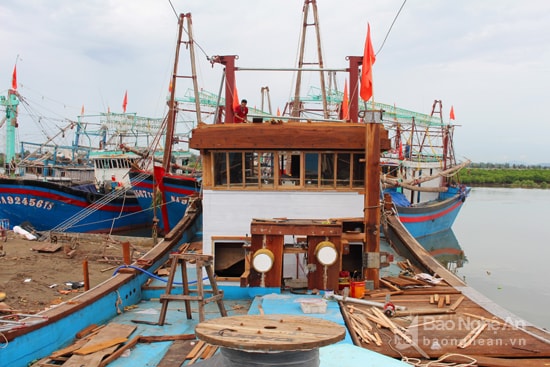 |
| A wooden-hulled fishing boat with an 820 horsepower engine, self-funded by fisherman Ho Huu Hung in Nghia Phu village, Quynh Nghia commune (Quynh Luu district), ventures out to sea. Photo: Viet Hung |
In Quynh Long commune, many households have boldly borrowed capital to invest in large-capacity fishing vessels. For example, the households of Mr. Nguyen Van Minh and Mr. Nguyen Sang in Dai Hai village each own three vessels. Each month, Mr. Minh and Mr. Sang earn over 300 million VND. The remarkable thing about the fishermen in Quynh Long commune is that they don't invest in buying vessels alone; instead, about 7-10 households share one vessel.
“We do this so that if one boat fails, another can take its place, avoiding financial losses, and also so that everyone is responsible for their own assets and catch. There’s no boss-employee dynamic; everyone is both boss and worker, doing whatever they’re good at. Because of this, we’re very close and harmonious, and the sense of community is strengthened, helping each other develop our family economies,” shared Mr. Nguyen Sang.
In Quynh Nghia commune (Quynh Luu district), Mr. To Duy The, Vice Chairman of the commune's Fisheries Association, said that there are currently 3 boat building facilities in the commune. Due to limited human resources and difficulties in finding work in the fishing industry, the number of boats tends not to increase, maintaining only 120-130, but focusing on increasing the capacity of the boats. Currently, Quynh Nghia mainly has large boats with powerful engines, averaging 500 horsepower per boat (compared to 2-3 years ago when most boats were under 300 horsepower).
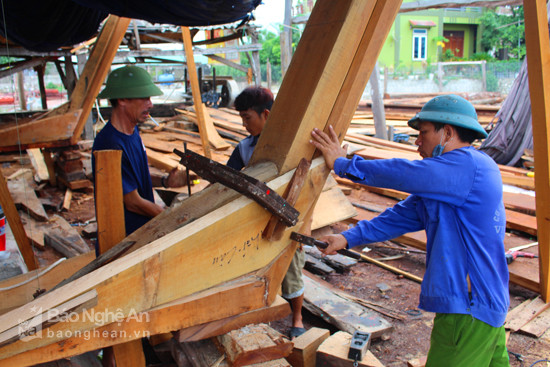 |
| Shipbuilding takes place at the Ngo Thuy facility, Quynh Nghia commune (Quynh Luu district). |
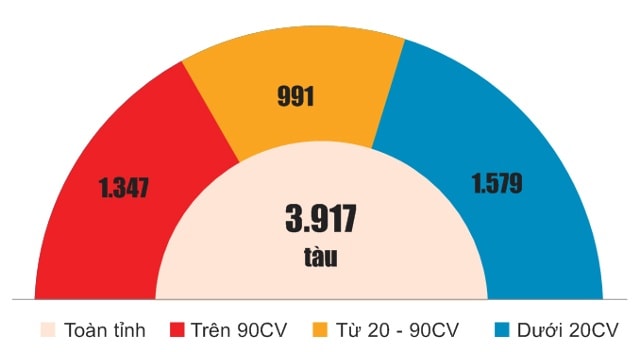 |
| Chart showing the number of fishing vessels in the entire province. Graphic: Hong Toai |
While accessing capital under Decree 67 was difficult, fishermen in Quynh Nghia proactively built large-capacity vessels using their own capital. “In 2007-2008, fuel prices were high, leading to a situation where fishermen stayed ashore due to inability to cover input costs, but in recent years, that hasn't happened, and fishing activities have been regular and continuous,” added the Vice Chairman of the Fisheries Association of Quynh Nghia commune.
In Tan An village (Phu Yen parish, An Hoa commune, Quynh Luu district), fishermen are also boldly investing in building large-capacity vessels. Within the village, there is a shipbuilding facility owned by parishioner Nguyen Van Tuan. In 2016, the facility built two vessels under Decree 67 for people in Phu Yen parish, and also built many other vessels with a capacity of 90 horsepower or more. Besides shipbuilding, Mr. Tuan's family also participates in offshore fishing. In the first few months of the year, his son's vessel achieved high yields, earning 200-250 million VND per trip.
It can be seen that, thanks to favorable fishing conditions and good prices, most fishermen in Quynh Luu are proactively seeking capital to build ships for offshore fishing. Mr. Bui Xuan Truc, Deputy Head of the Agriculture and Rural Development Department of Quynh Luu district, said: In 2016, about 100 dilapidated, small-capacity vessels were sold by fishermen to build new, modern ships for offshore fishing. The district always encourages fishermen to upgrade to larger-capacity vessels for more efficient fishing, gradually reducing the fleet of vessels used for near-shore fishing.
| A steel-hulled ship worth 16 billion VND, built according to Decree 67, was launched by parishioner Nguyen Kim Duong of Manh Son parish, Tien Thuy commune (Quynh Luu district). Photo: Viet Hung |
According to the Fisheries Resource Protection Sub-Department, the total number of fishing vessels in the province is 3,917, of which 1,347 are offshore vessels with a capacity of 90 horsepower or more, 991 are vessels with a capacity of 20-90 horsepower, and 1,579 are vessels with a capacity of less than 20 horsepower. Mr. Ho The Xuan – Head of the Fisheries Vessel Management and Fisheries Infrastructure Service Department, Fisheries Resource Protection Sub-Department, said: Fishermen are increasingly building new, larger vessels with powerful engines to venture further offshore, instead of the smaller, less efficient vessels used for near-shore fishing in the past.
Therefore, the number of boats and ships has not increased significantly compared to before, but their capacity has increased sharply. The total capacity of the province reached nearly 570,000 horsepower (CV), averaging 142.62 CV/boat, an increase of nearly 13% compared to 2015. For boats over 90 CV, the average capacity is 374.20 CV/boat, an increase of more than 11% compared to 2015. In 2017, it is expected that approximately 90 new boats will be built within the province. Of these, 10 boats will be between 30 and 90 CV, and about 80 boats will be over 90 CV.
Reporters' Team
| RELATED NEWS |
|---|


